
Decentralized finance can feel overwhelming the first time you encounter it. New terminology, new tools, unfamiliar interfaces. It’s normal to feel lost. But beneath the complexity lies a simple idea: a financial system where you control your money, without needing a bank, an exchange, or an institution to hold it for you. This first lesson in the Olympex School of Crypto is your introduction to that world. By the end, you’ll understand what DeFi is, how wallets work, and how to make your first on-chain transaction with confidence.
Press enter or click to view image in full size
What DeFi Really Is, and Why It Changes Everything
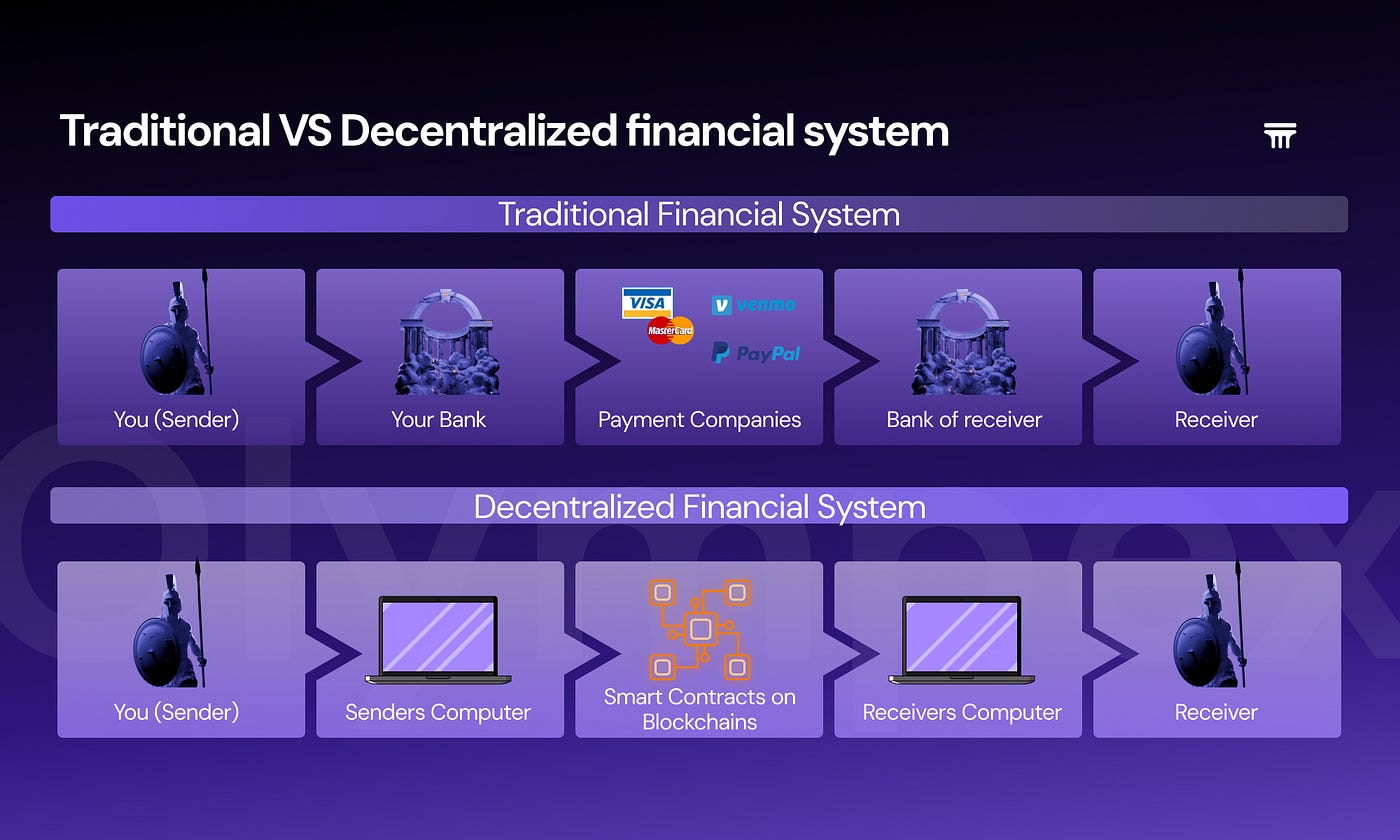
At its core, DeFi (Decentralized Finance) replaces banks and brokers with open-source smart contracts running on blockchains. Instead of relying on a bank ledger you can’t see, DeFi operates on public networks like Ethereum, Avalanche, or Arbitrum, where every transaction is verifiable, every rule is transparent, and access is open to anyone with a wallet.
This is one of the reasons DeFi is often compared to the early internet. The shift isn’t just technological, it’s philosophical. Traditional finance is built on gatekeepers, regulations, and layers of permission. DeFi, by contrast, removes these barriers. You can lend, trade, borrow, earn yield, or transfer funds without creating an account, showing ID, or waiting for approval.
If you’d like to explore how decentralization challenges the old financial system, you can reconnect later to our article
“The End of Centralized Trading”
Wallets: Your Passport to the Decentralized Economy
To interact with DeFi, you need a crypto wallet, a digital tool that stores your assets and allows you to sign transactions. MetaMask and WalletConnect are the most popular choices, precisely because they are simple, lightweight, and compatible with virtually every dApp in the ecosystem.
A useful way to think about wallets is to compare them to email clients. Your email account exists on a server somewhere, but you choose whether to access it via Gmail, Outlook, or Apple Mail. In DeFi, your funds live on the blockchain, not inside MetaMask. The wallet is merely the interface you use to access them.
This also means your wallet gives you complete control, and complete responsibility. Your private keys and recovery phrase are the only proof that you own your assets. Losing them is equivalent to losing ownership. No support line, no bank manager, no recovery option. It’s a shift in mindset, but it’s also the foundation of financial independence that DeFi offers.
Making Your First Swap: How On-Chain Trading Really Works
Once your wallet is ready, your next step is performing your first swap, the DeFi version of trading one asset for another. Unlike traditional exchanges that rely on order books and custodial accounts, DeFi swaps execute through liquidity pools, collections of tokens supplied by other users and governed by smart contracts.
When you swap USDT for ETH using a platform like Olympex, you’re not asking a company to sell you ETH; you’re interacting directly with the liquidity that other users have made available. The smart contract calculates the optimal route, executes the swap, deducts a small gas fee, and deposits the new tokens into your wallet within seconds.
This is where DeFi feels magical, a global market, open 24/7, executing financial operations instantly, transparently, and without intermediaries.
For a deeper look at how these interactions happen across chains, see
“Not Just Moving Tokens: Why Real Bridges Connect Experiences”
Press enter or click to view image in full size
What Makes DeFi Different From Banks
The simplest way to understand DeFi is to compare it to what you already know. In a traditional bank, you deposit money into an account controlled by the institution. They decide what happens to it, when you can access it, and where you can send it. In DeFi, the rules are written in code, and the code doesn’t change its mind.
Transactions settle instantly, funds remain in your custody, and transparency replaces trust. There are no artificial delays, no withdrawal limits, and no business hours. This shift transforms finance from a system controlled by entities into a system controlled by users.
For many newcomers, this difference is the moment the concept “clicks.”
From Swaps to Yield: Your First Steps Into On-Chain Opportunity
Once the basics make sense, you’ll naturally want to experiment with yield, one of the core innovations of DeFi. Yield can come from lending assets, providing liquidity, staking tokens, or using protocols that distribute rewards based on demand and supply.
What matters at the beginning is understanding the principle:
your assets can work for you on-chain, without a middleman.
Olympex helps simplify this exploration. By aggregating liquidity and routing trades through multiple chains, it exposes users to deeper liquidity while reducing costs, a beginner-friendly way to navigate advanced DeFi mechanics without needing to become a blockchain expert.
To learn more about how transparency and user control define safe DeFi experiences, you can revisit
“Think Your DeFi Is Safe? Think Again”
Putting It All Into Practice
Before moving into more advanced topics, take a few minutes to complete this introductory exercise:
1. Download or open MetaMask.
2. Transfer a small amount of stablecoins (USDT, USDC) to your wallet.
3. Visit Olympex and connect your wallet.
4. Swap a small amount (even $5–$10) for another token.
5. Observe the transaction in the block explorer to see the smart contract call.
This alone teaches more about DeFi than any textbook ever could. You see the transparency, the speed, the control, and the responsibility, that define the decentralized economy.
Welcome to the Future of Finance
Your first steps into DeFi open the door to a financial system built on transparency, autonomy, and innovation. As you navigate wallets, swaps, and yield opportunities, you’ll begin to understand why millions of users are moving away from traditional finance into a world where they hold the keys, literally.
Join the Olympex Telegram community to explore DeFi strategies, reward programs, and on-chain opportunities with builders and users focused on long-term value.
Ready when you are!





