Hi all,today I want to talk to you about the most anticipated event of the year for bitcoin, the halving, which should take place in about a couple of months.
I want to remind you that the term halving means the decrease in the remuneration of miners, following a mine block and it is an event that occurs about every 210,000 blocks.
One of the main reasons why bitcoin has value is its scarcity, the max supply of bitcoin is in fact "only" 21,000,000 BTC. Bitcoin therefore, as it was designed, has a "deflationary nature", because new bitcoins are created in each new mined block, but there is still a limit to the total number of coins that may be in circulation.
This is a fundamental point in understanding the difference compared to traditional currencies: for the latter, in fact, the total quantity is not at all fixed, but is managed by central banks, which have the ability to continuously generate new currency. This characteristic "dopes" the market and generates inflation, making the value of the currency lose over time.
At this link you can follow the progress of the countdown
The thesis of those who presume an increase in the price of Bitcoin in conjunction with halving is the most accredited, and one of the most popular models is the "stock to flow model", written by Twitter user PlanB, Modeling Bitcoin's Value with Scarcity.
The model foretells an exponential growth in the price of bitcoin, in fact it is assumed that between now and the next 4 years, the price may rise to about 100k dollars, assuming that the thesis of scarcity implies an increase in value.
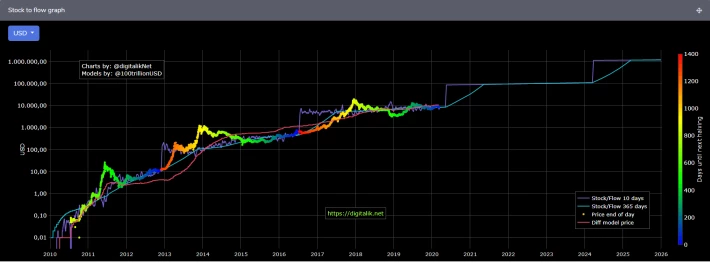
Ok, very nice, we all hope it can actually be like this ... but I would like to reason on some points that can deny this thesis:
- The increase in value must be driven mainly by an increase in demand. Even if the supply should paradoxically decrease, if there is no demand, the price will never increase, it is a fundamental law. If in the unfortunate future no one wants to buy Bitcoins anymore, their price will nevertheless drop!
- With the next halving it will go from 12.5BTC of remuneration to 6.25BTC for each mined block. The decrease in rewards could lead many miners to turn off their machines to avoid operating at a loss and consequently the value of the network's Hashrate could collapse. The Hashrate value is a very important data to indicate the health status of a cryptocurrency. It represents the unit of measurement of the network's processing power and a low value indicates a negative state of health for its currency.
Then there is the purely technical aspect to consider given by the fact that a hypothetical centralization of the computing power in the hands of only a few large mining pools, could compromise the security of the network itself; I remind you that Bitcoin uses the PoW consensus method, susceptible to 51% attacks. - Third and final point, but no less important. The STF model indicates a market capitalization of bitcoin of 1,000 billion dollars after halving in May 2020. The highest value for the market cap was in 2017, of 320 million and when Bitcoin reached its peak of 20k dollars.
The current capitalization is "only" 158 billion, so which are the markets from which all this liquidity should come out? My thought is that other phenomena, such as the hype and the FUD that is being created around halving are the real and only reasons for a possible bull market that could take place in the coming months.

The only thing that is certain is that the price of bitcoin is mainly linked to its real demand, which will only grow thanks to its global adoption and/or the support of institutional investors.
In general, most investors have a bullish sentiment towards halving, but we do not necessarily have to believe that the policy of the scarcity of coins consequently leads to an increase in the price!
Tell me in the comments, what do you really think about halving, will it really increase the price as expected?