The correlation between the Brave browser and psychological persuasion
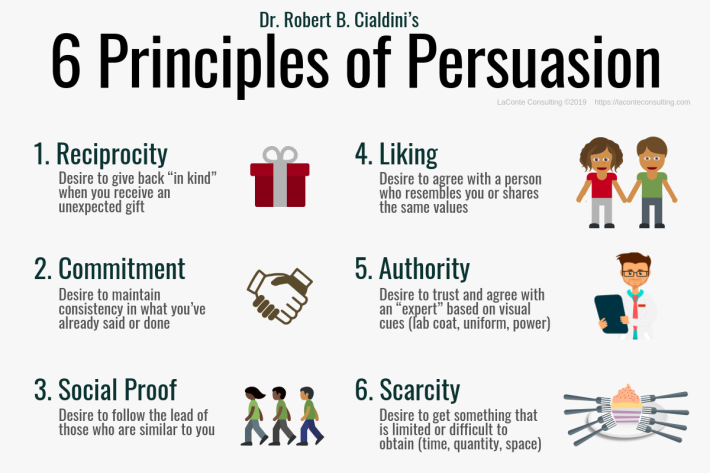
Alright, let me give you a quick lesson about Robert Cialdini and his research and literature to start this off. Robert Cialdini is a (by now retired) psychology professor from Standford university. He has spent many years researching the best salespeople in their fields in the hopes of unraveling what goes on in the human brain when we comply to buy or hire a product or service. After analyzing all the data he came up with the six principles of influence.
- Reciprocity: If someone does something for you, you are more likely to return the favor.
- Commitment: If you say that you think the environment is important, you're more likely to stand behind that when I attempt to sell you green energy for example.
- Social proof: If multiple other people before you have already made decision A, your brain will trick you into thinking that option B won't be the right answer.
- Liking: If you like the salesman or saleswoman because of whatever reason, you will be more likely to buy/hire their service or product.
- Authority: If someone with a certain degree of authority (an expert, law enforcement, a professor, etc.) tells you something, you're more likely to believe it.
- Scarcity: The most straightforward principle, the less there is, the better it must be.
Now how is this exactly relevant to Basic Attention Tokens and the Brave browser? Whether you like the concept behind the Brave browser or not. I think we can all agree that they do a very good job of portraying themselves to the prospects and consumers of the browser. Realizing that it's not just their unique concept is what makes it easier to see the connection between Robert Cialdini's work and Brave as they both play into those psychological triggers.
Reciprocity: Brave doesn't advertise itself like an application to surf the web. It lures people in through offering them something. Instead of platforms just making money off of you, you also make money by voluntarily checking out periodical ads in the browser. They give you this for free which immediately tricks your brain into trusting them.
Commitment: Brave is very good at heavily playing into privacy and your stance as a consumer on this matter. Most people who come in contact with the concept will agree that privacy is a very relevant and important matter. The convenient thing for Brave is that they have a very clear solution to this problem (their browser). If a company has a free solution for a problem of yours and on top of that they even give you periodical rewards then you would be rather stupid to not at least try it out, correct?
Social proof: Brave invest some of their resources into letting you know how many others already use their product. Take batgrowth.com for example, here you can see the exact number of Brave browser publishers and on what platforms they are located. Our brain thinks, a lot of people already use this, so it must be good!
Liking: Sometimes you just come across a certain company or product and it has that 'cool' vibe to it. Take a Red Bull, Airbnb, Uber or Apple for example. Their products don't even need to be at the top of the line, their image makes up for this. The same goes with Brave. They are a 'cool' company with their own ideas and a modern look and feel to it. People can easily relate to their beliefs and that's what makes them likable. On a psychological level, we realize that they are just like us and they believe in the same things as us so they must be reliable.
Authority: Now this is one of the principles which they could possibly improve on in my opinion. Currently, there isn't a very clear authoritarian person or organization endorsing the Brave browser. The moment that they do make this happen will probably be very big for them in terms of monthly users.
Scarcity: Okay now this is where stuff gets interesting. The direct product (the browser) is not scarce and never will be. Their entire goal is to grow and attract more users to limiting the number of products would be very strange in this case. The BAT, however, does have a scarcity to it which actually assigns its value.
To conclude this quick observation or summary I would like to invite you, the reader. To attempt to utilise these principles in your everyday life. Personally I am in the sales business but I've realized that they can be used in almost every context. Next time your friends want to go to a certain bar and you don't, just see what happens when you tell them a lot of people will be going to the other bar tonight (social proof).
Feedback and comments are very welcome, thank you for reading my first post!