
Between struggling in pain to creatively manifest new forms and contenting yourself with pleasure while generating nothing, which would you honestly choose after arduously thinking through what both entail?

As I stated on Monday, the Eighth of May, I began reading Faust by Goethe this weekend. I finished the first part within the first few days of reading it; it wasn’t that long. However, I’ve now begun reading the second half of Goethe’s epic and genre-defining poem. Today, I’ll be covering the first two acts of the second half of Faust. My goal will be to clarify my thoughts on the reading and to derive some questions that I hope spur conversation and lead to further self and social exploration.
I find this portion of Goethe’s work mysterious. I know I have not grasped the whole picture yet, and maybe that’s why it’s so fuzzy for me, but even if I did – there’s something very profound about these two acts. My initial instinct is to juxtapose the masquerade in the Great Hall with the Classical Walpurgis night. Of course, even these scenes are anchored by something deeper. In talking about dawn’s light, Faust has the following to say:
“ Look now above! The mountains’ mighty peaks
herald the hour of full solemnity,
by right partaking of the everlasting light
before it veers towards us below;
new radiant clarity extends its boon
to alpine meadows sloping green beneath them
and stage by stage completes its downward journey; --
now it appears! – and, to my sorrow blinded,
I turn my gaze away suffused with pain.
The same thing happens when our eager hope
believes its highest goal has been obtained
and finds the portals of fulfillment open wide;
then there bursts forth from those eternal depths
excess of flame, and so we halt confounded;
our wish had been to light the torch of life –
instead, a very sea of fire engulfs us.
Do love and hate envelop us in flame,
savagely alternating pain and joy,
so that we look once more towards earth and seek
concealment in its first new lacery?” (p. 123).
In the last scene of Faust I, Faust loses Margarete or Gretchen. She gives herself up, accepts her limits, embraces death, and is redeemed by the Lord’s grace. She forsakes Nature, seeing her judgmental mother in it, who seemingly would rather have her embrace death than go on living with Faust. Margarete’s loss would have – highly likely – been devastating for Faust. All his knowledge, the powers granted to him by Mephistopheles, the youth and vigor he’d acquired through the Witch’s spell in her Kitchen... none of it could save Margarete. Faust could not hold onto her; he was contractually prevented from doing so under threat of eternal damnation. Thus, he was condemned to struggle without her. The salvation she received, he could not accept.
As morning rises, perhaps over Walpurgis Night, Faust cannot bear the Sun’s light. He finds it painful. In a symbol typically associated with hope, knowledge, and life, Faust finds eternal torment, chaos, confusion, despair, and depression – solace only in the cold earth, filled with potential, which will not have him. This image – I think -- defines the scenes found in the Great Hall and the Rocky Inlets by the Aegean Sea. Yet, if we want to circumscribe the form we're dealing with, there are a few more lines we must look to.
Continuing, Faust says:
“ I am content to have the sun behind me.
The cataract there storming through the cliff—
the more I watch it, the more is my delight.
From fall to fall it swirls, gushing forth
in streams that soon are many, many more,
into the air all loudly, tossing spray and foam.
But see how, rising from this turbulence,
the rainbow forms its changing-unchanged arch,
now clearly drawn, now evanescent,
and casts cool, fragrant showers all about it.
Of human striving it’s a perfect symbol –
ponder this well to understand more clearly
that what we have as life is many-hued reflection.” (p. 123)
These few lines are deeply intriguing to me. Previously, I discussed how Faust is a being of becoming, and here, in the first few lines of the preceding stanza, that idea's affirmed. He is content residing within a pleroma of undulating shapes -- generated by the light behind him -- as they are tossed about. Yet there’s more here, specifically his statements about the rainbow. While this mightn’t seem like much, Faust – who in some ways is an embodiment of Goethe’s work (who was a prolific scientific investigator and thinker) – claims the rainbow causes fragrant showers to be cast about it – i.e., disparity and becoming cause sweet rain (a life-giving force) to be created. Is this not backward? Here, Faust seems to be partially confusing the necessary cause for the sufficient. What Faust says: because there’s a rainbow and light (the Sun), it’s raining (there are fragrant showers). The true logic: because it’s raining (there are fragrant showers) and there’s light (the Sun), there’s a rainbow. Faust seems to be confusing the causes of multiplicity, the rain and light (water and fire), for the rainbow’s effects.
Through the masquerade in the Great Hall, which I do not think prudent to repeat in its totality, a large procession of figures flows forth, culminating in a final scene where Pan, looking into flames, is consumed by them and destroys the entire hall and its patrons with him. However, this is but an illusion created by Mephistopheles and Faust. Yet, it represented what was about to proceed, as well. Faust and Mephistopheles (who fittingly takes the fool’s guise) find the state of the Holy Roman Empire in disrepair. It has gone bankrupt and can no longer take care of itself. Mephistopheles’s solution: plunder the lands beneath Germany for ancient gold! However, awaking from the masquerade, the Emperor discovers that – amid the masquerade – he handed out promissory notes for the gold. Legal tender of 1,000 crows represents (is) reserves of immense wealth stored underground. The people of the German court quickly proliferate and simulate these promissory notes, all speculating about the actuality of the immense wealth stored underground. They take the immense wealth stored underground as a given and, thus, assume the note for the 1,000 crows actually represents what it says it does. I.e., if the note for 1,000 crowns were X, and the immense wealth stored underground was Y, you could write the initial statement out in the following way: X, therefore Y. In an act of desperation, however, the Court, the Emperor, and the people of Germany assume the following: Y, therefore X. No one has demonstrated that there’s actually immense wealth stored underground (pp. 155-157).
Faust soon finds he’s promised to show the king Pairs and Helen of Troy and must descend into the enigmatic land of the Mothers to find a tripod that enables him to burn incense to bring forth the two spirits. While most of the people in the Emperor’s court, upon seeing Paris and Helen of Troy, do not understand their magnificence or beauty, in Helen, Faust recognizes a familiar figure: The woman he’d seen in the mirror in the Witch’s Kitchen. Possessed by her beauty, he charges toward the man she has at her disposal, and with an explosion (after stabbing him with a key he’s holding), the spirits vanish, Mephistopheles picks up Faust and carries him away from the court. So ends the first act of Part II of Faust.
In the second part, we pick up the story as Faust is asleep and Mephistopheles is awake, walking around in his old study. Some time has passed and Wagner, Faust’s old student, striving and ever-working himself, has manifested something new: Homunculus. The Homunculus is a hermaphroditic character, trapped in a vessel and depicted as a source of light. In many ways, the Homunculus represents the new self (soul) Faust – all great men – is striving toward. He is the self, a manmade being that – in some way – juxtaposes itself with Mephistopheles – that source of negation that both limits us and perpetuates our struggles.
The juxtaposition between Homunculus and Mephistopheles plays itself out through the Classical Walpurgisnight. The following lines from Mephistopheles also – I think – allow us to make the comparison between the Great Hall’s masquerade and the procession in ancient Greece:
“A masquerade proves here, as everywhere,
to be but show that entertains the senses.” (p. 198)
The masquerade in the Great Hall culminates when – in a massive conflagration – the illusion is brought to a close:
“ Slowly, the gnomes conduct Great Pan
towards the fountainhead of fire;
it surges up from its abyss,
then inks again down to the bottom,
and only gaping darkness shows;
again it wells up, glowing, seething,
Great Pan stands dauntless and enjoys
the strange and wondrous sight,
and iridescent bubbles spray about.
How can he trust such goings-on—
he’s bending low to look inside! –
Why, now his beard is falling off! —
To whom can the smooth-shaven chin belong
that’s hidden by his hand?
A great disaster now ensues:
his beard bursts into flame and, flying back,
sets fire to his crown, his hair, his torso,
and merriment turns into agony. –
The members of his crew rush to his aid,
but none of them escapes the flames,
and efforts to beat down the fire
only ignite still further flames;
trapped in this sea of fire,
all of this group of masqueraders burn to death.
…
Our forest has caught fire now,
and tongues of pointed flame
strive toward the rafters of the coffered ceiling
and threaten us with conflagration.
One cup of misery is overflowing,
I can’t imagine who might save us.
Tomorrow this imperial magnificence
will be the ash heap of one night.” (pp. 152-153).
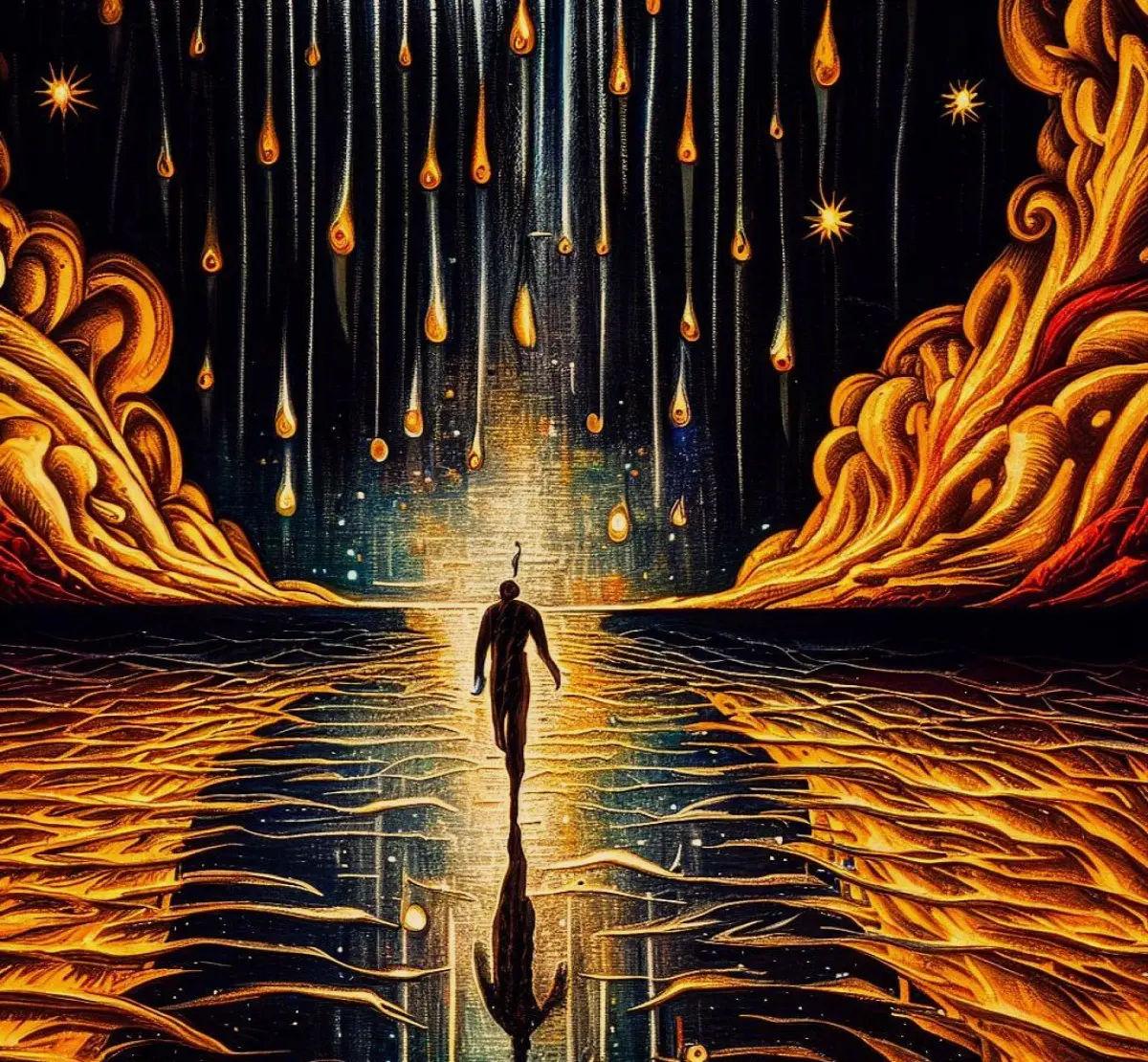
Against these all-consuming flames, Plutus conjures rain or water, which slowly quenches the fire’s thirst. Yet, by the end of Classical Walpurgisnight, this scene is inverted through the passionate sacrifice of Homunculus to the sea.
“HOMONCULUS. All that my lamp illuminates
amid these fostering waters
has grace and beauty.
PROTEUS. Amid these living waters
your lamp, now bright at last,
resounds with a glorious tone.
NEREUS. Here in the middle of all this host,
what new revelation are we to see?
A flame by the conch, at my daughter's [Galatea] feet,
now mounts high and strong, now burns sweet and low,
as though It were stirring with pulsations of love.
THALES. That is Homunculus, whom Proteus has taken….
Those are the symptoms of passion’s imperative—
I almost can hear the loud groans of its travails.
He’ll shatter his vial on her glittering throne—
there’s the flame, there the flash, and already it empties!
SIRENS. What miraculous fire transfigures our waves,
that break on each other and shatter and sparkle?
Lights wave and hover, the brightness comes nearer,
what moves in the darkness is pure incandescence,
and all is enveloped in eddies of fire.
Let Eros now rule, the creator of all!
ALL (all together). Hail to Ocean and the waves
now embraced by sacred fire!
Hail to Water! Hail to Fire!
Hail this strange and rare event!
Hail to Air and its soft breezes!
Hail to Earth’s mysterious depths!
To you four, o Elements,
here we offer solemn praise!” (pp. 214-215).
Through Homunculus’ sacrifice (Wagner’s creation), beauty is given to the sea! Fascinatingly, the Satyr – a reflection of Mephistopheles’ – Negation’s nature – within the Emperor is also a type of hermaphroditic beast, especially because Mephistopheles is seemingly a hermaphroditic creature, as well. As he’s speaking to the Graeae, they tell him the following, seemingly in jest:
“A PHORKYAD. You only have to close one eye
and let but one incisor show;
in profile then you will at once possess
a perfect sibling-likeness to us.
MEPHISTOPHELES. I’m flattered! But so be it!
PHORCIDES. Be it so!
MEPHISTOPHELES (in profile, as PHORKYAS). I stand before you now as Chaos’ well loved son!
PHORCIDES. There’s no denying we’re his daughters.
MEPHISTOPHELES. Then I, o shame! Will now be called hermaphroditic.” (p 204)
Although these lines are stated facetiously, they make it appear as if Mephistopheles and Homunculus were intended to be juxtaposed as hermaphroditic beings.
Mephistopheles and Homunculus represent two sides of creative cycles. Faust – for a time – is trapped in Mephistopheles’ cycle. However, Wager – Faust’s most diligent student – seems to have manifested or captured the other creative cycle: the cycle of self-creation, beautification, harmony, and unification. Mephistopheles’ creative cycle is founded on illusion, faulty reasoning, and misperceived relations, causing fire and destruction that must be quenched through another living force (rain), producing illusive multiplicity once again. Wagner’s creative cycle is founded on diligence and generates light that, when combined with water (life), produces a beauty that unifies, in harmony, differentiation rather than perpetuating it.
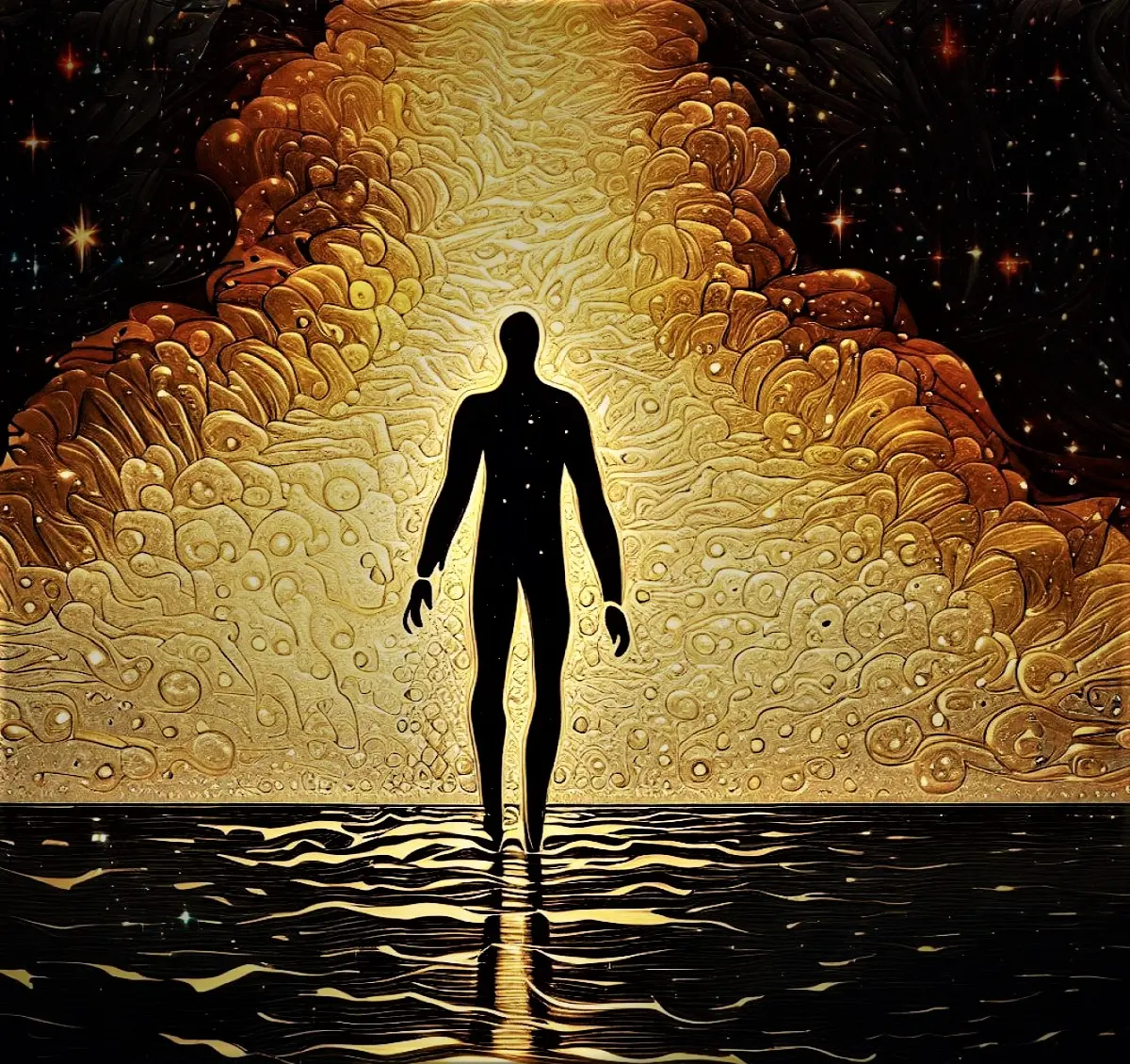
When I reflect on the ethical form provided to us by the likes of Foucault, I think about how it – too – produced cyclical effects that enabled one to manifest a self that could be embodied. This self-created, embodiable self could enable an individual to care for themselves, know themselves, and grow perpetually; it was an ethical mode intended to allow the individual to find meaning in their lives and become a productive member of society. This embodiable self seems to be something like the homunculus created by Wagner.
Homunculus is depicted throughout the play as a beacon of light guiding the way and revealing the world – even capturing the world in its multiplicity (e.g. when Homunculus uses its light to spot Proteus while with Thales pp. 209-210). In the end, Homunculus uses its abilities to bring beauty and harmony to the world, uniting the Nereids, Sirens, Proteus, etc. Homunculus, the ethically embodied self, brings the polis (the people) together and beauty to the world while interacting harmoniously and creatively with it through acts of passion and love. These beautified waters then enable life and beauty to be brought to the earth.
Mephistopheles, on the other hand, deceives through sleight of hand, faulty reasoning, and illusion in the form of representation. He ensnares men by their desires and leads them toward his flames, who consume the scandalized figure, destroying him and generating further multiplicity, disunity, disharmony, discord, etc. It seems Faust is caught in Mephistopheles' cycle, which was viscerally depicted in Faust I. Faust is stuck in multiplicity’s realm (the realm of disharmony and disunity) because he’s possessed by his desires and cannot settle down. His actions are creative – no doubt – but are they properly creative?
Both creative cycles require something like a sacrifice. Homunculus sacrifices himself and brings about unity, beauty, and harmony while Mephistopheles – i.e., Faust’s alter-ego – sacrifices being for endless multiplicity and chaos, which inspires and entices. No doubt, something about chaos, multiplicity, and destruction seem fun to humans. Still, is it how we should properly create?
Starting at line 8327 (p. 211), Proteus and Thales have the following discussion:
“PROTEUS. Come, still a spirit, with me to the open waters,
where, as a living being, you’ll be free
to move in all dimensions and directions;
just don’t aspire to the higher classes,
for once you have become a human being
you’ve reached the end of everything.
THALES. That’s as may be; it’s also good, I think,
when one’s time comes, to be a proper man.”
“When one’s time comes, to be a proper man.” As every philosopher ought to know, Thales' lines allude to philosophy’s initial purpose: to prepare the soul for death. Sacrifice – of oneself for another – is a species of death and, thus, it is philosophy’s role to prepare us for this self-sacrificial death. While this death may be literal – ethically speaking, it is also allegorical. To properly die and be reborn requires wisdom and know-how (connaissance). The question: What's the best way to create? How best should we bring from the depths of our being or non-being the most august thing? In either instance, so it seems – work is required. Sacrifice, striving, suffering, struggling, pain, diligence – these are required to bring something out of oneself that was not there before. But is modern Man willing to do this?
I would be repeating myself if I reiterated the sorry state of modern man, so I will not do so. But his ennui, his unwillingness to engage in the kind of necessary work for him to find meaning in his life is not something he seems to find value in. He is content to gorge himself on himself in representation. Maybe he should be burnt up by the conflagration that must follow from his self-delusion. Out of this chaos, why can’t something better emerge from his destruction? Why must we think it’s black-and-white, as well? Surely there are men capable of producing and creating in such a manner that enables them to do more than simply survive or live – men capable of producing genuine meaning in their lives. It is these men – then – who will do the necessary ethical work to generate harmony, unity, and beauty in the world who should be its inheritors. By serving themselves, they serve others; they self-generate a kind of man capable of defining a world worth living in and loving.
Can a Man truly live as such? Can he be a Hero of Creation rather than a Consuming Scourge? He not only can -- but if he’s to survive -- he must.
Bibliography:
Von Goethe, J. W., Atkins, S. (Editor), Wellbery, D.E. (Introduction) (1994). Faust I & II. Princeton University Press.






