It should be clear to everyone by now that we are living in an inflationary environment. Western central banks have started raising interest rates in earnest in an effort to quell inflation. The Bank of Canada just raised by half a percentage point earlier this week while the FED is set to raise their overnight lending rates this coming Wednesday. I expect fireworks this week and I have my popcorn ready.
The topic of this post is gold's reaction in a hyper-inflationary environment. Case in point, the hyper-inflationary money printing of Weimar Germany's central bank in the early 1920s, following the end of WWI. Prior to the 'Great War', as it was known then, Germany was on the classical gold standard in which money printing is fixed by the amount of gold held by a central bank. At the outbreak of war in 1914, Germany went off the gold standard, thereby allowing for unlimited money printing to finance what they believed would be a short lived war.
By the end of 1918 however, the war was finally over and Germany was in ruins. The following year, the Allies met at Versailles, France to negotiate terms of peace, blaming Germany for starting the war and forcing them to pay reparations of 6.6 Billion Pounds, payable at 100 million pounds per year. At that rate, it would take 66 years to pay off this enormous reparations bill.
Before the war, Germany was an economic powerhouse, similar to the Germany we have today. By the time the war was over, Germany's manufacturing base was in ruins. The only way they could pay off these reparations was by turning on the printing presses and print new bank notes.
And print they did!
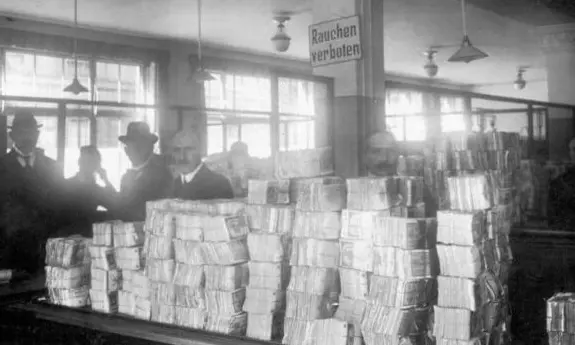
(Historical photos used: public domain - no permissions needed)
At first, the inflation was hardly noticed but in 1921, cost of goods slowly began to rise. In January, 1919 one gold ounce could be bought for 170 marks. By January, 1920 one gold ounce cost 1,340 marks. In May of 1920, the gold price actually fell to 966 marks but by September, 1921 gold had shot up to 2,175 marks.
That's really when people started to take notice.
By September, 1922 gold did what some at the time probably called a 'moonshot', to 30,381 marks. Little did they know just how bad things would get. On a monthly basis, inflation was rising 100% per month that year.
In January 1923, French and Belgian troops captured the Ruhr region (manufacturing hub). Germany had failed in reparation payments and now they were expected to pay with manufactured goods. The German people refused to work to pay reparations so the German government responded by going on an unprecedented money printing spree to pay reparations. Of course, the Allies would not accept 'FIAT' currency as payment and for Germans, 1923 was a year to remember as so much currency was printed that one needed a wheelbarrow to carry the cash around.
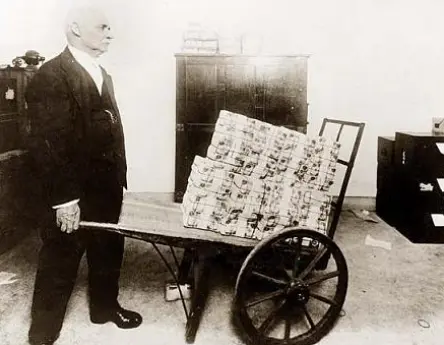
Between November 1918 and November 1922, wages had increased by 200 times. Sounds good doesn't it? Don't hold your breath. The cost of living rose by at least 1,500 times. This is eerily similar to wages today not keeping up with inflationary costs of living. By that point, the German stock markets fell an astonishing 97%.
This inflationary environment finally came to an end in November ,1923 when a new central bank was formed which printed a new, temporary currency, the Rentenmark. Printing of the previous currency was cancelled. One new Rentenmark could be gotten in exchange for 1 trillion old marks.
That's right, one trillion old marks for one new Rentenmark. Things had gotten so bad in 1923 Germany that prices were rising by the minute. One famous story goes that a young student visited a cafe and ordered one cup of coffee for 5,000 marks but didn't pay yet and ordered a second cup of coffee. When the bill arrived, the total was for 14,000 marks. By the time he had finished drinking his first cup, the price of a cup of coffee almost doubled. The server told the student that he should have bought both cups at the same time to avoid paying more.
Needless to say, the exponential rise in the cost of living forced the majority into poverty, bringing about severe malnutrition, homelessness, disease and even death. The sad part about all this is that Germany never wanted war but having allied with Austria-Hungary, was treaty bound to back Austria-Hungary if war broke out. The assassination of Austria's Crown Prince Ferdinand (and his wife) in Serbia was the beginning of the end of Weimar Germany.
So how did gold fare in 1923 Germany?
January, 1923: 372,337 marks
May, 1923: 710,355 marks.
June, 1923: 1,295,256
August, 1923: 68,382,000 marks
September, 1923: 269,429,00 marks
October, 1923 week one: 24,868,950,000 marks
October, 1923 week two: 84,969,072,000 marks
October, 1923 week three: 1,160,552,662,000 marks
October, 1923 week four: 1,347,070,000,000 marks
November, 1923 week one: 8,700,000,000,000 marks
November, 1923 week two: 17,400,000,000,000 marks
November, 1923 week four: 87,000,000,000,000 marks
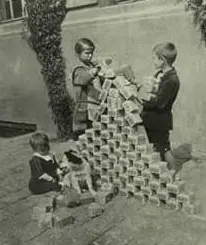
You read correctly. In January, 1919, one ounce of gold went for 170 marks. By the time the German hyper-inflation event ended at the end of 1923, that same ounce of gold cost a mind numbing 87 trillion marks.
Some people think that owning gold will make them rich someday. This is not true. As mentioned earlier, one trillion old marks could be exchanged for just one new Rentenmark, making the old marks effectively worthless. This brought the price of one ounce of gold back down to Earth at just 87 Rentenmarks.
Had Germans bought gold in 1919, they would have fared very well, discovering that gold is an inflation buster. I'm sure there were a few who could see what was coming and did buy some gold but the vast majority of Germans had to go under the steam roller. What followed was the rise of the NAZI party with Adolf Hitler and eventually another devastating war.
This hyper-inflationary event was contained to Germany alone and their mark was not a reserve currency. In modern times, every currency issued by governments around the world is 'fiat', backed only by the trust in the government issuing said currency.
Gold is insurance against any future hyper-inflationary event. Just ask the people of Zimbabwe. This time around though, it's the reserve currency of the world, the U.S. dollar that is facing a possible hyper-inflationary event of which the effects would be felt around the world. This might explain why Russia, India, China and others are buying gold in such high quantities not seen since at least 1967.
The U.S. government is not about to let go of their dollar's reserve status willingly which is why they are raising interest rates. The higher interest rates go, the weaker all the rest of the world's currencies will be. We are already seeing the turmoil it is causing. Revolts in Sri Lanka, gas shortages in Vietnam, to name a few.
While the U.S. dollar might get stronger initially, it too is destined to end up in the currency dust bin of history. So, what happens when we reach that point. More importantly, what happens in the years, months and weeks leading up to its demise. The next time around, it could spread around the world instead of being contained to just one country.
Germany's early 1920s hyper-inflationary event should give you plenty of clues as to how this will unfold in the next crisis and what we can do to protect ourselves. Gold keeps proving itself, time after time and this has been going on for some 5,000 years.
Another metal that did equally well during Germany's hyper-inflation was silver!
In January, 2019 silver sold for just 12 marks per ounce. By November, 1923 silver cost 547.750 billion marks. I'm not making these numbers up. So if you really want to beat inflation in a possible future hyper-inflationary event, you now have the answer.
Peace and Love to everyone.
Earn free Bitcoin Satoshis using CryptoTab Browser.
Purchase any precious metal at OwnX.
Secure your crypto in a private wallet - Ledger Nano X
Support free speech - join Rumble today.
Earn TFuel watching livestreams on Theta tv
Subscribe to my blog and hit the 'like' button if you enjoyed this post. Tips are always appreciated.
Check out some of my previous posts.
My first Etherium transaction from PublishOx to my cold storage wallet.
Gold and silver's performance since year 2000 will surprise you.
Just another rate hike from the Bank of Canada.
Gold has broken 200 day moving average, a bullish sign.
Negative real rates explained.
USAWatchDog's Greg Hunter interview with Jim Rickards.