
From Bitcoin's meteoric rise to bonds' sharp declines, 2024 was a year of stark contrasts across different asset classes.
The financial markets in 2024 delivered a mix of surprises and expected trends, marked by significant divergence across asset classes. While some assets posted stellar returns, others faced challenges in adapting to an evolving macroeconomic landscape. Bitcoin led the pack with a staggering annual return of 120.8%, highlighting the resurgence of risk appetite in specific corners of the market.
This wide spectrum of performance last year can be attributed to a combination of factors, including Federal Reserve monetary policy, geopolitical events, inflation trends, and sector-specific drivers. Below, we break down the performance of major asset classes and the underlying reasons for their respective outcomes in 2024.
Bitcoin kept up its track record of outperforming major asset classes since 2015 - notable exceptions being 2022 and 2018. Gold experienced its most successful year since 2010, driven by a confluence of factors including central bank buying, interest rate reductions, and geopolitical uncertainties. For the second consecutive year, U.S. large-cap stocks, represented by the S&P 500 Index, achieved returns exceeding 20%.
Top Performers
Bitcoin (+120.8%): Bitcoin emerged as the best-performing asset class in 2024, soaring by 120.8%. The cryptocurrency benefited from a combination of factors, including the Federal Reserve’s pivot to rate cuts, heightened institutional adoption through Bitcoin ETFs, a friendlier incoming U.S administration, and the tailwind of its 2024 halving event. The continued AI-driven tech boom further supported sentiment, as investors sought exposure to innovation-driven assets.
Gold (+27.2%): Gold demonstrated its resilience, delivering a solid 27.2% return. The precious metal capitalized on increased investor interest as a hedge against persistent inflation and geopolitical uncertainty. Additionally, declining real interest rates in the latter half of the year provided a supportive environment for gold prices.
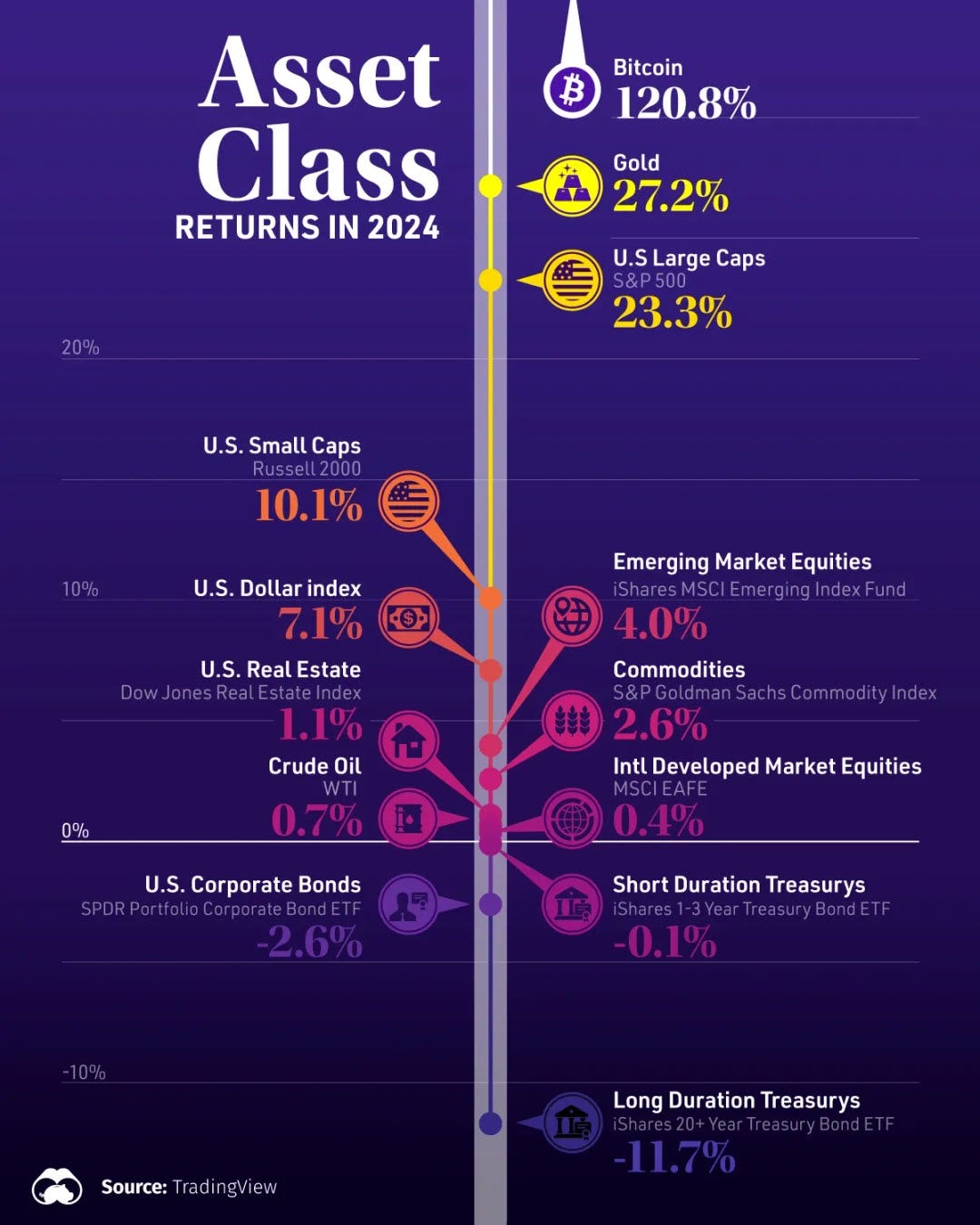
U.S. Large Caps (S&P 500, +23.3%): The S&P 500 achieved back-to-back annual gains exceeding 20%, driven by a combination of falling interest rates and a continued rally in mega-cap technology stocks. The AI boom remained a dominant driver, with tech-heavyweight stocks fueling the broader index’s performance.
U.S. Small Caps (Russell 2000, +10.1%): Smaller companies, represented by the Russell 2000, saw moderate gains of 10.1%. While not as dramatic as their large-cap counterparts, small-caps benefited from the improving economic backdrop and a resurgence in consumer spending.
Mixed Results
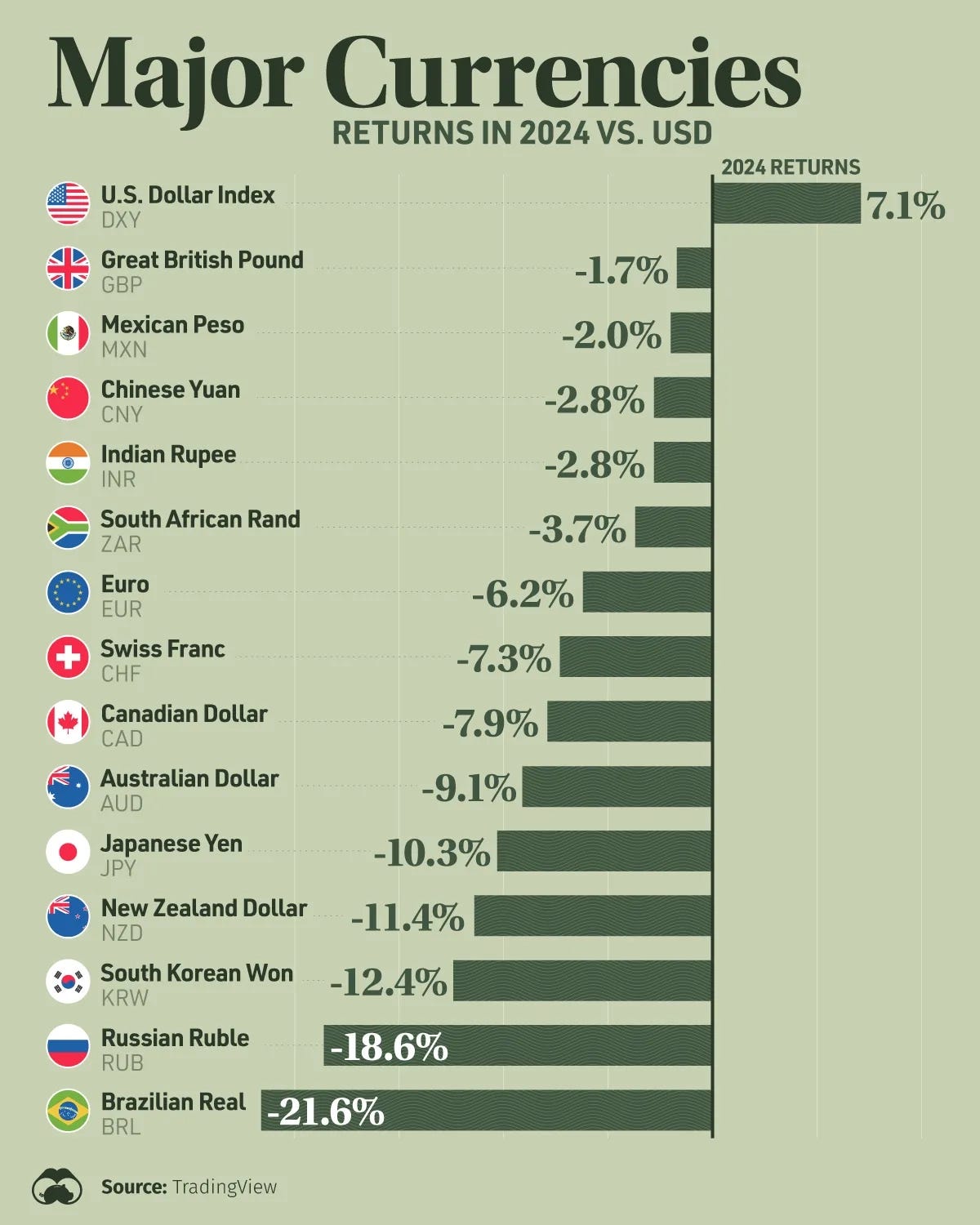
U.S. Dollar Index (DXY, +7.1%): The U.S. dollar index managed a 7.1% gain despite the Fed's rate cuts (figure below). This can largely be attributed to global demand for the dollar as a safe-haven asset and geopolitical events that bolstered its status as the world’s reserve currency.
Emerging Market Equities (+4.0%): Emerging markets saw modest gains as easing inflation in certain regions and favorable commodity prices offered support. However, headwinds such as slower-than-expected economic growth in China capped performance.
Commodities (+2.6%): The broader commodities sector ended with slight gains of 2.6%. Strong performance in energy and industrial metals was offset by weaker agricultural commodity prices due to improved supply conditions.
Laggards in 2024
U.S. Real Estate (+1.1%): Real estate investments posted minimal growth of 1.1%, reflecting challenges posed by higher interest rates in the first half of the year and tepid commercial property demand.
Crude Oil (WTI, +0.7%): Crude oil had a flat year, rising just 0.7%. While supply constraints and geopolitical tensions supported prices early in the year, global economic uncertainties and concerns over waning demand kept gains subdued.
International Developed Market Equities (+0.4%): Developed market equities barely moved, with a 0.4% return. Lingering inflation and stagnant economic growth in Europe and Japan weighed on performance, even as monetary easing provided limited relief.
Short Duration Treasuries (-0.1%): Short-term treasuries ended the year flat, with a marginal -0.1% decline. The asset class remained stable as investors balanced between seeking higher yields and avoiding duration risks.
Corporate Bonds (-2.6%): Corporate bonds faced modest losses, losing 2.6% as spreads widened due to concerns over corporate leverage and credit risks amid economic uncertainties.
Long-Duration Treasuries (-11.7%): Long-duration treasuries were the worst-performing asset class, shedding 11.7% as rising yields and inflation fears eroded their value. Despite the Fed’s rate cuts, the bond market remained under pressure due to expectations of persistent deficits and elevated debt issuance.
Outlook for 2025
The financial landscape in 2025 is expected to be shaped by a continued easing of monetary policy, evolving geopolitical dynamics, expected trade tariffs, and the enduring impact of AI-driven innovation. Here are some of the expected moves:
-
Bitcoin and Risk Assets: Bitcoin could continue to thrive as the post-halving bull market unfolds, though investors should brace for increased volatility.
-
Gold and Commodities: Gold is likely to remain a preferred hedge in uncertain times, while commodities could see divergent performance based on global growth trends.
-
Equities: The S&P 500 may see moderate gains, though valuations could become a concern. Small-cap stocks could outperform if economic conditions continue to improve.
-
Bonds: Long-duration treasuries may remain under pressure, but corporate bonds could stabilize if economic growth surprises on the upside.
Disclaimer: This article is for informational purposes only and does not constitute investment advice. Please conduct your due diligence based on your risk profile before making any investment decisions.
Originally published at Substack.






