With 30-day ETF flows flat, Bitcoin’s price momentum is muted. The Fed’s next move could determine whether flows turn positive or negative.
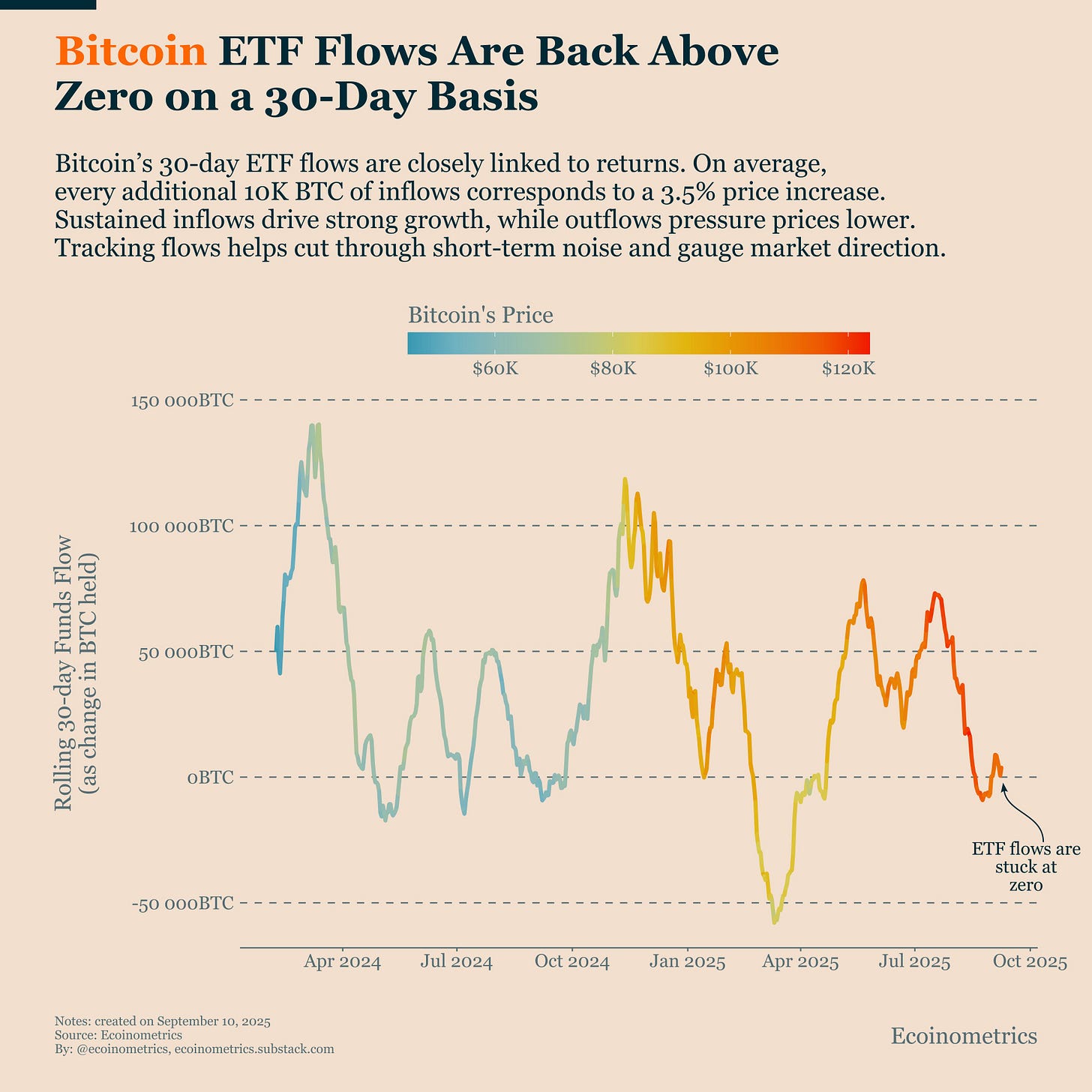
Bitcoin ETF flows, a key measure of institutional participation in the crypto market, have once again stalled. According to recent data from Ecoinometrics, rolling 30-day flows are stuck just above zero, suggesting a lack of momentum to push Bitcoin decisively higher. While this may seem like a neutral signal, the timing couldn’t be more critical: the Federal Open Market Committee (FOMC) meets next week, and the outcome could determine whether Bitcoin’s next move is upward or downward.
ETF Flows: The Institutional Pulse of Bitcoin
Exchange-traded funds (ETFs) tied to Bitcoin have become one of the most important vehicles for institutional and retail investors alike. Unlike direct purchases of Bitcoin on exchanges, ETFs offer regulated access through brokerage accounts, making them particularly attractive to pension funds, asset managers, and high-net-worth individuals who may not want to deal with the custody risks of holding crypto directly.
ETF flows, therefore, act as a proxy for institutional sentiment and liquidity allocation toward Bitcoin. As Ecoinometrics points out, Bitcoin’s 30-day ETF flows are closely linked to returns: on average, every additional 10,000 BTC of inflows corresponds to a 3.5% price increase. Sustained inflows have historically driven strong rallies, while persistent outflows have put downward pressure on prices.
The chart below makes this relationship visible. Over the past 18 months, major surges in ETF inflows, such as in early 2024 and late 2024, coincided with sharp upward moves in Bitcoin’s price. Conversely, outflow periods, particularly in early 2025, saw prices come under pressure. Today, however, ETF flows are flat. The rolling 30-day measure is sitting just above zero, meaning inflows are not strong enough to build sustained buying pressure, nor are outflows dragging prices lower. In other words, Bitcoin is in limbo, awaiting a catalyst.
Why Zero Flows Matter?
At first glance, ETF flows hovering near zero may seem unremarkable. But in a market as sentiment-driven as crypto, neutrality itself can be revealing.
-
Lack of conviction: Investors are neither piling in with enthusiasm nor fleeing in panic. This suggests uncertainty, likely tied to macroeconomic developments.
-
Price stasis: With inflows insufficient to drive momentum, Bitcoin’s price risks getting stuck in a holding pattern, oscillating without a clear direction.
-
Sensitivity to catalysts: In this environment, even small shocks, positive or negative, can have an outsized impact. A dovish comment from the Fed could ignite new inflows, while a hawkish stance could push flows negative.
Thus, the significance of ETF flows hovering at zero is less about where they are and more about where they could go next.
The Fed Looms Large
The upcoming FOMC meeting is the immediate catalyst that could break Bitcoin out of its current stalemate. While inflation in the U.S. has cooled from its 2022–2023 peaks, it remains above the Federal Reserve’s 2% target, leaving policymakers in a delicate balancing act between tightening financial conditions further or holding steady to avoid choking growth.
The key scenarios for Bitcoin and ETF flows are as follows:
-
Fed Turns Hawkish
If the Fed maintains a tone of concern about inflation, liquidity could tighten across global markets, although a hawkish tone is the least likely scenario. Risk assets, including Bitcoin, are particularly sensitive to such signals. In this scenario, ETF flows could turn negative, accelerating outflows and dragging Bitcoin prices lower. -
Fed Stays the Course
If the Fed indicates loosening the monetary policy, acknowledging inflation risks but putting more weight behind a weakening labor market, markets are likely to breathe a sigh of relief. With liquidity conditions stable, ETF inflows could resume, supporting not just Bitcoin but equities, bonds, and other risk assets. This is the most likely scenario. -
Unexpected Dovish Shift
Although unlikely, if the Fed hints at a bigger rate cut or faster balance sheet expansion, it could ignite a major risk-on rally. Bitcoin, as a high-beta asset with a history of outperforming during periods of monetary easing, would be among the biggest beneficiaries.
Bitcoin as a Macro Asset
One of the most important takeaways from the ETF flow data is that Bitcoin is increasingly trading like a macro asset rather than a purely idiosyncratic one. While early Bitcoin cycles were dominated by internal factors, such as mining economics, protocol developments, and crypto-native adoption, today the asset is deeply tied to broader financial conditions.
-
ETF flows mirror equity market fund flows: Both move with shifts in risk appetite.
-
Correlation with liquidity cycles: Bitcoin tends to rally when global liquidity expands and suffers when it contracts.
-
Policy sensitivity: Statements from central banks can now swing Bitcoin just as much as they move traditional asset classes like stocks or bonds.
This means that Bitcoin’s path forward cannot be analyzed in isolation. Its trajectory will depend heavily on whether the Fed and other central banks maintain liquidity conditions that are supportive of risk-taking.
Risks Beyond the Fed
While the FOMC meeting is the immediate focus, it is worth acknowledging other risks that could weigh on ETF flows and Bitcoin’s price:
-
Geopolitical tensions: Escalating conflicts or trade disruptions could trigger a flight to safety, pulling money out of risk assets.
-
Regulatory developments: Stricter rules on crypto trading, custody, or ETF operations could dampen inflows.
-
Broader financial stress: Weakness in equities or corporate credit markets could spill over into Bitcoin, as institutions de-risk portfolios.
At the same time, upside risks exist. Increased adoption of Bitcoin ETFs by major pension funds or sovereign wealth funds could create sustained inflows that break the current stalemate. Similarly, improvements in market infrastructure, such as custodial solutions or derivatives, could bolster institutional confidence.
Waiting for a Breakout
At present, Bitcoin ETF flows hovering at zero reflect an uneasy truce between bulls and bears. Momentum is lacking, and direction will likely remain unclear until the Fed provides guidance at its upcoming meeting. The stakes are high. A hawkish pivot risks tipping flows negative again, which history suggests could weigh heavily on Bitcoin’s price.
On the other hand, if the Fed maintains its current stance, the liquidity backdrop is supportive of a recovery in Bitcoin and risk assets more broadly. For investors, this moment calls for vigilance rather than complacency. Zero flows are not a sign of stability but of suppressed volatility waiting to be released.
As we head into next week, one question remains: Will the Fed’s decision unlock the next wave of Bitcoin inflows, or push them back into negative territory?
Originally Published on Substack.