
To enforce country wide lockdown, governments have resorted to digital surveillance which might not be retracted
In some ways, it already has. It was expected that the enforcement of such an endeavor would need the implementation of extensive surveillance. Billions of people across the globe are now facing enhanced monitoring. The scary part, however, is not the monitoring itself, but that the measures enforced on the pretext of controlling the spread of the pandemic, might not be rolled back.
While surveillance of citizens already existed in some countries to varying degrees, the pandemic has given the authorities an excuse of a blanket implementation. China, where the coronavirus originated is already considered a surveillance state — where a vast network of 170 million surveillance cameras is used to monitor the 1.4 billion of its citizens.
As restrictions begin to ease off in countries where the pandemic infections have dropped off, return to the new normal is being helped along with the use of technology. In China, people have been asked to install mandatory “health code” apps that determine whether they are free to work/travel or stay quarantined, dependent upon the color-coded designations of green, yellow, and red on the app.
“Most of these measures don’t have sunset clauses. They could establish what many people are describing as a new normal, I think we have to be really vigilant about that to make sure there are appropriate safeguards in place because the potential for the abuse of power is pretty extreme.”
~ Ron Deibert, Head of Citizen Lab at the University of Toronto
Following a similar model, governments in 25 countries are putting in place new programs to track their citizens via mobile data tracking, apps to record personal contact with others, CCTV networks equipped with facial recognition, permission schemes to go outside and drones to enforce social isolation regimes.
Two of the big techs, Apple & Google have come together to develop a “contact tracing” smartphone platform. Contact tracing has been widely employed by many countries to control the spread of the pandemic — it involves tracking the patient’s movements to halt the community spread of the virus. While both the companies have reiterated the stance of keeping a tight check on the personal information of the users, a lot of people are still skeptical considering their past record on privacy.
While this app is going to be available in the coming months to all global users of Andriod and Apple phones, individual digital tracking measures are being employed in various countries right now, all in the name of controlling the pandemic. Samuel Woodhams, the digital rights lead at the London-based Top10VPN, who has compiled digital rights live tracker of new surveillance measures related to the COVID-19 outbreak, being implemented by various countries across the globe.
Last time I checked, it showed the following results.
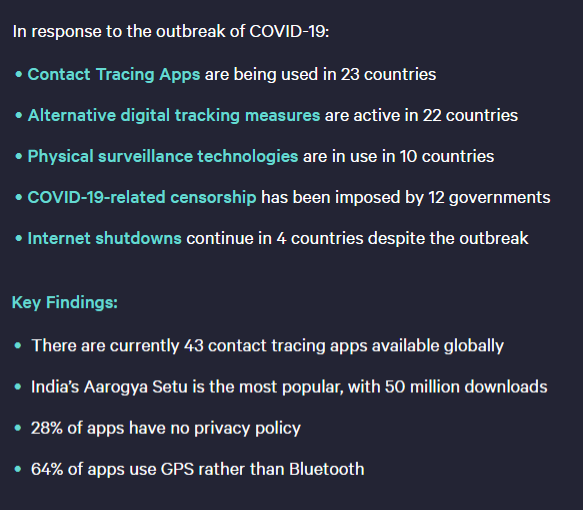
Credit: COVID-19 Digital Rights Live Tracker by Top10VPN
“This isn’t just an issue with authoritarian governments. This is happening across the world. A lot of the technologies we’re seeing are alarmingly similar.”
~ Samuel Woodhams, digital rights lead at Top10VPN
Although China seems to be the only country that is making it mandatory for its citizens to install health code apps as mentioned above, various other countries are in the process or doing the same with or without the knowledge of its citizens. Here is a brief summary:
- Some of the most privacy-conscious governments in Europe are collecting telecom data, using drones & contact-tracing apps — Poland, Netherlands, Spain, Ireland & the UK expressed interest or started to roll out mobile phone apps to track people infected with the virus.
- The U.S is already using contact tracing apps apart from the Bluetooth enabled platforms being pioneered by Apple & Google.
- In Asia, Hong Kong issues tracking wristbands to international arrivals that connect to a StayHomeSafe mobile app and a registered “quarantine address”, while Singapore utilizes Bluetooth enabled TraceTogether app to find people within two meters of someone diagnosed with COVID-19 for half an hour or more. It an open-source app which any country can repurpose for their own use.
- The biggest city of Russia, Moscow (12 million population) has rolled out a system of QR codes for travel on its streets using surveillance cameras and facial recognition technology.
- Authorities in India are already experimenting with mobile tracking apps, geolocated selfies, and releasing the addresses of coronavirus patients.
- Israel has implemented surveillance on a national scale, initially with phone tracking measures.
Apart from lingering concerns from privacy advocates, campaigners are also warning that too much focus on surveillance measures may be diverting resources from health-focused approaches, such as aggressive testing capability, expediting vaccine efforts, or supplying hospitals with more personal protective and other medical equipment.
Privacy concerns for the majority of the population might be on the back burner right now, as the focus remains on controlling the pandemic with whatever means possible. The bigger question is whether the governments would roll back these privacy infringing measures once things get back to normal? My guess is as good as yours…
Originally Published on Medium
Medium 📭| Twitter 📜 | LinkedIn 📑| StockTwits 📉 | Telegram 🔗






