
After more than a decade of U.S. dominance, international stocks are reclaiming the stage. Here’s what’s driving the shift and what it means for investors.
For over a decade, U.S. equities have been the undisputed champions of the investing world. The S&P 500, led by technology giants and fueled by years of accommodative policy, has regularly outperformed international peers. This dominance created a sense of inevitability among investors: bet on America, and the rest will follow. Yet, 2025 has broken that narrative wide open.
Despite U.S. stock indices climbing to fresh record highs, many international markets are handily outperforming America’s best. South Korea, Italy, Mexico, and even Germany have delivered returns that make Wall Street’s “exceptionalism” look ordinary. It’s a development that has taken investors by surprise, particularly as much of the last decade was defined by American tech innovation, geopolitical uncertainty, and sluggish global growth.
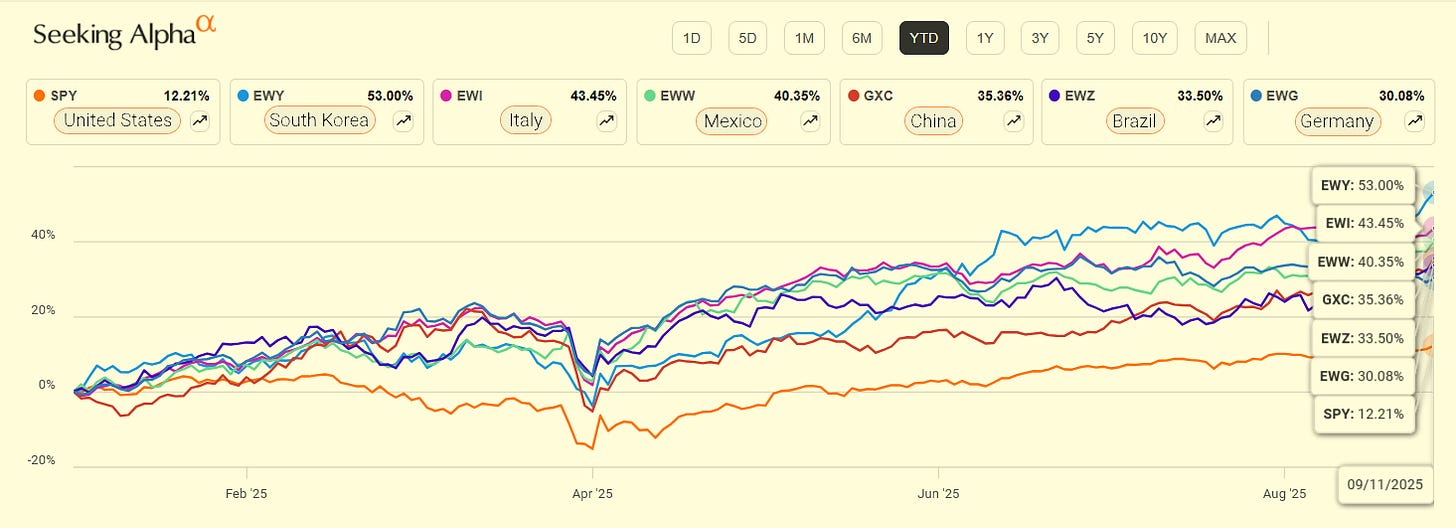
The data speaks for itself. As of September 11, 2025, the year-to-date (YTD) performance snapshot from Seeking Alpha (chart below) highlights this divergence:
-
South Korea (EWY): +53.0%
-
Italy (EWI): +43.45%
-
Mexico (EWW): +40.35%
-
China (GXC): +35.36%
-
Brazil (EWZ): +33.50%
-
Germany (EWG): +30.08%
-
United States (SPY): +12.21%
At a glance, the numbers tell a clear story: while the U.S. market is still rising, it pales in comparison to the outsized gains occurring abroad. Investors, long conditioned to think of American markets as the default growth engine, are beginning to ask: What changed?
Monetary Policy: Diverging Paths
One of the most significant drivers of this divergence is monetary policy. While the U.S. Federal Reserve has maintained a cautious stance, waiting for more clarity on inflation and growth, many other central banks have moved aggressively to cut interest rates. Across Europe, Asia, and Latin America, policymakers have embarked on easing cycles designed to reinvigorate their economies.
Lower rates have boosted consumer demand, encouraged corporate investment, and made equities more attractive relative to bonds. In contrast, the Fed’s hesitation has left U.S. investors grappling with lingering uncertainty about borrowing costs, trade dynamics, and inflationary pressures. This divergence has created a tailwind for international markets. Investors see an opportunity: in regions where monetary policy is actively stimulating growth, equity returns are being amplified.
The Dollar’s Decline: A Tailwind for Foreign Assets
Another critical factor in 2025’s global equity rally is the decline of the U.S. dollar. After years of strength, the greenback has retreated, providing a double boost to international stocks, both in terms of local economic competitiveness and in returns for U.S.-based investors holding foreign assets.
A weaker dollar makes exports from countries like South Korea, Mexico, and Germany more competitive globally, fueling corporate profitability. For American investors, the currency effect magnifies returns when foreign earnings are converted back into dollars. In short, the dollar’s slide has not only leveled the playing field but tilted it in favor of international exposure.
Valuations: Bargains Abroad
Valuations are another piece of the puzzle. U.S. equities, after years of outsized gains, have become expensive. Price-to-earnings (P/E) ratios, particularly among the so-called Magnificent Seven technology stocks, remain elevated by historical standards. Meanwhile, many international markets still trade at relatively modest valuations. Italy’s stock market, for instance, has benefitted from strong earnings in energy and industrials but remains far cheaper than its American peers.
South Korea, with its heavy concentration of semiconductor and electronics giants, offers investors access to industries at the heart of global growth but at a discount to U.S. tech valuations. The result has been a reallocation of global capital. Investors are increasingly looking beyond the United States, attracted by the opportunity to buy growth at more reasonable prices.
Geopolitics and Spending: Context Matters
Global markets are also being buoyed by policy shifts and fiscal spending. Europe, for example, is undergoing a major rearmament push, with military-industrial investment ramping up in response to Russia’s ongoing war in Ukraine. This surge in defense spending has created opportunities for European equities, particularly in the industrial and aerospace sectors.
Latin America, too, has seen momentum. Mexico’s economy is benefiting from nearshoring trends, as companies seek to diversify supply chains away from China and closer to the United States. Brazil, supported by natural resources and a recovering consumer market, has also attracted investor flows.
In Asia, South Korea’s semiconductor sector has surged on the back of global demand for advanced chips, while China, despite its regulatory overhang, has seen renewed optimism as authorities rolled out pro-growth measures. These developments contrast with the United States, where political gridlock, Fed caution, and uncertainty around regulation have clouded the outlook for corporate America.
Lessons for Investors: Diversification Revisited
The resurgence of international markets in 2025 carries an important lesson: diversification still matters. For years, investors could argue that a U.S.-centric portfolio was enough. American equities not only outperformed but also offered exposure to world-leading innovation and global brands.
But markets are cyclical. The last time international equities significantly outpaced the U.S. was in the 2000s, during the commodities boom and the rise of emerging markets. After more than a decade of U.S. dominance, we may now be entering a new phase where international diversification is not only prudent but necessary.
Trying to predict which markets will lead is a futile exercise. Context matters, and forecasts are rarely both accurate and timely. A better approach is to maintain a globally diversified portfolio, with disciplined rebalancing to take advantage of shifts like those we see today. By doing so, investors are positioned to benefit from whichever region outperforms, without the need to place concentrated bets.
Looking Ahead
Will this international surge last? That remains the billion-dollar question. Bears argue that many of these markets are riding temporary policy boosts and currency effects, while long-term challenges, like demographic headwinds in Europe or structural inefficiencies in Latin America, could resurface. Bulls counter that a new global growth cycle is underway, fueled by technology diffusion, industrial spending, and a realignment of supply chains.
What’s clear is that 2025 has broken the monotony of U.S.-only outperformance. Investors now face a more balanced, multipolar investment landscape—one where opportunities abound far beyond Wall Street. For those willing to look outward, the message of 2025 is simple: don’t underestimate the rest of the world.
Originally Published on Substack.






