
How long-term unemployment is climbing without an official recession, and why it matters more than we think.
The U.S. labor market has long been viewed as one of the economy’s most resilient pillars. Even when confronted with shocks, whether the dot-com bust, the Great Recession, or the COVID-19 pandemic, employment has eventually rebounded with surprising strength. But in 2025, a different kind of challenge is emerging: long-term unemployment is climbing again, even though the economy has not officially entered a recession.
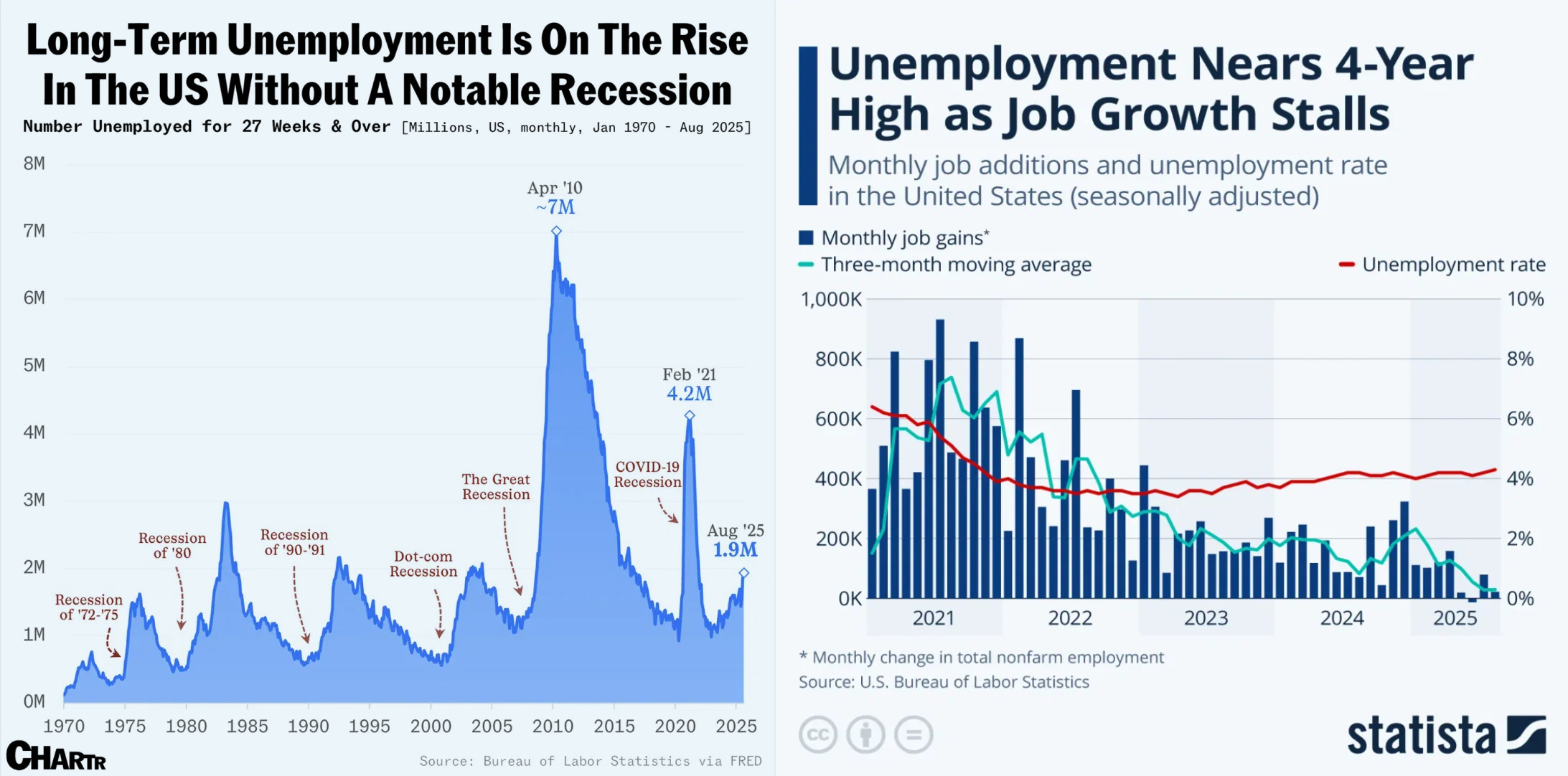
According to data from the Bureau of Labor Statistics (BLS), the number of Americans unemployed for 27 weeks or longer, a threshold commonly used to define long-term unemployment, stood at 1.9 million in August 2025. This marks the highest level since the immediate aftermath of the pandemic in early 2021, when the figure peaked at 4.2 million. To put this in historical perspective, the current rise is unusual: long-term unemployment typically surges during or immediately after recessions, not in periods of slow but steady growth.
The Shift in Job Market Dynamics
The latest job reports have painted a picture of a labor market losing momentum. Job gains, once robust in 2021 when the economy was recovering from pandemic lockdowns, have steadily dwindled. In 2021, monthly job additions frequently exceeded 600,000, with occasional spikes above 800,000. By 2023, those gains had slowed significantly, averaging closer to 200,000. And in 2025, monthly additions have inched dangerously close to zero.
The Statista chart underscores this slowdown: the three-month moving average of job gains has slipped below 100,000 in recent months, while the unemployment rate has crept up to around 4.3%, its highest point in four years. The worrying element here is not just the rise in unemployment, but its composition. The growing share of the unemployed has now been without work for over six months, suggesting that people are struggling to re-enter the labor market once displaced.
Why the Six-Month Mark Matters?
Crossing the six-month threshold in unemployment is not just a bureaucratic milestone; it often represents a turning point in an individual’s life. By this point, many have exhausted their unemployment insurance benefits and any severance pay they may have received. Financial stress begins to compound, and the costs of joblessness start to extend beyond the wallet.
Economists have long argued that long-term unemployment can become “structural” unemployment. The longer individuals remain out of work, the harder it becomes for them to return. Skills can atrophy, confidence can wane, and employers may perceive long gaps in resumes as red flags. Studies also show that prolonged unemployment is correlated with higher rates of depression, anxiety, and even physical health deterioration.
In short, while short-term unemployment can be seen as a temporary friction in an otherwise dynamic economy, long-term unemployment carries risks that can linger for years—both for individuals and for society.
What Makes 2025 Different?
Traditionally, spikes in long-term unemployment have coincided with downturns. For instance, during the Great Recession of 2007–2009, long-term unemployment reached an unprecedented 7 million in April 2010, as millions were displaced from sectors like housing, construction, and finance. Similarly, the COVID-19 recession in 2020–2021 pushed long-term unemployment to over 4 million.
But 2025 stands apart: the U.S. is not in a technical recession. GDP growth, while modest, remains positive. Corporate earnings have shown resilience, and inflation has cooled from its 2022 highs. Yet, companies appear to be in a hiring freeze mode, reluctant to expand payrolls despite relatively healthy balance sheets.
Several factors may explain this paradox:
-
Post-Pandemic Adjustments: Many firms over-hired during the pandemic recovery in 2021–2022, anticipating sustained demand that never fully materialized. Today, they are “rightsizing” rather than expanding.
-
Productivity and Technology: Advances in artificial intelligence and automation have reduced the need for labor in certain sectors, particularly administrative and service roles.
-
Global Uncertainty: Geopolitical tensions, supply chain realignments, and the unpredictability of consumer demand are making employers cautious about long-term commitments to new staff.
-
Policy and Interest Rates: Higher borrowing costs, a lingering consequence of the Federal Reserve’s anti-inflation campaign, may also be dampening business expansion and investment in labor.
Broader Economic and Social Risks
The rise of long-term unemployment carries implications far beyond the labor market statistics. A sustained increase in long-term joblessness can weigh on the economy in several ways:
-
Consumer Spending: Households led by long-term unemployed individuals tend to cut back sharply on spending, which drags down demand for goods and services.
-
Public Finances: Prolonged reliance on safety-net programs increases strain on state and federal budgets.
-
Inequality: Long-term unemployment disproportionately affects vulnerable populations, including older workers, minority groups, and individuals without advanced degrees. This can exacerbate already widening wealth and income gaps.
-
Political Polarization: Economic insecurity often fuels political frustration and populist sentiment, influencing policy debates and elections.
What Can Be Done?
Addressing the rise of long-term unemployment requires proactive measures that go beyond traditional economic stimulus. Some potential strategies include:
-
Reemployment and Training Programs: Expanding access to retraining initiatives, especially in growing sectors such as clean energy, health care, and technology, can help workers transition more smoothly.
-
Employer Incentives: Policies that incentivize firms to hire the long-term unemployed—through tax credits or wage subsidies—can reduce stigma and open doors.
-
Mental Health Support: Recognizing the psychological toll of long-term unemployment, governments and nonprofits can strengthen programs offering counseling and community support.
-
Targeted Fiscal Policy: Rather than broad stimulus, targeted investments in infrastructure, housing, and regional development can create jobs where they are most needed.
A Warning Sign, Not a Crisis
The current rise in long-term unemployment may not yet constitute a crisis on the scale of the Great Recession or the pandemic. But it is a warning sign. A cooling labor market combined with a stagnant hiring environment can erode one of America’s greatest economic strengths: its dynamic and flexible workforce.
If left unaddressed, today’s long-term unemployed could become tomorrow’s permanently discouraged workers—individuals who exit the labor force entirely. That would not only diminish potential economic output but also risk leaving behind a generation of Americans struggling to reconnect with the workforce.
Conclusion
The paradox of 2025 is clear: the U.S. is not in recession, yet long-term unemployment is rising as if it were. This development challenges policymakers, businesses, and society to rethink how resilience is measured in the labor market. It is no longer enough to look only at headline job numbers or unemployment rates.
The composition of that unemployment and the lived experiences of those searching for work month after month must also be part of the equation. In the absence of decisive action, the silent creep of long-term unemployment could become one of the most significant economic and social challenges of the decade.
Originally Published on Substack.






