
The premier digital asset which had been in tandem with the tech-heavy index has started to diverge
Have you ever heard the saying, “correlation doesn’t imply causation”? Well, it turns out that not only does correlation not always imply causation, but the strength of correlations between certain variables has been decreasing over time. According to a recent study by economists at the University of Chicago, the average correlation between stock returns and economic indicators has decreased by over 50% since the 1960s. In other words, it’s becoming less and less useful to look at the economy as a predictor of stock market performance.
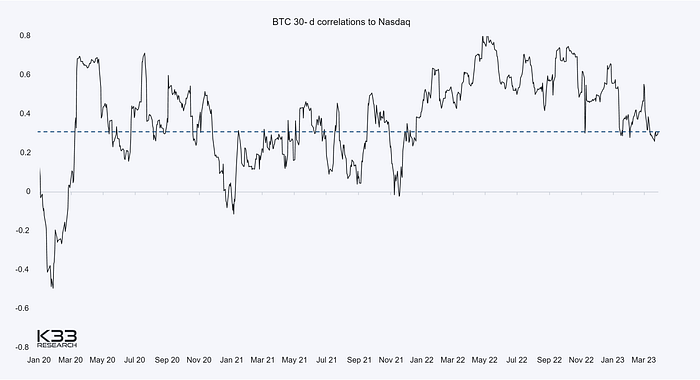
On the topic of correlation, I have written on many previous occasions about how digital assets fare when it comes to comparing them with traditional financial markets. One such relationship that we saw play out for most of 2022, was Bitcoin’s price action mirroring moves in the U.S tech-heavy index Nasdaq. However, this correlation has been in a steady decline since September of the last year.
As of now, Bitcoin’s 30-day correlation with Nasdaq sits at 0.3, which is down from 0.75 in October (chart below). This decline can be attributed to several factors, including the fact that Bitcoin is more sensitive to short-term interest hikes rather than long-term trends. Essentially, there are several forces at play, including the absence of a natural long-term relationship with interest rates, worsened liquidity, structural changes, and evolving behavioral patterns that all contribute to the current paradigm.
Let’s try to decode how these factors played out in the crumbling of this relationship.
Policy Issues
During the zero-interest rate regime of 2020–2021, the main priority was growth. However, in the world of crypto, the focus on growth was perverse, leading to a yearlong correlated hangover in 2022. As interest rates increased, bad risk management practices could no longer be remedied through private fundraising. Loans were called back, liquidity tightened, and irresponsible lenders crumbled under the pressure.
As a result, the crypto credit market has significantly reduced in size. While tighter monetary conditions have long-term effects on public companies, they are more critical in the case of BTC. Public companies with debt will always be exposed to interest rates, but this is not necessarily the case with BTC. Simply put, Bitcoin is a scarce digital commodity with a nascent industry built around its pursuit of growth. Unlike equities, a fair value or fundamental value of Bitcoin cannot be assessed through discounted cash flow (DCF) models.
Liquidity Constraints
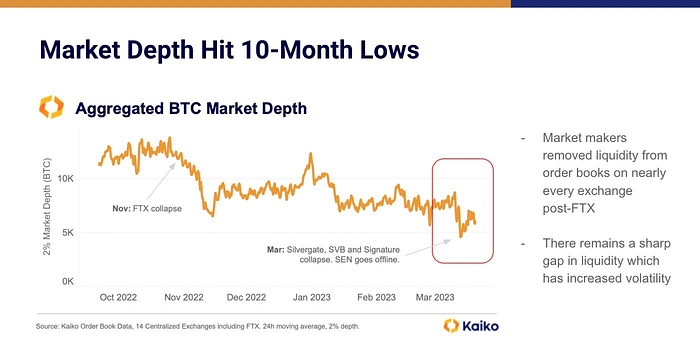
In the past year, many market makers experienced significant losses, causing them to reassess their risk assessment of the market. One clear example of this is the funds locked in FTX, as reported by Coindesk. The decrease in trust has made market makers more cautious about holding significant amounts at centralized exchanges. As a result, there is less liquidity in the market, which means that the net buyer and net seller have a more significant impact on the overall direction of the market.
Reduced Corporate Exposure
Last year, Tesla, one of the biggest corporate holders of Bitcoin, sold 29,000 BTC and currently holds less than 10,000 BTC. Additionally, public miners have sold BTC, causing BTC’s natural connection to Nasdaq through companies holding it as a corporate treasury asset to decline. The only net buyer in this scenario was Microstrategy.
Macroeconomics
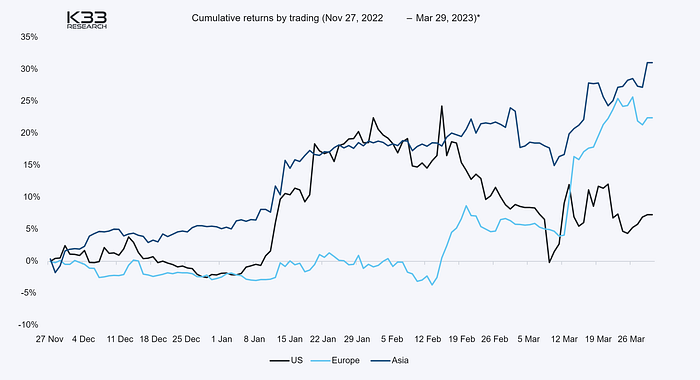
Silicon Valley Bank collapse (SVB) had a severe impact on Nasdaq companies and venture capital firms. However, BTC has the unique quality of being able to be custodied independently, which makes it an excellent store of value in that regard. Furthermore, global demand for BTC exposure has grown, with BTC seeing most of its recent upside during European and Asian trading hours (chart above).
When analyzing this correlation at the micro level, it is evident that BTC has had a significantly lower correlation with Nasdaq during U.S. hours than earlier this year, and notably lower than during October. There are several reasons for these lower correlations and momentum is currently strong. Additionally, tighter liquidity in the market means that the net buyer and seller will continue to have a larger impact on BTC’s price action.
Originally Published on Medium
Email | Twitter | LinkedIn | StockTwits | Telegram | Newsletter






