Despite strong ETF inflows, Ethereum remains highly correlated with Bitcoin. What will it take for ETH to stand on its own as an independent asset class?
Cryptocurrency markets thrive on narratives. Bitcoin is often cast as “digital gold,” a hedge against inflation and a store of value, while Ethereum is framed as the foundation of decentralized finance (DeFi), smart contracts, and Web3 innovation. Over the past several years, Ethereum has carved out a unique identity in terms of technology and use cases. Yet, despite this divergence in function, Ethereum’s performance in financial markets continues to be overwhelmingly tethered to Bitcoin.
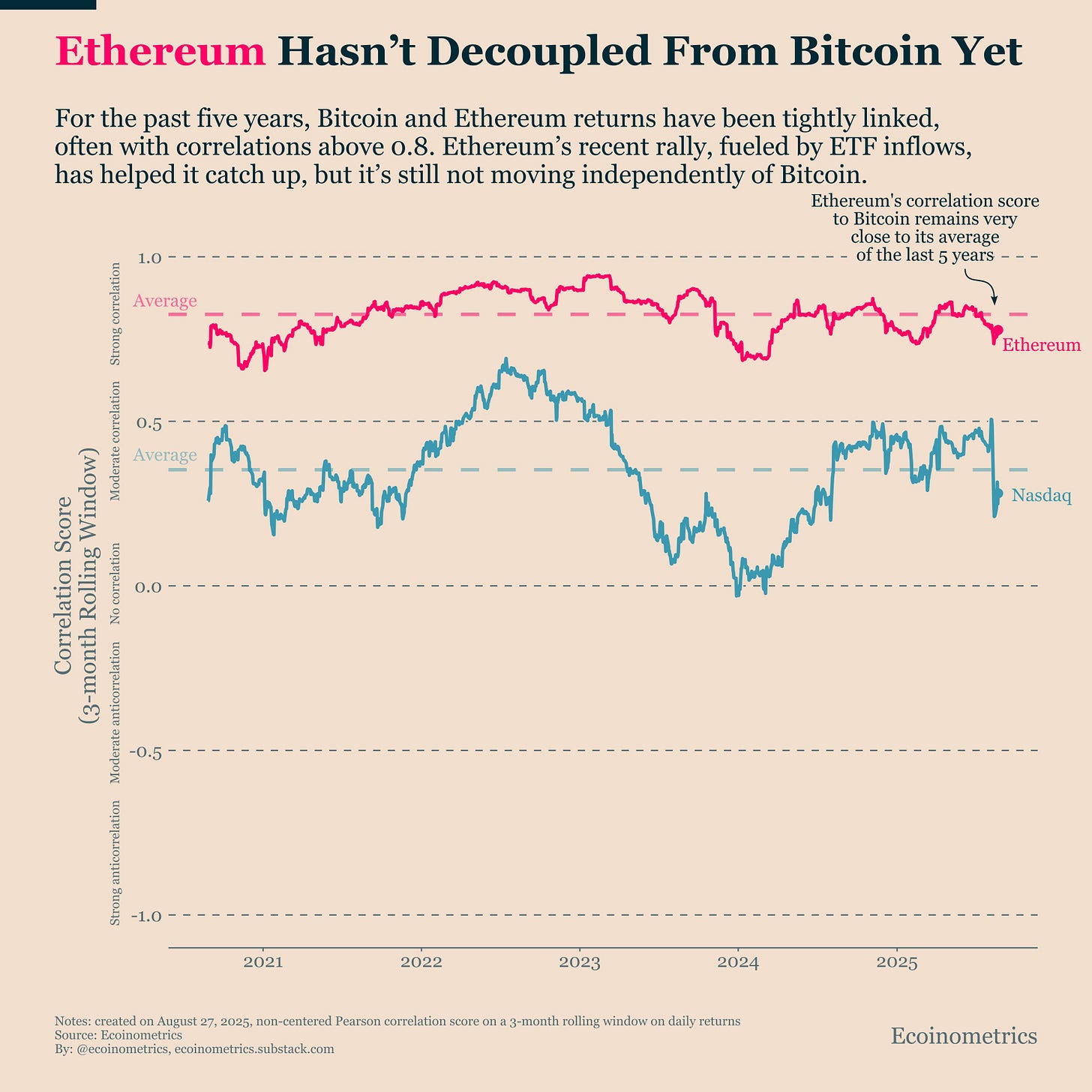
The chart provided by Ecoinometrics (below) underscores this reality. For the past five years, the correlation between Bitcoin and Ethereum returns has averaged above 0.8—a level of strong statistical linkage. Even today, in the midst of Ethereum’s latest rally, that correlation remains stubbornly close to its historical average.
In contrast, Bitcoin itself is only moderately correlated with the tech-heavy Nasdaq index, with correlation scores hovering around the 0.3–0.5 range. This suggests that while Bitcoin is carving out its own trajectory relative to traditional equity markets, Ethereum has yet to do the same in relation to Bitcoin. The question is: why, and what does this mean for investors?
Ethereum’s Recent Rally: ETF Inflows & Market Sentiment
Ethereum’s current strength in price terms can largely be attributed to ETF inflows. Since regulators began approving Ethereum-based exchange-traded funds, institutional and retail investors alike have gained a new, regulated pathway to exposure. This has fueled steady capital flows, providing Ethereum with fresh momentum and enabling it to narrow its performance gap relative to Bitcoin.
The dynamic here is important: ETFs represent more than just convenience; they symbolize legitimacy. For years, skeptics dismissed Ethereum as too experimental, too dependent on a niche developer community, or too entangled with unproven DeFi protocols. But ETF approval by financial watchdogs has altered that perception.
Institutional investors now view Ethereum not simply as an altcoin, but as an asset worthy of structured investment vehicles. Yet, even with this tailwind, the data tells us that Ethereum is not yet moving independently. Its price movements, up or down, are still overwhelmingly shaped by Bitcoin’s trajectory.
The Correlation Story: Why ETH Still Shadows BTC
At its core, correlation in financial markets measures how closely two assets move together. A correlation of 1.0 indicates perfect synchronicity, while 0.0 implies no relationship, and -1.0 suggests assets move in opposite directions. Ethereum’s five-year average correlation with Bitcoin, above 0.8, is not just high, it’s telling. It signals that Ethereum is still perceived by the market as part of the same risk basket as Bitcoin.
When Bitcoin rallies, Ethereum typically rallies too. When Bitcoin falters, Ethereum rarely escapes unscathed. Contrast this with Bitcoin’s relationship to the Nasdaq, which averages closer to 0.3–0.5. This is a moderate correlation, reflective of overlapping risk factors (such as macroeconomic conditions or interest rate expectations), but still weak enough to suggest Bitcoin is evolving into its own asset class. Ethereum, by comparison, remains anchored to Bitcoin’s gravitational pull.
Why does this persist? Several reasons stand out:
-
Market Psychology
Retail investors and institutions alike still view Bitcoin as the benchmark. It’s the first mover, the most recognized name in crypto, and the largest by market cap. As such, Ethereum is often treated as a “high-beta version” of Bitcoin—meaning it tends to exaggerate Bitcoin’s moves rather than chart its own path. -
Liquidity Dynamics
Bitcoin markets are deeper and more liquid. This makes Bitcoin the natural reference point for crypto risk, with Ethereum’s price behavior trailing as secondary liquidity follows suit. -
Macro Forces
In times of risk-on or risk-off sentiment, broad crypto markets tend to move together. Bitcoin sets the tone, and Ethereum reflects the broader mood.
Why Ethereum’s Independence Matters?
The lack of decoupling raises important questions. If Ethereum is to be valued not merely as “crypto’s silver” but as a distinct financial and technological asset, it must eventually demonstrate independence in its returns. After all, Ethereum underpins a vast network of decentralized applications, from non-fungible tokens (NFTs) to lending protocols to decentralized exchanges.
Its fundamentals differ from Bitcoin’s, which is designed purely as a store of value and transactional medium. Moreover, Ethereum’s transition to Proof of Stake (PoS) in 2022 and its ongoing roadmap of scalability upgrades underscore its distinctive technological trajectory. These structural differences should, in theory, translate into differentiated price action over time. But as the data shows, the market hasn’t fully recognized or rewarded these differences yet.
ETF Momentum: A Potential Catalyst
If there’s one area where Ethereum currently stands apart, it is in ETF inflows. Bitcoin may have set the precedent with its spot ETF approval in early 2024, but Ethereum’s own approval in 2025 brought fresh enthusiasm. These inflows are not just a matter of capital; they are a barometer of investor confidence.
ETF growth could help Ethereum carve out more independence, particularly if institutional portfolios begin to treat it as a core allocation alongside Bitcoin, rather than merely a speculative adjunct. The challenge will be whether that confidence is strong enough to persist through Bitcoin downturns, or whether Ethereum remains chained to Bitcoin’s cycle.
The Big Picture: Where Ethereum Goes From Here
For now, the story is clear:
-
Ethereum is rallying—thanks to ETF inflows and renewed investor interest.
-
Ethereum is holding up better than Bitcoin in price terms, suggesting some relative strength.
-
But the correlation hasn’t budged—Ethereum remains tethered to Bitcoin with a correlation score near its long-term average of 0.8+.
-
Bitcoin, by contrast, is less tied to equities, showing only moderate correlation to the Nasdaq.
This dynamic suggests Ethereum still has more work to do if it wants to establish independence in the eyes of markets. Until then, it remains part of the broader “crypto beta” story: a derivative of Bitcoin’s risk-on/risk-off cycle rather than an autonomous asset.
Independence or Perpetual Shadow?
Ethereum’s challenge moving forward is not merely technological; it is psychological and financial. If investors continue to treat Ethereum as Bitcoin’s sidekick, its market dynamics will reflect that reality, no matter how innovative its blockchain ecosystem becomes.
Breaking free will require not just technological differentiation, but sustained, large-scale capital flows that treat Ethereum as a foundational, independent asset. The next phase of crypto maturity may hinge on exactly this: whether Ethereum can step out of Bitcoin’s shadow. The ETFs are a good start, but the correlation chart reminds us that the journey is far from over.
Originally Published on Substack.