
Bitcoin’s October streak ended in 2025 after a global macro shock reversed six straight years of “Uptober” gains.
For years, October has been a beacon month for the crypto faithful — a time when Bitcoin often stages its strongest rallies of the year. This trend became so consistent that the community coined a term for it: “Uptober.” It was a lighthearted nickname, but one that drew strength from real data. On CoinGlass’s Bitcoin Monthly Returns heat map (below), every October from 2019 through 2024 flashed green, reinforcing the perception that the tenth month was almost preordained to deliver gains.
Until now.
October 2025 broke the streak. Bitcoin’s monthly return came in at –3.69%, marking the first “Red October” since 2018. The break in that six-year run carries symbolic and practical weight, not because one red cell changes Bitcoin’s long-term trajectory, but because it underscores a truth many traders forget during bull runs: seasonality is a tendency, not a guarantee.
The Birth of “Uptober” and the Power of Pattern Recognition
Why the “Uptober” label stuck is simple. Bitcoin’s October record over the past decade reads like a case study in positive reinforcement. The CoinGlass data makes that clear:
-
2019: +10.17%
-
2020: +27.7%
-
2021: +39.93%
-
2022: +5.56%
-
2023: +28.52%
-
2024: +10.76%
Across wildly different market environments, from late-cycle surges to post-sell-off recoveries, October reliably produced green candles. The average October return over the full data set sits near +19.9%, and the median around +14.7%. It wasn’t just a meme.
It was a pattern grounded in data and, until 2025, a statistically persuasive one. The consistency became lore: analysts pointed to Uptober as a self-fulfilling prophecy, when optimism, post-summer accumulation, and year-end positioning combined to drive prices higher.
Traders leaned into it. Fund flows strengthened. Social media timelines filled with green candles and memes of pumpkins morphing into Bitcoin logos. But markets have a cruel way of humbling collective conviction. The red flip in October 2025 serves as a reminder that history may rhyme, but it never promises to repeat.
When Macro Shocks Collide with Market Mythology
The catalyst for this year’s reversal came not from within crypto, but from the world’s largest economy. On October 10, 2025, U.S. President Donald Trump threatened a new wave of steep tariffs on Chinese goods, citing rare-earth mineral supply risks, a move that instantly rattled global markets. What followed was a textbook risk-off cascade. Equity indices plunged. Yields spiked. The U.S. dollar strengthened.
And Bitcoin, despite its narrative as “digital gold,” fell alongside other risk assets. Within hours, the world’s largest cryptocurrency dropped from the low $120,000s to around $105,000, triggering a chain reaction across leveraged crypto positions.
Over just two trading sessions (October 10–11), derivatives exchanges auto-liquidated tens of billions in positions, while an estimated $500 billion in total crypto market capitalization evaporated before a shaky rebound stabilized prices. In hindsight, it wasn’t “Uptober” that failed; it was the market’s assumption that October couldn’t fail. Macro shocks don’t respect seasonal patterns, and overconfident positioning turned a normal correction into a full-blown liquidation event.
The CoinGlass Data: A Story of Cycles, Not Certainties
The following monthly returns chart, a colorful mosaic of Bitcoin’s history, puts the 2025 result into long-term perspective. Despite October’s stumble, the broader trend remains undeniably bullish. Since 2013, Bitcoin’s average monthly gain sits around +8.18%, even with double-digit drawdowns sprinkled throughout.
But zooming in on 2025, the tone shifts. The year has been erratic, marked by +9.29% in January, a brutal –17.39% in February, then a rebound of +14.08% in April and +10.99% in May, followed by quieter summer months. October’s red close of –3.69% fits into that broader pattern of volatility-without-trend, a market searching for equilibrium after a parabolic 2024.
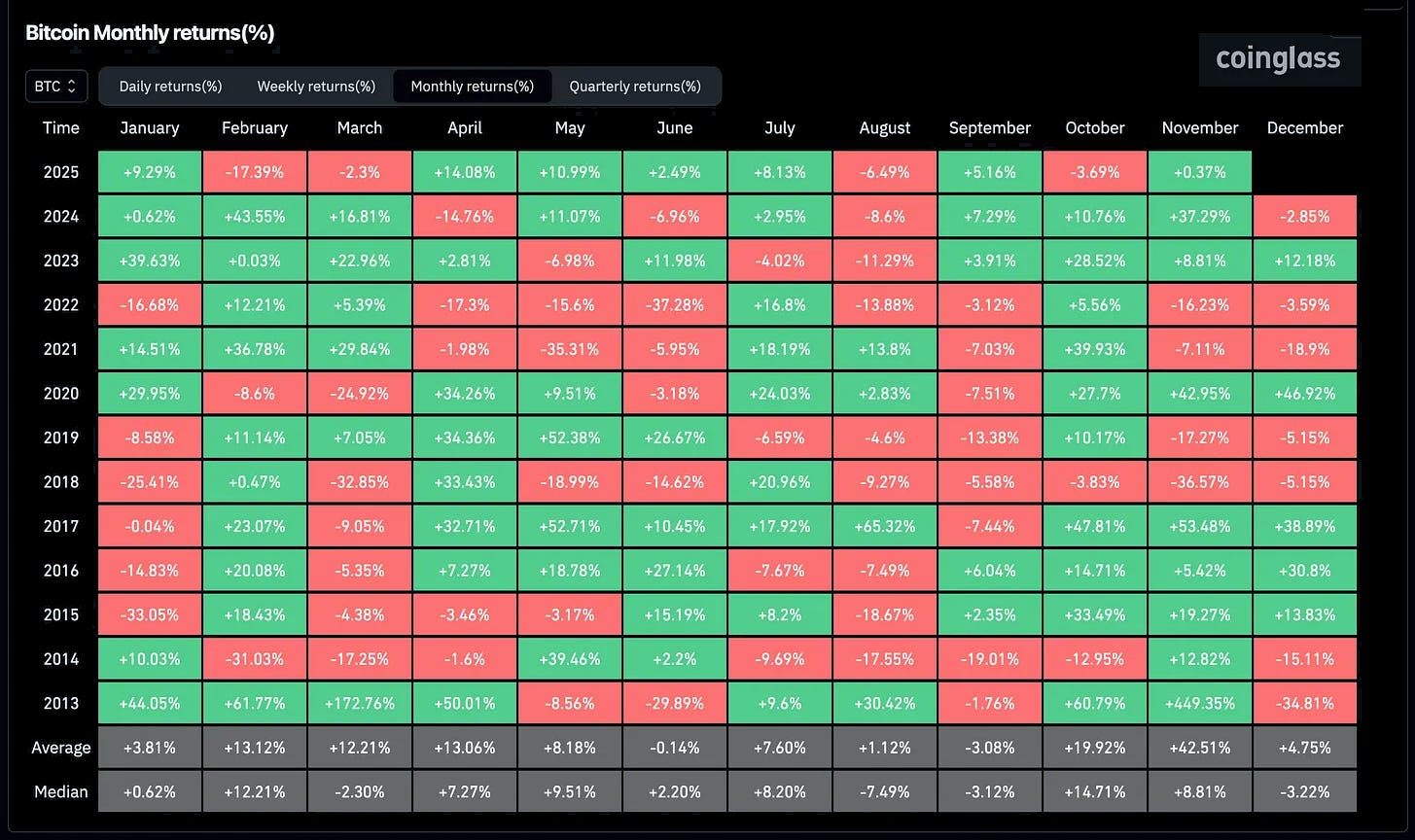 More importantly, the CoinGlass heat map reminds us how macro context shapes these returns:
-
2021’s Uptober (+39.93%) came in the euphoric phase before Bitcoin hit its then all-time high.
-
2022’s modest +5.56% was a bear-market bounce amid tightening global liquidity.
-
2023’s +28.52% was powered by ETF anticipation and rate-cut hopes.
-
2024’s +10.76% coincided with institutional accumulation and an expectation of a favorable crypto-friendly administration taking power in the U.S.
Each “Uptober” was driven by distinct catalysts, not a seasonal spell. The 2025 breakdown simply exposes that narratives alone cannot shield markets from macro risk.
Seasonality vs. Reality: A Risk Management Lesson
Seasonality can be a useful compass, but it’s not a GPS. Traders often mistake statistical tendencies for predictive power, especially in crypto, where sentiment cycles amplify every narrative.
The 2025 Red October underscores three key lessons:
-
Seasonality is context-dependent.
Patterns persist only when macro conditions allow. Rising U.S. yields, geopolitical tensions, and liquidity shocks can overwhelm even the most favorable historical trends. -
Crowded positioning magnifies reversals.
When traders pile into a narrative — such as Uptober — leverage builds up. A single macro trigger can turn that positioning into fuel for cascading liquidations. -
Data should guide, not dictate.
CoinGlass’s dataset remains an invaluable historical map, but risk management demands tape confirmation. Trust the trend, not the calendar.
Even sophisticated players fall prey to “recency bias.” After six consecutive green Octobers, the market’s collective muscle memory leaned too heavily on expectation. The 2025 correction, mild by Bitcoin’s historical standards, feels sharper only because it broke a story traders wanted to believe.
A Sobering but Healthy Reset
The failed Uptober of 2025 is less a tragedy and more a recalibration. It breaks the spell of automatic optimism, reintroduces discipline, and rebalances the relationship between narrative and evidence. Markets that climb forever on memes are brittle; those that learn to adjust after setbacks are resilient.
Bitcoin’s red October may, paradoxically, strengthen the next bull phase by flushing excess leverage and reminding investors that fundamentals and macro context matter. The broader backdrop still holds promise: institutional inflows via ETFs remain robust, sovereign adoption discussions continue in emerging markets, and Bitcoin’s post-halving supply dynamics are still tightening. Short-term setbacks don’t erase long-term asymmetry.
Beyond the Calendar
The lore of Uptober isn’t dead, it’s just matured. The CoinGlass grid will forever show that red cell in 2025, a footnote reminding traders that the market doesn’t care about memes. Seasonality might nudge probability, but only real-time price action confirms reality.
As Bitcoin stabilizes into November and eyes 2026, the wiser takeaway is not to mourn a broken streak but to celebrate a regained sense of realism. In the end, “Uptober” was never about October; it was about confidence. And the confidence that survives a correction is far stronger than the one built on calendar superstition.
Originally Published on Substack.





