
It could eventually hamper blockchains’ ability to become a truly decentralized public infrastructure
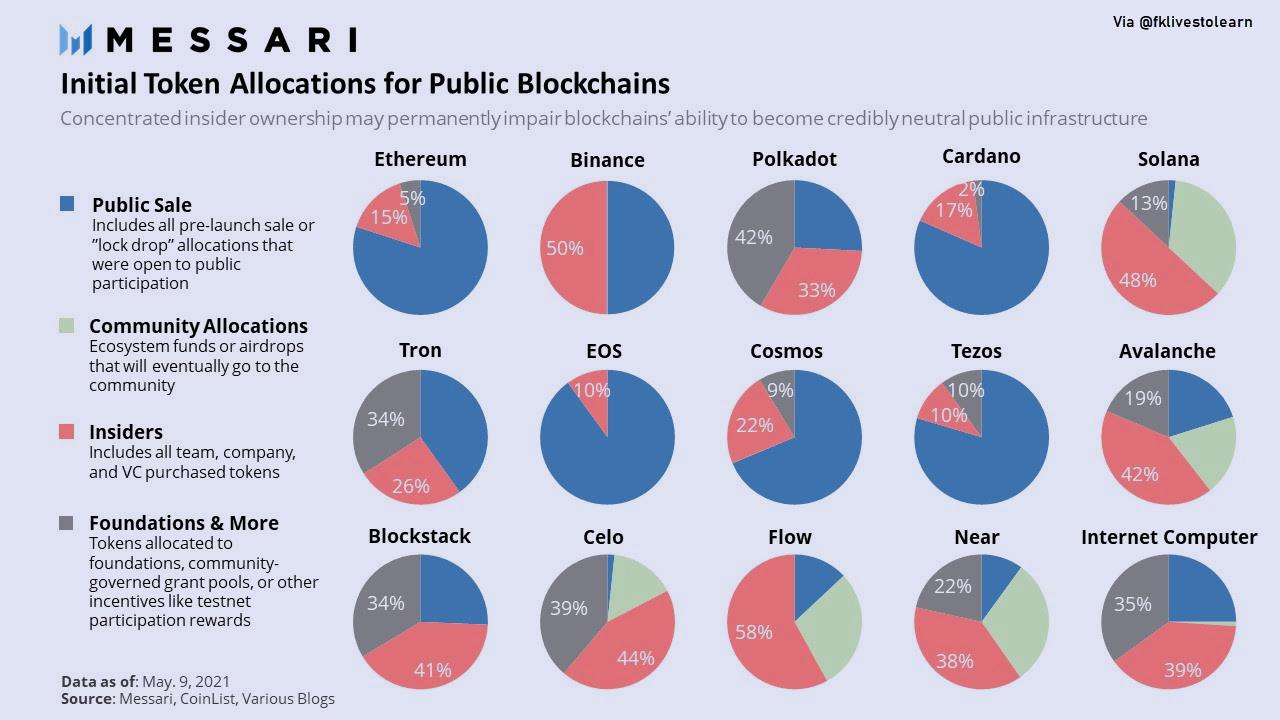
One of the most enticing features of blockchain technology is its decentralized nature. And many of the initial public blockchains have adhered to this functionality — launching the project and eventually how it operates with that key feature in mind. Just like designing a new economic system from scratch, blockchain projects have to tackle the issues of resource allocation to property rights to how this entire system will ultimately be governed and controlled.
This is becoming really important considering some of these blockchains would become an integral part of the public infrastructure that the global economy runs on. Therefore, the blockchain developers have an added responsibility on how to address the key metrics mentioned above. As described in the infographic above, the initial asset allocation is distributed broadly into four categories:
① Public Sale — allocations open to public participation
② Community Allocations — Ecosystem funding going back to the community
③ Insiders — Core team, Investors & the Company
④ Foundations etc. — Community governed grant pools & other rewards like testnet participation rewards
Projects like Ethereum, Cosmos, Tezos, and EOS for example allocated more than 70% of their token supplies to their communities — adhering religiously to the original philosophy of communities funding open-source projects and receiving ownership in return.
Over the years, however, the philosophy seems to have shifted towards a less generous supply of token distribution for the public. This could be attributed to a bunch of factors — the increased presence of venture capitalists who treat blockchains like companies and seek larger ownership allocations, increased regulation, or an erosion of the early egalitarian ideals.
It may just be a combination of these factors. The trend could be seen in some of the more recent entrants into the market like Binance, Solana, Flow, and Avalanche — all of whom where insiders own more than 40% of each projects’ token supply. The allocation is even more extreme when you also consider foundation allocations.
Personally, I also experienced this shift recently, when working for one of the decentralized finance (DeFi) projects, where the “management” drastically reduced token allocations from public sale to accommodating wealthy investors with deep pockets. I guess, some people probably don’t get the philosophy of decentralization.
Originally Published on Medium
Email 📭| Twitter 📜 | LinkedIn 📑| StockTwits 📉 | Telegram 🔗 | Facebook 📘






