
The second largest crypto, Ethereum, is losing ground to the premier digital asset, signaling challenging times for Altcoins.
I use the word “bloodbath” sparingly for financial markets, but perhaps it is the most relevant way to describe what happened out there today. The sell-off on Wall Street intensified as the day progressed on renewed inflation and tariff concerns. Dow lost more than 700 points, while the tech-heavy Nasdaq was the worst performer of all the benchmark indices, dropping 2.70%. And when the risk-off sentiment is this high, cryptos take an even bigger hit.
Before discussing the main theme of the ETH/BTC ratio, let’s analyze how Bitcoin performed today. Bitcoin’s recent bullish retracement has lost momentum after briefly surpassing the 200-day moving average at $85K, leading to a minor rejection. This price action suggests a potential false breakout and a bull trap, highlighting the presence of sellers.
The current retracement appears to be corrective, and if selling pressure intensifies, a drop toward the critical $80K support level could unfold in the short term. However, if unexpected buying pressure emerges, a breakout above this level could trigger a short squeeze, pushing Bitcoin to new highs. Let’s now compare this to what’s happening in the ETH/BTC ratio.
ETH/BTC ratio: Multi-Year Decline
The cryptocurrency market is a fascinating ecosystem, constantly shifting and evolving. Among the many indicators that provide insights into its trends, the ETH/BTC ratio stands out as a key metric. This ratio measures the relative strength of Ethereum (ETH) against Bitcoin (BTC), offering a glimpse into the performance of altcoins compared to the market leader. Recent developments in this ratio have sparked discussions about its implications for the broader crypto market.
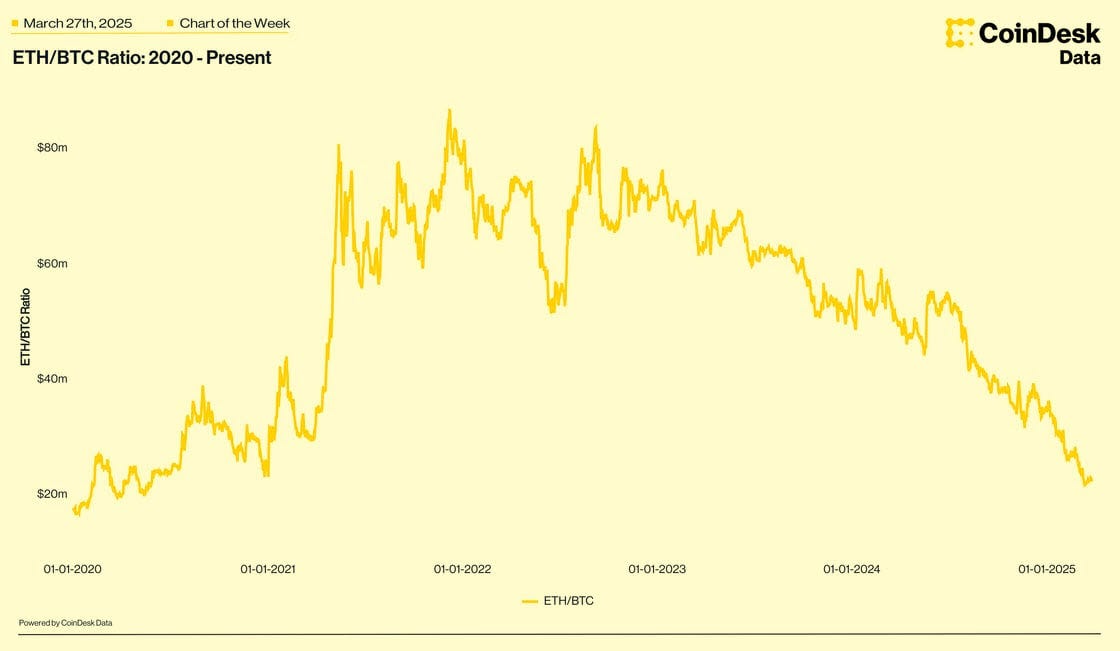
On March 14th, 2025, the ETH/BTC ratio dropped to 0.0227, marking its lowest point since May 2020 (chart below). This decline is significant, as it underscores Ethereum's underperformance relative to Bitcoin in the current cycle. While Bitcoin has maintained a steady price between $80K-$90K, Ethereum is trading below $1900 - a level not seen since November 2023. This prolonged downtrend in the ETH/BTC ratio raises important questions about the state of the crypto market and the factors driving these changes.
Historical Context and Trends
To understand the current state of the ETH/BTC ratio, it's essential to examine its historical trajectory. From 2020 to early 2021, the ratio experienced a steady increase, reflecting Ethereum's growing prominence in the crypto space. This period was marked by the rise of decentralized finance (DeFi) and non-fungible tokens (NFTs), both of which heavily relied on the Ethereum blockchain. The ratio peaked in late 2021, driven by the anticipation of Ethereum 2.0 upgrades and the surge in DeFi activity.
However, the ratio began to decline in 2022, signaling a shift in market sentiment. Bitcoin's status as a store of value and its increasing institutional adoption contributed to its dominance. Meanwhile, Ethereum faced challenges such as network congestion and high transaction fees, which impacted its appeal to users and developers.
Factors Behind the Decline
Several factors have contributed to the recent drop in the ETH/BTC ratio. Bitcoin's stability and recognition as "digital gold" have solidified its position as a preferred asset during uncertain times, with a growing preference for the perceived stability and established track record of Bitcoin over the more speculative and potentially volatile altcoins.
In contrast, Ethereum has faced hurdles that have affected its performance. The transition to Ethereum 2.0, while promising scalability and energy efficiency, has been slower than anticipated. Concerns about network congestion and high fees have deterred some users, prompting them to explore alternative blockchains like Solana and Avalanche. Additionally, macroeconomic factors such as higher interest rates and geopolitical tensions have influenced investor sentiment toward Bitcoin.
Implications for the Crypto Market
The decline in the ETH/BTC ratio has broader implications for the crypto market. As a widely recognized indicator of altcoin strength, its downtrend highlights the challenges faced by Ethereum and other altcoins. Investors seem to have shifted their focus to Bitcoin, perceiving it as a safer and more stable option in the current environment. This could lead to the consolidation of market capitalization towards Bitcoin, potentially squeezing the liquidity and growth prospects of smaller altcoins.
However, it's crucial to acknowledge that the cryptocurrency market is inherently unpredictable. The current trend could be temporary and cyclical, and a resurgence of interest in altcoins is entirely plausible, once the dust settles on the macroeconomic front. Ethereum's ongoing development efforts, including the eventual implementation of Ethereum 2.0, could reignite investor enthusiasm. I favor this narrative.
Looking Ahead
The ETH/BTC ratio serves as a valuable lens through which to view the dynamics of the crypto market. Its recent decline underscores the challenges faced by Ethereum and the growing dominance of Bitcoin. While this trend may shift in the future, it highlights the importance of adaptability and innovation in the ever-changing world of cryptocurrencies. For investors and developers alike, understanding these dynamics is crucial for navigating the complexities of the market.
Originally published on Substack.







