
Rate cuts have historically been good news for digital assets.
The relationship between the Federal Reserve’s monetary policy and Bitcoin’s price movements has become increasingly evident over the past few years. As is the case with most of the risky assets, cryptocurrencies led by Bitcoin have historically benefitted from lower borrowing costs. While many of the central banks have already embarked on easing cycles, the Federal Reserve of the U.S is widely expected to start doing that tomorrow.
In late 2020 and 2021, Bitcoin experienced a historic bull run, culminating in an all-time high of around $70,000 in November 2021. This is illustrated in the chart below. This was when the Federal Reserve introduced massive liquidity into the financial system via an extremely loose monetary policy, which took the interest rates to almost zero. The chart below highlights this move. And then the reverse happened.
Amid rising inflation in 2022, the Fed initiated a series of aggressive rate hikes to rein in consumer prices. Bitcoin, like other risk assets, experienced significant volatility during this period. As borrowing costs increased and liquidity became scarce, Bitcoin’s price corrected sharply - at times dropping below $20,000, from its all-time high.
However, as 2023 unfolded and the Fed began to signal an end to the rate-hike cycle, Bitcoin experienced a more stable environment. After the Fed paused its rate increases, Bitcoin entered a new bull market, with prices rebounding into the $30,000 to $40,000 range. This recovery reflected investor optimism that the Fed’s tightening cycle might be coming to an end, potentially leading to more favorable conditions for speculative assets.
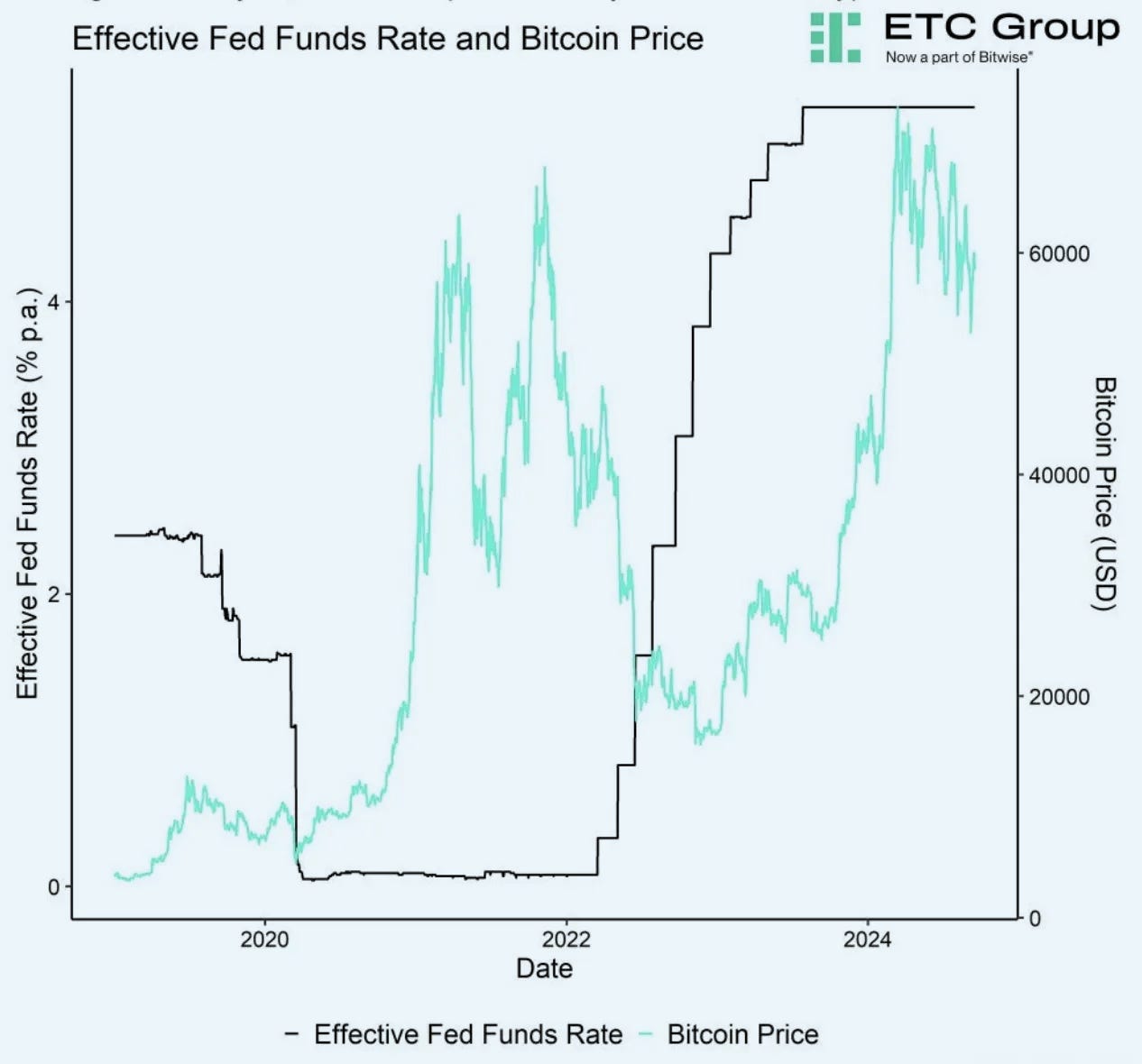
And as 2024 rolled in, the dynamic of cryptocurrencies saw yet another transformation. As a continued sign of mainstream adoption, a number of Bitcoin ETFs were approved by the Securities and Exchange Commission (SEC). This landmark decision coupled with the Fed’s next anticipated move expected to be a rate cut, took Bitcoin to a new all-time high of $73.6k.
Since then, Bitcoin has been in a holding pattern - a kind of bearish consolidation seeing lower highs. Looking at various economic data including inflation, employment & retail sales, etc, investors widely expect the Feds to start lowering interest rates tomorrow. Some are anticipating even a bigger 50 basis points cut. Nevertheless, more liquidity, a weaker dollar, and increased risk appetite could once again propel Bitcoin to new highs.
For now, crypto investors remain cautiously optimistic about the effects of the incoming rate cuts by the Federal Reserve. As Bitcoin continues to mature as an asset class, its sensitivity to interest rate changes highlights its role as a speculative investment influenced by broader economic conditions. Technical indicators also support this narrative as Bitcoin has found strong support around $50k. Whether Bitcoin will find another high remains to be seen, nonetheless, Bitcoin’s fortunes remain closely aligned with the Fed’s rate decisions.
Originally published at http://khanfk.substack.com.






