From Mar-a-Lago to Wall Street, crypto now accounts for more than 20% of the Trump family’s estimated $7.2 billion fortune, signaling a political and financial realignment.
In the gilded ballroom of Mar-a-Lago recently, a striking tableau unfolded: Wall Street executives, crypto entrepreneurs, and government officials convened for a conference hosted by the Trump family’s crypto venture. The symbolism was unmistakable. Digital assets, once dismissed as speculative fringe instruments, have evolved into both a policy priority and a personal profit center in Donald Trump’s second term.
Among the attendees was Goldman Sachs CEO David Solomon, a former skeptic who has since acknowledged holding Bitcoin. Also present was Changpeng Zhao, the billionaire co-founder of Binance, who recently reemerged on the public stage following legal troubles and a high-profile pardon. The convergence of establishment finance and crypto insurgents in one of the most politically charged venues in America underscores a deeper shift: crypto has moved from the margins to the center of financial and political power.
A Rapid Repricing of the Trump Fortune
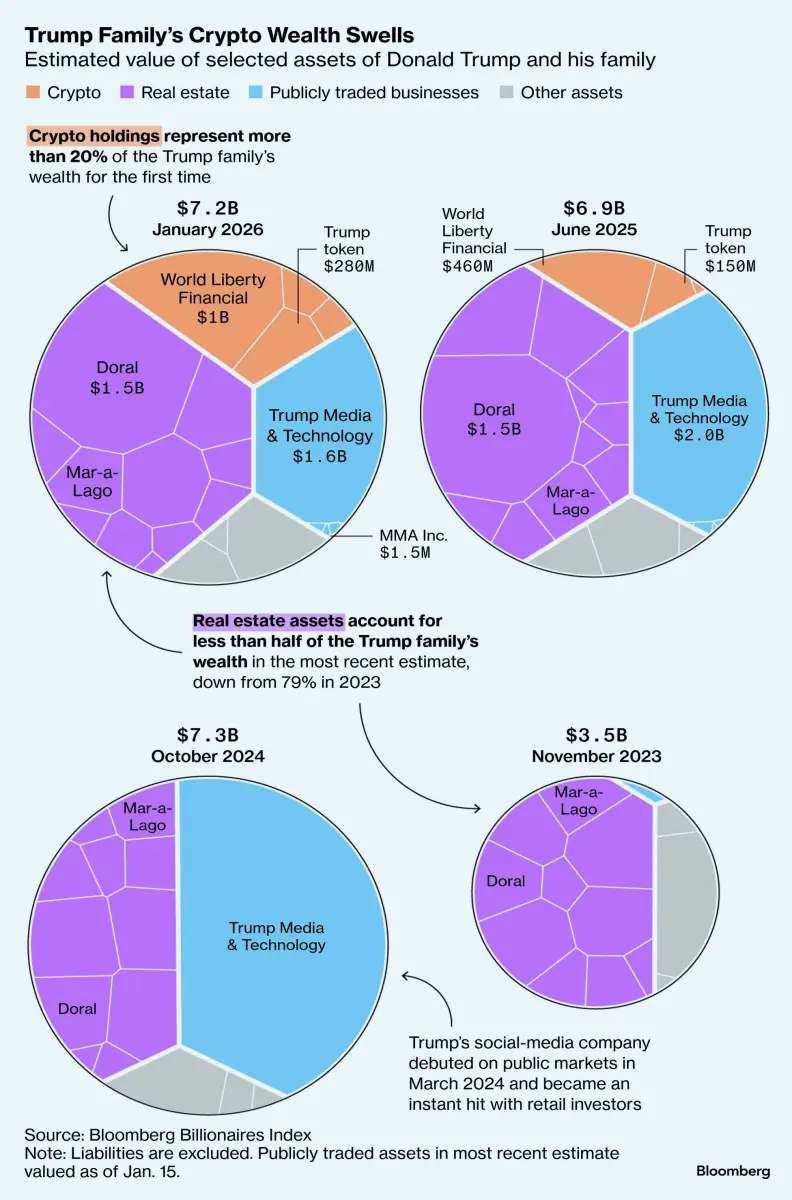
The backdrop to this gathering is a dramatic transformation in the composition of the Trump family’s wealth. According to the Bloomberg Billionaires Index, crypto holdings now represent more than 20 percent of the family’s net worth for the first time. In November 2023, the Trump family’s estimated wealth stood at $3.5 billion, with real estate assets such as Mar-a-Lago and Doral comprising the overwhelming majority. By October 2024, net worth had surged to $7.3 billion, propelled largely by the public debut of Trump Media and Technology Group, which became an instant retail investor phenomenon after listing in March 2024.
The most recent estimate, from January 2026, places the family’s net worth at $7.2 billion. Within that figure, crypto exposure has grown markedly. World Liberty Financial, the Trump family’s crypto platform, is valued at approximately $1 billion. Additionally, a Trump-branded token is estimated at $280 million. By contrast, in June 2025, World Liberty Financial was valued at $460 million, and the token at $150 million. The trajectory is unmistakable: crypto is no longer peripheral to the Trump portfolio.
Notably, real estate now accounts for less than half of the family’s wealth, down from 79 percent in 2023. This rebalancing represents a structural pivot from bricks-and-mortar to digital ledgers.
From Policy Debate to Profit Center
The Mar-a-Lago conference highlights a delicate convergence of interests. As president, Trump has signaled a more favorable regulatory posture toward digital assets, positioning the United States as a potential hub for crypto innovation. At the same time, the Trump family’s direct financial exposure to the sector creates an unprecedented overlap between public policy and private gain. For Wall Street leaders, the calculus is pragmatic. Institutional adoption of crypto has accelerated, with spot Bitcoin exchange-traded funds gaining approval and attracting billions in inflows.
Major banks are exploring tokenization of assets, stablecoin infrastructure, and blockchain-based settlement systems. In this context, Solomon’s presence was less an ideological conversion than a strategic alignment. For crypto entrepreneurs such as Zhao, the event represents normalization. Once viewed as regulatory adversaries, crypto executives now find themselves in dialogue with policymakers at the highest levels. The optics suggest a new détente between Washington and the digital asset industry.
The Political Economy of Digital Assets
The implications extend beyond a single conference. When political power brokers, Wall Street executives, and crypto magnates gather under one roof, the lines between regulation, innovation, and influence blur. Digital assets are no longer a niche investment class; they are an arena where economic policy, market speculation, and personal wealth intersect.
Critics argue that such convergence raises conflict-of-interest concerns, particularly when policy decisions could materially affect the value of family-linked crypto ventures. Supporters counter that fostering a pro-innovation environment is consistent with broader economic goals, and that personal investment signals conviction in the technology’s future.
What is clear is that crypto’s institutionalization is accelerating. From Goldman’s trading desks to Mar-a-Lago’s ballroom, the industry’s integration into mainstream finance and political life appears well underway. The scene at Mar-a-Lago was not merely a conference. It was a signal: digital assets have become embedded in America’s financial architecture and political strategy. Whether this fusion ultimately strengthens markets or complicates governance will shape the next chapter of the crypto era.