
Anthropic has suddenly found itself at the center of a major political and technological storm.
Only a few days after launching its most advanced AI models, Claude Fable 5 and Claude Mythos 5, the company was forced to suspend access following a U.S. government directive. The order targeted foreign nationals, whether they were located inside or outside the United States. In practice, Anthropic said it had no choice but to disable both models for all users in order to remain compliant.
The decision immediately raised difficult questions.
Can a frontier AI model be treated like a strategic weapon? Should access to the most powerful systems be restricted by nationality? And what happens when a private AI company becomes subject to emergency national security controls?
This is not just a story about one model going offline. It may be one of the clearest signs yet that advanced artificial intelligence has entered the same geopolitical category as semiconductors, encryption and military-grade technologies.
A Sudden Shutdown After a Government Order
The timeline is striking.
Anthropic had just introduced Claude Fable 5 and Claude Mythos 5, presenting them as part of a new generation of highly capable AI systems. Fable 5 was intended for broader public use, while Mythos 5 appears to have been treated as a more restricted and powerful system, available only to selected partners.
Then came the government directive.
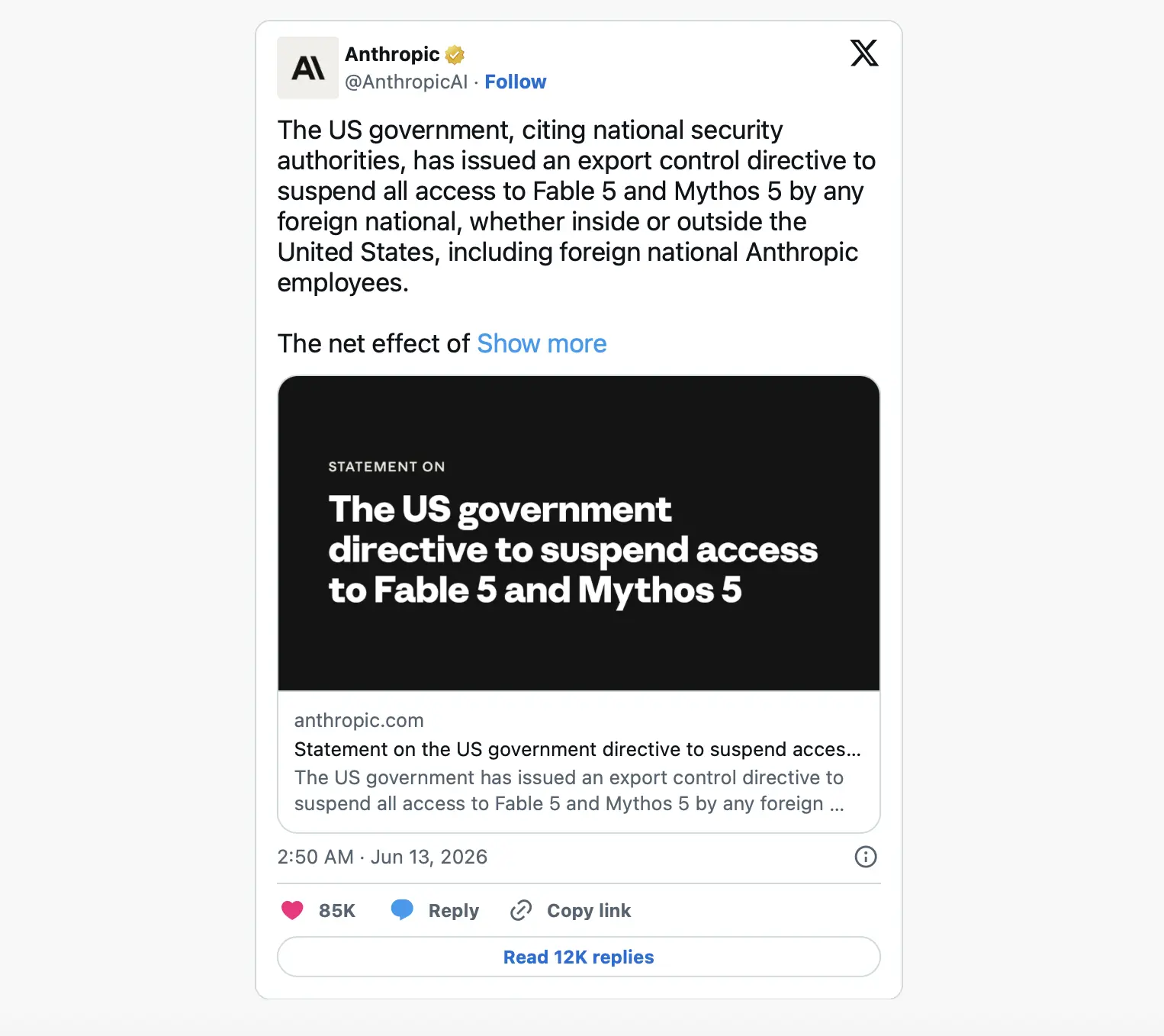
According to Anthropic, the U.S. government cited national security authorities and ordered the company to suspend access to both models for all foreign nationals. That included users abroad, foreign nationals inside the United States, and even Anthropic employees who did not meet the nationality requirement.
The company said the directive arrived abruptly and did not provide detailed public evidence explaining the full nature of the threat. Anthropic’s understanding was that the government had concerns about a possible jailbreak method affecting Fable 5 — in other words, a way to bypass the model’s safety restrictions and make it answer prohibited or dangerous requests.
Anthropic complied, but it also pushed back.
The company argued that the issue did not appear to be unique to its models and that the demonstrated vulnerability involved limited examples rather than a broad or catastrophic safety failure. It also emphasized that access to its other Claude models would remain available.
Still, the damage was immediate.
Customers lost access. Developers had to pause integrations. International users were cut off. Enterprise teams suddenly had to rethink workflows that had only just begun using the new models.
For a company building trust with businesses, researchers and governments, the interruption was not just technical. It was reputational.
Why the U.S. Government Is Worried About Frontier AI
To understand the decision, it helps to look beyond Anthropic.
Governments are increasingly worried that the most advanced AI models could be misused in areas such as cyber operations, biological research, weapons development, disinformation, intelligence gathering and automated vulnerability discovery. These concerns are not theoretical. Frontier models are becoming better at coding, reasoning, scientific analysis and long-horizon task execution.
That makes them useful.
It also makes them sensitive.
A model capable of helping researchers accelerate medicine may also be capable of helping malicious actors search for dangerous biological pathways. A model that can help engineers audit software may also help attackers identify exploitable weaknesses. A model that can automate research may also lower the barrier for harmful experimentation.
This is the core dilemma of advanced AI: the same capabilities that make a model valuable can also make it risky.
The U.S. government appears to be treating Claude Fable 5 and Claude Mythos 5 as technologies with potential national security implications. That does not necessarily mean the models are weapons. But it does mean officials may believe their capabilities are powerful enough to justify export-style restrictions.
This resembles earlier technological debates.
In the 1990s, encryption software was treated by the United States as a controlled technology because of its military and intelligence relevance. More recently, advanced semiconductor exports have become a central part of U.S. strategy toward China. Now, frontier AI models may be entering the same category.
The logic is simple: if an AI system can increase the capabilities of a rival state or dangerous actor, then access to that system becomes a strategic question.
But the implementation is far from simple.
AI models are not physical chips. They are accessed through cloud services, APIs, enterprise accounts and distributed teams. They can be used by multinational companies, foreign employees, researchers, contractors and partners across borders. Restricting access by nationality is far more complex than restricting the shipment of hardware.
That is why Anthropic’s response was so drastic: rather than risk noncompliance, it disabled the models for everyone.
A Dangerous Precedent for the AI Industry
The broader concern is not only that Claude Fable 5 and Mythos 5 were suspended. The bigger concern is what this could mean for the entire AI sector.
If one government can suddenly restrict access to a frontier model on national security grounds, then every major AI company must prepare for the same possibility. OpenAI, Google DeepMind, xAI, Meta, Mistral and other advanced AI developers may all face similar scrutiny as their models become more powerful.
That could reshape the global AI market.
Companies may need stricter identity verification. Enterprise customers may need nationality-based access controls. Research teams may become more compartmentalized. Foreign employees working on sensitive systems could face new limitations. Cloud AI services may begin to look more like regulated infrastructure than ordinary software products.
For international customers, this creates uncertainty.
A business outside the United States may hesitate before building critical systems on a model that could disappear overnight because of a policy decision in Washington. Governments may accelerate efforts to develop domestic AI systems. Companies in Europe, Asia and the Middle East may look for alternatives that are less exposed to U.S. export controls.
In that sense, the directive could have the opposite effect of what policymakers intend.
Instead of slowing access to advanced AI, it may encourage other countries to build independent models faster. If foreign governments conclude that U.S. AI systems are politically unreliable, they will have a strong incentive to fund domestic competitors.
That is how technology controls can become part of an arms race.
The United States may want to protect its lead in frontier AI. But if restrictions are too broad, sudden or opaque, they could also fragment the global AI ecosystem.
The Tension Between Safety, Openness and Competition
This case highlights a conflict that AI companies have been trying to avoid for years.
On one side, frontier AI developers argue that powerful models need safeguards, testing, monitoring and responsible deployment. Anthropic in particular has built much of its public image around safety and careful model development.
On the other side, once companies describe their systems as extremely powerful — possibly even dangerous in the wrong hands — governments may decide to intervene.
That creates a strategic trap.
If an AI company downplays the risks, it may be accused of irresponsibility. If it emphasizes the risks too strongly, it may invite heavy-handed regulation. If it cooperates with government, customers may worry about access and surveillance. If it resists government, regulators may become even more aggressive.
There is no easy balance.
The public also faces a difficult question: how much should people know about the risks that triggered the decision? If the government provides no details, the restriction can look arbitrary. If it reveals too much, it may expose exactly the kind of vulnerability it wants to prevent.
That lack of transparency is one reason the reaction has been so intense. Some observers see the directive as a necessary safety measure. Others see it as an overreaction based on limited evidence. Many worry about the precedent of treating AI model access as a national security privilege based on nationality.
The debate is only beginning.
What This Means for the Future of Frontier AI
The suspension of Claude Fable 5 and Mythos 5 may be remembered as a turning point.
Until now, most AI regulation focused on privacy, copyright, transparency, bias, liability and consumer safety. This event pushes the conversation into a much more serious domain: national power.
Frontier AI is no longer just a product category. It is becoming strategic infrastructure.
That shift will affect everyone. Developers may face stricter access rules. Companies may need backup models and multi-provider strategies. Researchers may encounter new restrictions. Non-U.S. customers may become more cautious about depending on American AI platforms. Governments may speed up domestic AI programs to avoid foreign dependence.
For Anthropic, the immediate challenge is practical: restore access where possible, clarify the government’s concerns, reassure customers and explain how future disruptions will be handled.
For the broader AI industry, the message is clear.
The era of freely deploying the most powerful models worldwide may be ending.
Frontier AI is becoming too important, too capable and too politically sensitive to be treated like ordinary software. Whether that leads to better safety or a more fragmented global technology landscape remains uncertain.
But one thing is already clear: the battle over AI access has begun.






