
New data reveals how political alliances and public disputes triggered Tesla’s most dramatic stock swings.
Over the past decade and a half, few corporate narratives have been as intertwined with a single individual as Elon Musk and Tesla. Unlike traditional CEOs, Musk’s public persona does not merely complement Tesla’s brand; it actively drives its valuation, investor sentiment, and market volatility. New analysis from NeoMam Labs illustrates just how profound this “Musk Effect” has been, particularly in the context of his complex relationship with Donald Trump.
The findings reveal a striking reality: Tesla’s market capitalization has repeatedly surged and plunged in direct response to Musk’s statements, alliances, and controversies. Nowhere is this more evident than in the dramatic events of 2025.
A Timeline of Influence and Volatility
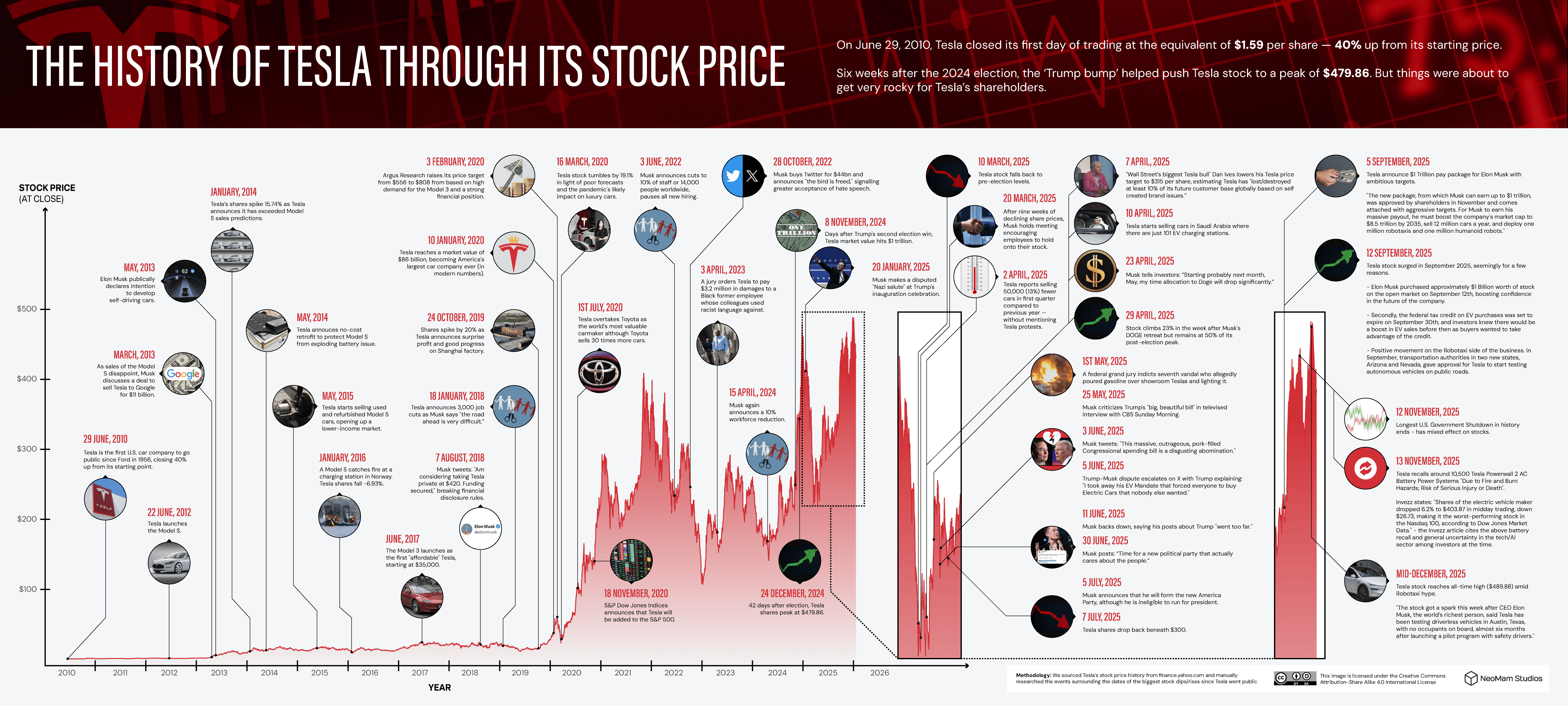
The NeoMam Labs dataset traces Tesla’s evolution from a niche electric vehicle startup into a trillion-dollar giant. Early milestones highlight how Musk’s public declarations fueled investor optimism. In May 2013, his confident push toward mass-market electric vehicles helped catalyze a surge in Tesla’s valuation. By January 2020, Tesla had crossed $80 billion, briefly becoming America’s most valuable automaker.
The trajectory continued upward, culminating in a record-breaking $1.5 trillion valuation shortly after the 2024 U.S. presidential election. This peak reflected not only strong fundamentals but also market enthusiasm tied to Musk’s growing political influence and perceived alignment with a pro-business administration. However, the same forces that propelled Tesla upward also introduced unprecedented fragility.
The Musk–Trump Dynamic: From Alignment to Fallout
Musk’s relationship with U.S President Donald Trump has been marked by phases of cooperation and conflict. At times, Musk benefited from government incentives, regulatory support, and access to policymaking circles. His role as a de facto advisor within the current U.S administration signaled to markets that Tesla might enjoy favorable conditions, from subsidies to infrastructure expansion.
Yet this proximity to power came with reputational risk. Investors began pricing in not just Tesla’s technological prospects, but also the unpredictability of Musk’s political engagements. The turning point arrived in June 2025, when a highly publicized social media dispute between Musk and Trump triggered immediate market consequences.
According to NeoMam Labs, Tesla lost $152 billion in market value overnight following the fallout. Musk himself saw his personal wealth decline by $8.73 billion in a single day. This episode underscored a critical insight: when a company’s identity is tightly coupled with its leader, personal conflicts can translate directly into financial losses.
The Larger Collapse: A $770 Billion Reckoning
While the June 2025 incident was dramatic, it pales in comparison to the broader market correction that followed. Within weeks of reaching its $1.5 trillion peak, Tesla’s valuation plummeted by approximately $770 billion. This decline cannot be attributed to a single event. Rather, it reflects a convergence of factors: political uncertainty, shifting investor sentiment, and growing skepticism about the sustainability of Tesla’s valuation.
Musk’s visible alignment with the Trump campaign and subsequent involvement in the administration introduced polarization into Tesla’s brand, potentially alienating segments of its customer base. The NeoMam Labs analysis also points to an often-overlooked dimension: the used car market. Tesla’s resale values showed sensitivity to Musk’s public image, suggesting that consumer perception of the brand is influenced not only by product quality but also by executive behavior.
The Broader Implications for Markets and Society
Tesla’s volatility under Musk raises broader questions about corporate governance in the age of personality-driven capitalism. Traditionally, companies are evaluated based on earnings, innovation, and competitive positioning. However, Tesla represents a paradigm shift, where executive conduct and political affiliations can materially affect shareholder value.
For investors, this introduces a new layer of risk. The “key man risk” associated with Musk is amplified by his outsized media presence and willingness to engage in public disputes. For policymakers, the situation highlights the complexities of corporate leaders wielding influence within government structures while simultaneously running publicly traded companies.
Most importantly, the ripple effects extend beyond Wall Street. Pension funds, retail investors, and even consumers are indirectly exposed to these fluctuations. As NeoMam Labs notes, every American has a stake in Tesla’s performance, whether through investments, employment, or participation in the broader economy.
Innovation Meets Instability
The Musk Effect is both a testament to visionary leadership and a cautionary tale about the concentration of influence. Elon Musk has undeniably transformed Tesla into a global powerhouse, redefining the automotive and energy sectors. Yet the same traits that drive innovation—boldness, unpredictability, and a willingness to challenge norms—also introduce systemic volatility.
The events of 2025 serve as a stark reminder that in today’s interconnected landscape, the line between personal behavior and corporate performance has all but disappeared. For Tesla, the road ahead will depend not only on technological breakthroughs but also on whether it can decouple its market value from the turbulence of its most prominent figure.
Originally published at https://khanfk.substack.com.






