
Nvidia and OpenAI dominate a trillion-dollar AI boom—powering startups, cloud deals, and a global investment frenzy that shows no signs of slowing.
In the span of just two years, Artificial Intelligence (AI) has gone from experimental promise to the most expensive technological race in history. The latest example comes from Germany, where N8n, an automation startup backed by Nvidia, has raised $180 million at a $2.5 billion valuation. It’s an impressive feat for a company that few outside the developer community had heard of just a year ago.
Yet, N8n’s meteoric rise is hardly an anomaly; it’s part of a broader pattern in which venture capital, cloud infrastructure, and semiconductor muscle converge to feed the world’s insatiable hunger for AI. According to Bloomberg, N8n’s funding round exemplifies the gravitational pull of Nvidia’s influence.
Every new investment, whether in foundational AI startups, automation tools, or AI-driven applications, seems to trace its roots back to a familiar duo: Nvidia and OpenAI. Together, these two companies have become the twin engines of what Bloomberg aptly calls the AI money machine.
The Billion-Dollar Loop Between Nvidia and OpenAI
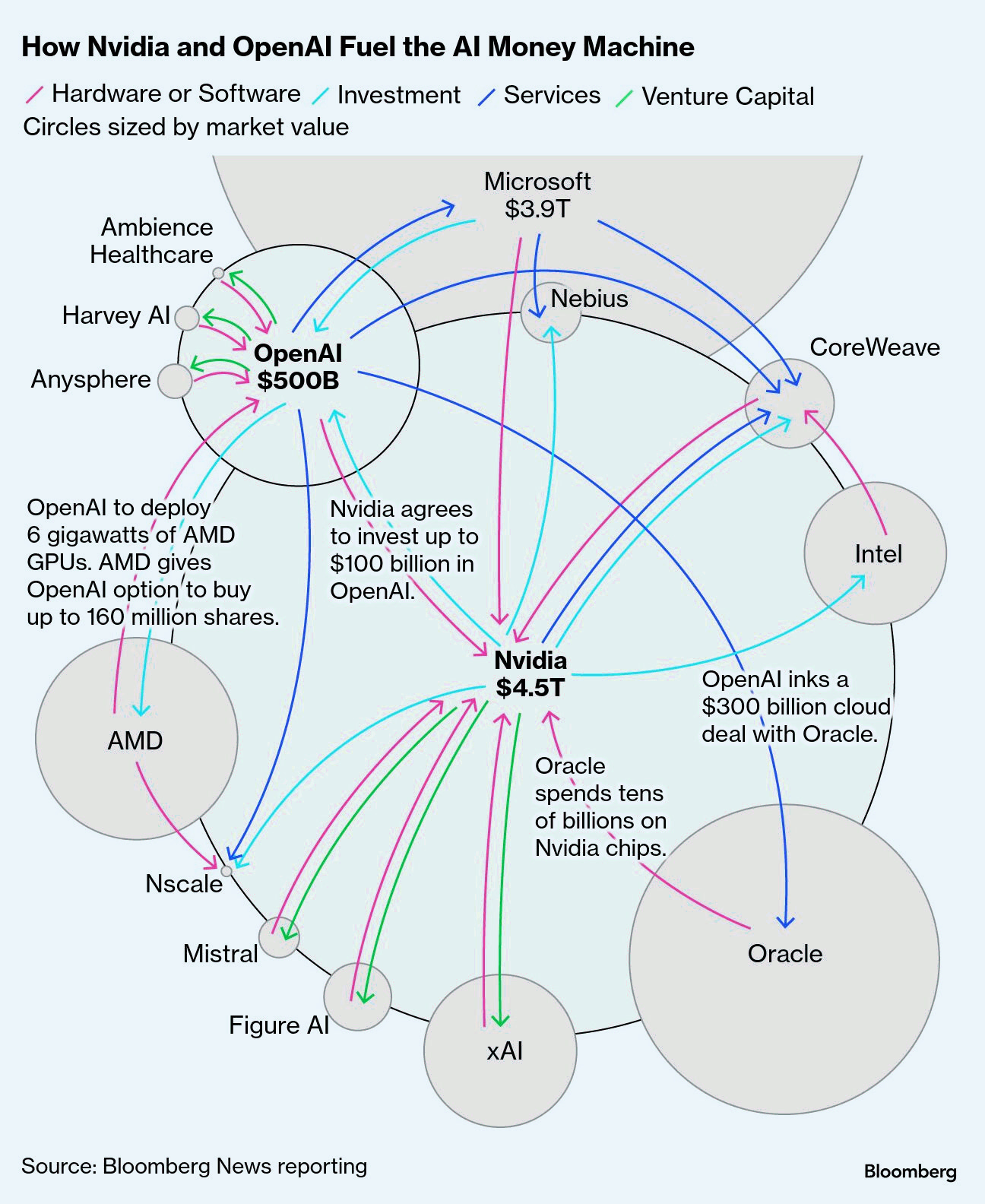
At the center of this machine sits Nvidia, now valued at an astonishing $4.5 trillion, and OpenAI, reportedly valued at $500 billion after its latest financing rounds. The Bloomberg chart (below) visualizing this ecosystem reveals a complex web of dependencies, investments, and circular cash flows connecting some of the world’s biggest tech players.
Nvidia, once known primarily for gaming GPUs, has become the indispensable supplier of computational power for modern AI. Its high-end chips, like the H100 and B200, are the lifeblood of large language models and AI data centers. But Nvidia is more than just a chipmaker; it’s now an investor, ecosystem builder, and strategic orchestrator. As the infographic shows, Nvidia has agreed to invest up to $100 billion in OpenAI, cementing a deep financial alliance.
Meanwhile, Oracle, Microsoft, and AMD form other key nodes in this feedback loop. Oracle spends “tens of billions” on Nvidia chips while simultaneously signing a $300 billion cloud services deal with OpenAI. Microsoft, worth nearly $3.9 trillion market cap, has built much of its AI stack, including Copilot and Azure AI, on top of OpenAI’s models, which themselves run on Nvidia’s hardware.
The result is a self-reinforcing economic cycle:
-
Nvidia sells GPUs to companies like Microsoft, Oracle, and CoreWeave.
-
Those companies provide compute capacity to OpenAI.
-
OpenAI, in turn, drives demand for more GPUs to train ever-larger models.
-
Nvidia profits and reinvests in startups, like N8n, that will generate even more AI-driven workloads.
This cycle has turned AI infrastructure into one of the most lucrative and crowded investment frontiers in modern history.
A Flood of Capital into an Unproven Market
Never before has so much money been spent so rapidly on a technology that remains, in many respects, unproven as a profit engine. While AI breakthroughs have dazzled the public and transformed industries from media to healthcare, monetization remains uneven. Most companies experimenting with AI tools are still searching for sustainable revenue models.
And yet, capital keeps pouring in. Venture funding for AI startups surpassed $70 billion in 2024, according to PitchBook data, with Nvidia-backed companies capturing an outsized share. The logic is simple but risky; whoever controls AI compute and foundational models could dominate the next industrial revolution. But the gold rush mentality has also inflated valuations to speculative levels.
Take N8n’s case. The Berlin-based company builds low-code automation tools that integrate AI workflows across platforms. It’s a valuable utility, but a $2.5 billion valuation for a startup with limited revenue underscores how inflated expectations have become. Investors are betting less on immediate returns and more on the potential to become indispensable in an AI-saturated economy.
The Power Brokers: Nvidia and OpenAI’s Expanding Reach
The chart above also highlights how Nvidia and OpenAI’s influence now extends across nearly every layer of the AI stack, from chips and data centers to software platforms and venture capital. Nvidia’s dominance is both technological and financial. By backing startups like xAI, Mistral, Figure AI, and CoreWeave, Nvidia ensures that its chips remain at the heart of every AI innovation.
Even AMD, traditionally its fiercest rival, is collaborating with OpenAI to deploy 6 gigawatts of GPU capacity while granting OpenAI an option to purchase up to 160 million AMD shares. On the software and services front, OpenAI’s partnerships with Microsoft, Oracle, and startups like Harvey AI and Ambience Healthcare extend its reach far beyond ChatGPT.
These collaborations create a lattice of dependencies where OpenAI’s models fuel productivity tools, cloud services, and enterprise automation—all of which require more Nvidia chips. In essence, every dollar spent on AI software eventually finds its way back to Nvidia’s silicon.
The Fragility Beneath the Frenzy
Yet beneath this financial symbiosis lies a fragile foundation. The current AI boom is heavily concentrated among a few players, creating systemic dependencies that could prove dangerous. A disruption in chip supply, regulatory backlash against data usage, or a slowdown in enterprise adoption could send shockwaves through this tightly knit ecosystem.
Moreover, AI’s profitability problem persists. Most startups in the space are running at significant losses, and even the giants, OpenAI included, rely on massive infrastructure subsidies from partners like Microsoft and Oracle. The hope is that as AI models become more capable and efficient, monetization will catch up. But for now, the industry runs on speculative momentum and a belief that scale alone will yield dominance.
What Comes Next: From Frenzy to Foundation
The rise of N8n marks more than a headline in the AI funding frenzy; it reflects how deeply Nvidia’s capital has permeated every layer of the AI landscape. Whether it’s chip manufacturing, model development, or workflow automation, Nvidia and OpenAI sit at the nexus of this trillion-dollar experiment.
But as the sector matures, the AI money machine may need to shift from expansion to justification. Investors will eventually demand clear revenue streams, operational efficiency, and real-world impact. The coming years will determine whether this ecosystem evolves into a sustainable digital economy or becomes the next speculative bubble in tech history.
Still, one thing is certain: the AI revolution, for all its risks, is no longer confined to the labs of Silicon Valley. It’s a global economic force, and companies like N8n, fueled by Nvidia’s capital and OpenAI’s innovation, are its newest accelerants.
Originally Published on Substack.






