
Nvidia and Microsoft are racing to $4 trillion. But this isn’t just about who gets there first — it’s about who defines the AI economy.
There is no racetrack on Earth quite like Wall Street, and no competitors quite like Nvidia and Microsoft currently. Forget Formula 1 — the real high-speed, high-stakes race is playing out in market capitalizations, semiconductor shipments, hyperscaler deals, and artificial intelligence dominance. At the heart of it all is a trillion-dollar tango that has transformed into a $4 trillion sprint.
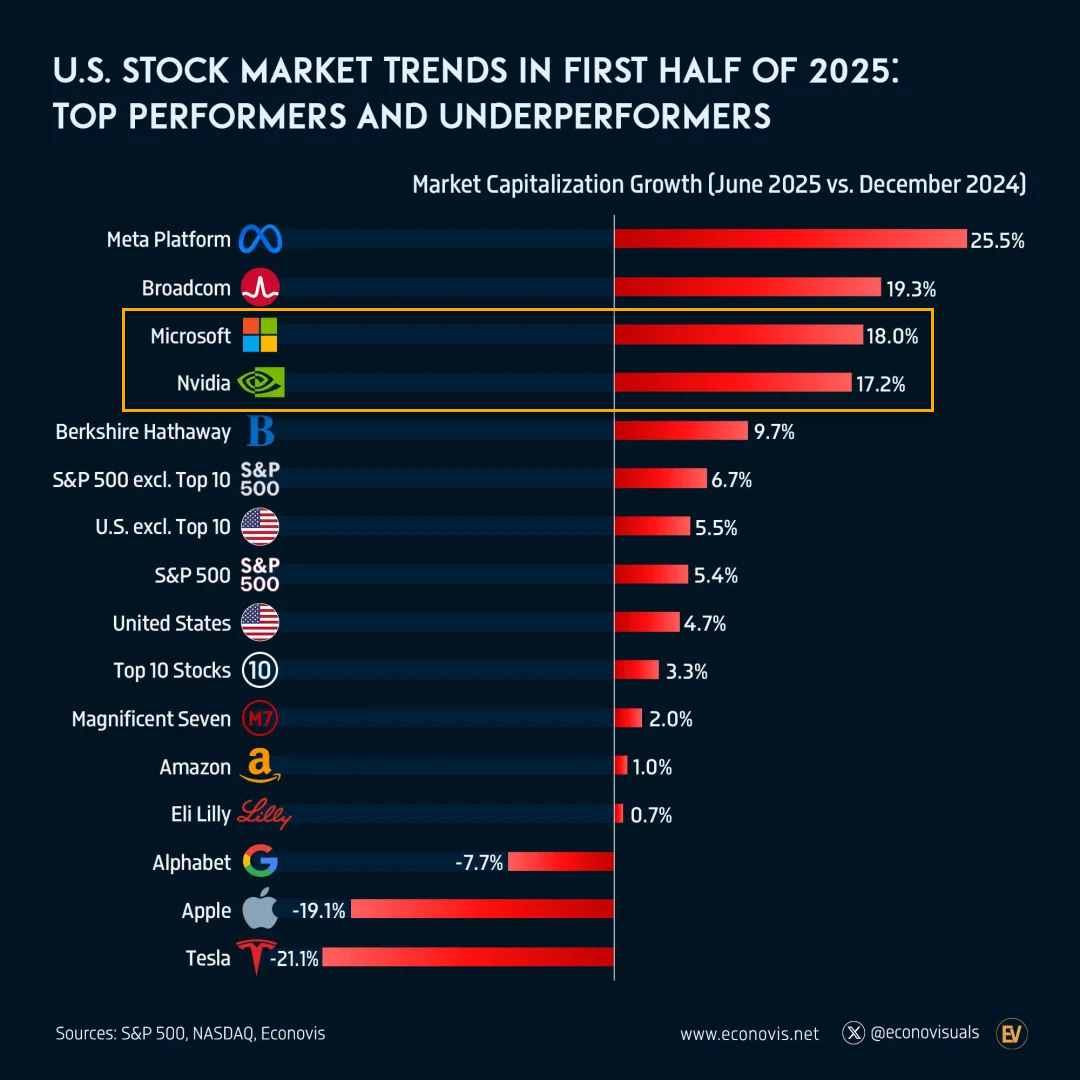
The two protagonists? Microsoft, the AI software titan embedding Copilot AI into every productivity suite, and Nvidia, the undisputed king of silicon, whose GPUs are the beating heart of the generative AI revolution. Earlier this June, Nvidia briefly overtook Microsoft to become the world’s most valuable public company. The moment was symbolic — a hardware company built on powering dreams of AI momentarily surpassing the cloud-software Goliath that has arguably done more than any other firm to commercialize and scale those dreams.
But the baton didn’t stay long in Nvidia’s hands. Microsoft surged back, only to give it back again, underscoring the volatile, high-speed nature of this trillion-dollar dance. At the end of the day today, the market cap of Nvidia and Microsoft stood at 3.83 trillion and 3.65 trillion, respectively.
The Contenders: Silicon vs. Software
In one corner is Nvidia, the silicon savant whose GPUs — particularly the H100s and the upcoming Blackwell chips — are the foundation upon which the AI gold rush is being built. Nvidia’s hardware powers OpenAI, Google DeepMind, Meta, Amazon, and practically every serious contender in the AI arms race.
According to estimates by Bernstein Research, Nvidia commands more than 80% of the AI chip market — a monopoly by modern tech standards. And it’s not just about GPUs. For every dollar spent on Nvidia chips, $8–$10 is spent downstream in services, software, cloud computing, and model training — effectively positioning Nvidia as the central gear in AI’s economic flywheel.
In the other corner is Microsoft, the software sovereign that has leveraged its early $13 billion bet on OpenAI into an all-encompassing Copilot strategy. Azure, its cloud platform, has become the AI backbone for enterprises. From Teams to Excel, GitHub to Outlook, Microsoft is infusing generative AI into every product.
This is not just a race between companies — it's a referendum on where the value in AI truly resides. Is it in the rare and powerful chips that enable model training and inference? Or is it in the software ecosystems that deliver AI’s power to end users?
Why This Race Matters?
This isn't just investor theater. The implications are macro-economically existential.
Whichever company pulls ahead first will signal to markets, policymakers, and the broader tech world where the future of AI lies. Nvidia’s dominance would reinforce the idea that the bottleneck — and therefore the value — lies in compute. Microsoft’s victory would emphasize the platform play, reinforcing that it’s not enough to build intelligence; you have to deliver and scale it.
Meanwhile, hyperscalers like Amazon and Google are racing to build or rent more Nvidia chips, exacerbating the demand crunch. The scarcity of GPUs — especially H100s and Blackwells — has become a central constraint on AI growth, giving Nvidia a pricing and negotiating advantage that’s almost unprecedented in tech history.
And let’s not forget geopolitics. U.S. restrictions on chip exports to China, growing scrutiny of AI’s role in labor markets, and energy concerns about massive data centers all add layers of complexity. A missed earnings report, a regulatory hiccup, or a delayed product release could swing the race in either direction.
The $300 Billion Coin Flip
Jensen Huang and Satya Nadella, the respective CEOs of Nvidia and Microsoft, are not just business leaders — they are now macro influencers. Each company’s trajectory is deeply intertwined with how the world adopts AI. It’s not hyperbole to say that a single decision from either man can create or destroy hundreds of billions in shareholder value overnight.
The irony? Despite the rivalry, they are inextricably linked. Microsoft is one of Nvidia’s biggest customers. Nvidia’s chips power Microsoft’s Azure AI workloads. Both benefit from the hype, the usage, and the monetization of AI. In some sense, this race is less about who wins and more about how both continue to shape the new digital economy.
The Road Ahead: 4 Trillion and Beyond
Will both companies hit $4 trillion during the summer? Possibly. Some analysts believe this rally still has legs, especially with a new wave of enterprise AI spending forecast for Q3 and Q4. Retail investor FOMO is surging again. ETFs are overweighting big tech. Hedge funds are piling into “Magnificent Seven” stocks. The stars are aligned — for now.
But history reminds us that no valuation is guaranteed. Microsoft stumbled in the dot-com bust. Nvidia faced collapse in the 2018 crypto winter. Black swan events, regulation, or simple investor fatigue could shift sentiment. What’s different now is the depth of structural demand. AI is not just a feature — it’s becoming the foundation of how software and hardware alike will be built, deployed, and monetized in the 2020s.
Who Wins, and What Does It Mean?
This race to $4 trillion is more than a financial spectacle. It’s a symbolic battle for the soul of AI. If Nvidia wins, it cements silicon as king. If Microsoft pulls ahead, the crown may go to cloud and software. But ultimately, both are rewriting the rules of business, value creation, and innovation. And the rest of the market? It’s either trying to keep up or get out of the way. The most expensive race on Earth isn't about speed. It’s about scale, leverage, and the power to shape the next decade of human-machine collaboration. So, who will win?
The answer may not matter, because in this rare case, the race itself is the real story.
Originally Published on Substack.






