
Prediction markets are booming, but Kalshi’s regulatory-first strategy is overtaking Polymarket in the race for US dominance.
Prediction markets are digital trading platforms where participants buy and sell contracts tied to the outcomes of future events, with prices reflecting the collective probability of those outcomes occurring. In essence, they transform uncertainty into a tradable asset: a contract priced at 60 cents implies a 60% perceived likelihood of an event happening.
Unlike traditional betting, these markets aggregate dispersed information from a wide range of participants, often producing forecasts that rival or exceed expert predictions. Platforms such as Polymarket and Kalshi have brought this model into the mainstream, enabling users to speculate on everything from elections and economic policy to sports and cultural events, while increasingly attracting attention from institutional investors and regulators alike.
What began as a niche experiment in collective forecasting has matured into a multi-billion-dollar ecosystem, where probabilities are traded as assets, and market sentiment often rivals traditional analysis. At the center of this transformation is now an intensifying rivalry between Polymarket and Kalshi. Once the undisputed leader, Polymarket is now losing momentum, while Kalshi is capitalizing on a fundamentally different strategy, one rooted in regulatory alignment and institutional integration.
The Data Signals a Structural Shift
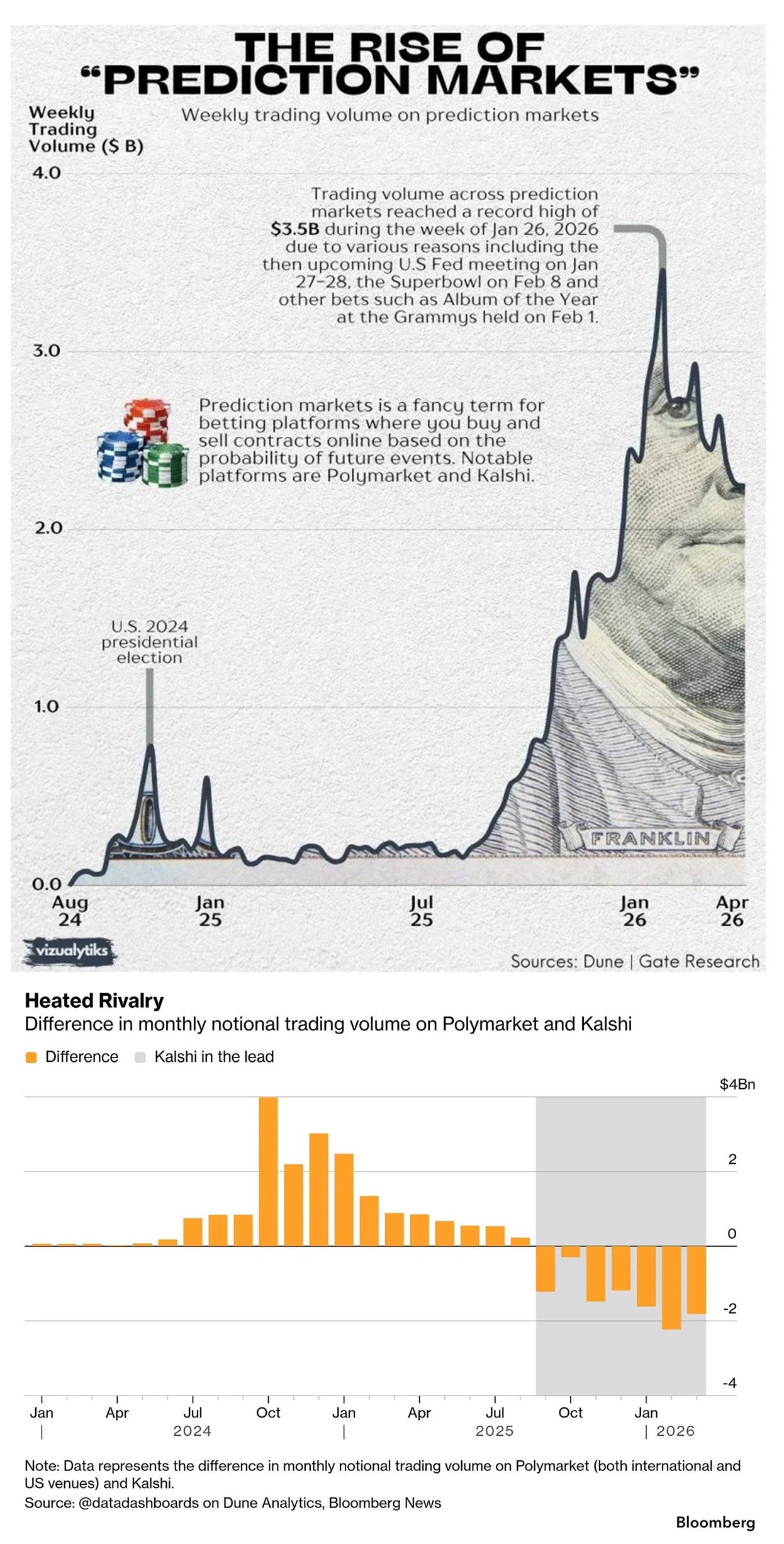
Recent market data underscores the scale and speed of change. Weekly trading volumes across prediction platforms surged to a record $3.5 billion during the week of January 26, 2026 (chart below), driven by a convergence of high-stakes events, including a Federal Reserve meeting, the Super Bowl, and the Grammy Awards.
This spike is not an anomaly but part of a broader acceleration. After relatively subdued activity through 2024 and early 2025, volumes began climbing sharply in late 2025, culminating in a steep upward trajectory entering 2026. The implication is clear: prediction markets are moving from the periphery toward the financial mainstream.
Yet beneath this growth lies a decisive competitive realignment. Monthly notional trading data shows Polymarket leading comfortably through much of 2024. By late 2025, however, that lead had eroded, and by early 2026, Kalshi had overtaken it (second chart below), establishing a widening advantage.
Two Models, Two Philosophies
The divergence between these platforms is not merely operational; it is philosophical. Polymarket built its early dominance on openness. It offered a wide array of global event contracts with relatively few barriers to entry, attracting a diverse and international user base.
Its willingness to operate at the edge of regulatory frameworks allowed it to scale rapidly and capture early liquidity. Kalshi, by contrast, pursued legitimacy from the outset. Operating under the supervision of the Commodity Futures Trading Commission (CFTC), it positioned itself as a compliant exchange rather than a disruptive outsider.
This decision initially constrained its growth but ultimately laid the foundation for institutional trust and domestic expansion. What once appeared to be a conservative limitation is now proving to be a strategic advantage.
The US Market: Decisive Battleground
The United States represents the most consequential frontier for prediction markets. It offers deep liquidity, sophisticated participants, and a regulatory environment capable of legitimizing the entire sector. Here, Polymarket’s approach has encountered its greatest friction.
Regulatory barriers have limited its ability to fully engage US users, effectively capping its growth in the world’s largest financial market. While its global footprint remains significant, the inability to scale domestically has become a critical constraint. Kalshi, on the other hand, has turned compliance into a competitive moat.
Its regulatory approval has enabled it to onboard US participants at scale, attract institutional capital, and build partnerships that reinforce its credibility. The result is not just increased volume, but a qualitative shift in the type of market participants it serves. This distinction is now reflected in the data: Kalshi is not only growing, it is also reshaping the center of gravity in the industry.
Capital, Credibility, and Momentum
Investor sentiment is increasingly aligned with Kalshi’s model. Its recent funding round, valuing the company at $22 billion, signals strong confidence in a regulated, institution-first approach to prediction markets. This influx of capital reinforces a virtuous cycle. Regulatory clarity attracts institutional players; institutional participation drives liquidity; and liquidity, in turn, enhances market efficiency and legitimacy.
Polymarket, despite its early innovation, faces a more complex narrative. Its association with high-profile political figures has amplified visibility but also introduced reputational and strategic ambiguity. In an industry where trust and neutrality are paramount, such dynamics can influence both user perception and regulatory scrutiny.
An Industry Defining Moment
The rivalry between Polymarket and Kalshi is not simply a contest for market share; it is a referendum on the future architecture of prediction markets. Two competing visions are emerging. One emphasizes decentralization, accessibility, and rapid innovation. The other prioritizes regulation, institutional integration, and long-term stability.
Each carries distinct trade-offs, and neither is inherently superior across all dimensions. What is becoming evident, however, is that scale in this sector increasingly depends on regulatory legitimacy. As trading volumes expand and the stakes grow higher, the tolerance for ambiguity diminishes, particularly among large capital allocators.
From Experiment to Infrastructure
Prediction markets are transitioning from experimental platforms into potential financial infrastructure. They offer a compelling alternative to traditional forecasting mechanisms by translating belief into price and uncertainty into tradable risk.
In this evolving landscape, Kalshi’s ascent and Polymarket’s relative decline highlight a broader truth: innovation alone is insufficient without alignment to the systems that govern capital and participation.
The coming years will determine whether prediction markets remain fragmented and experimental or consolidate into a regulated, institutionalized segment of global finance. Either way, the current inflection point marks a decisive phase, one where strategy, not just technology, will determine who defines the future of forecasting.
Originally Published on Substack.






