
Although the Microsoft-backed maker of ChatGPT is now the world's most valuable private company, it also raises questions about sustainability, regulation, and ethics.
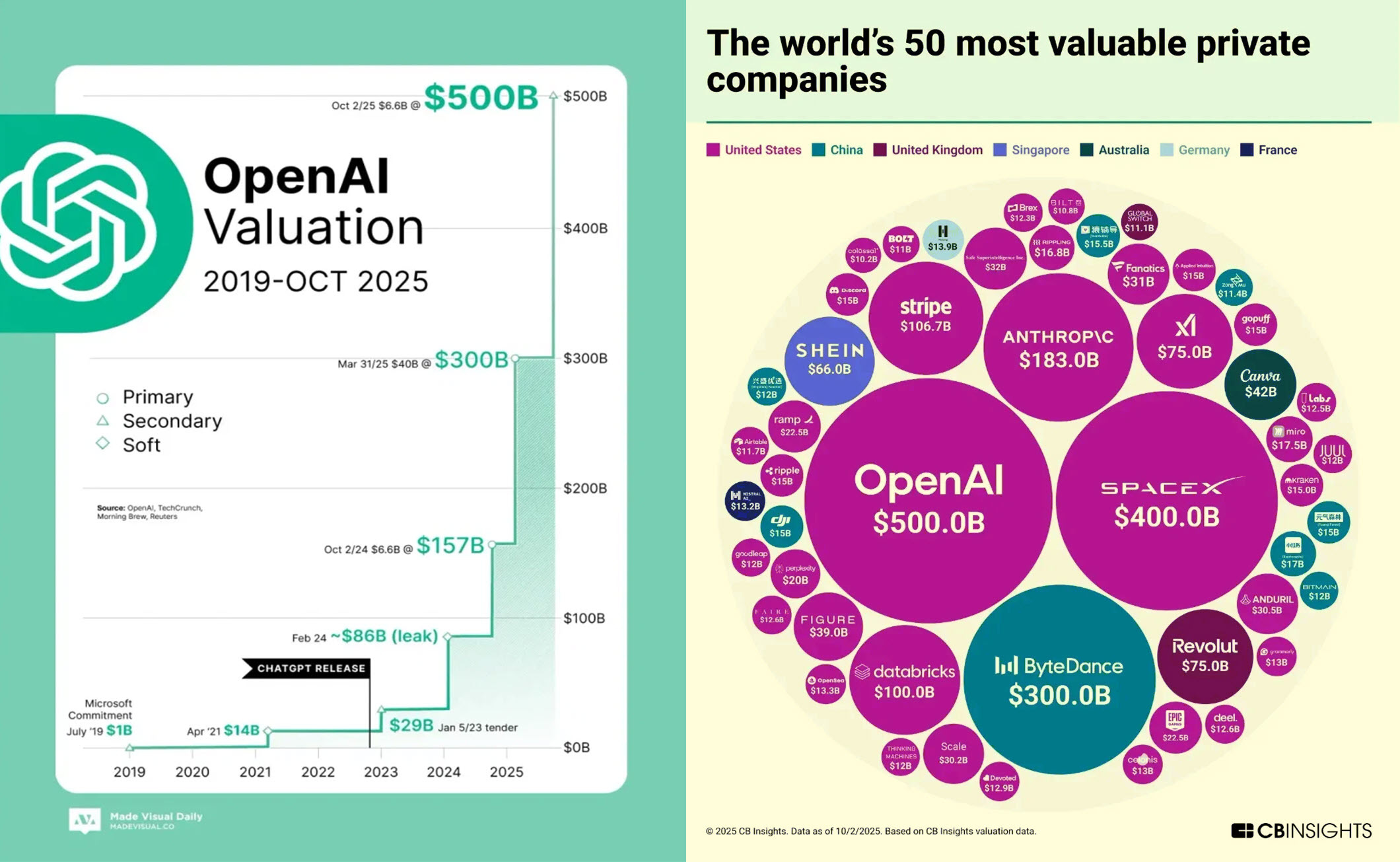
In just six years, OpenAI has evolved from a promising artificial intelligence research lab into the world’s most valuable private company. Following a recent secondary stock sale, the Microsoft-backed firm has achieved a record-breaking $500 billion valuation, overtaking Elon Musk’s SpaceX ($400 billion) and China’s ByteDance ($300 billion).
This milestone places OpenAI at the very center of the global AI revolution, reflecting both investor confidence and the massive societal expectations placed on artificial intelligence technologies. But behind the headline-grabbing valuation lies a complex story: a company balancing astronomical growth, surging revenues, and profound losses, all while navigating the enormous risks and transformative potential of generative AI.
From Humble Beginnings to a $500B Titan
OpenAI’s valuation journey has been nothing short of meteoric. According to data compiled from various sources, the company’s value grew as follows:
-
2019: Microsoft committed $1 billion in funding to support OpenAI’s mission of building artificial general intelligence (AGI).
-
2021: OpenAI’s valuation crossed $14 billion, driven largely by early adoption of its language models.
-
2023: Following a $6.6 billion raise, the valuation jumped to $29 billion.
-
2024: Reports leaked of an internal valuation nearing $86 billion, just months after the release of ChatGPT transformed OpenAI into a household name.
-
Early 2025: A $40 billion funding round led by SoftBank pushed OpenAI’s valuation to $300 billion.
-
October 2025: The company finalized a secondary stock sale, officially pegging its value at $500 billion, cementing its place as the world’s most valuable startup.
For context, the world’s second-most valuable private company, SpaceX, is currently valued at $400 billion, while TikTok parent ByteDance sits at $300 billion. OpenAI’s rapid ascent underscores the extraordinary investor appetite for AI, a sector viewed as the defining technological battleground of the 21st century.
The Revenue-Loss Paradox
Despite this staggering valuation, OpenAI remains an unprofitable company. In the first half of 2025, the firm:
-
Generated $4.3 billion in revenue, primarily from its enterprise AI services, API access, and consumer subscriptions to ChatGPT.
-
Reported an operating loss of $7.8 billion, with $2.5 billion burned in the same period.
-
Spent the majority of its resources on R&D and infrastructure costs, particularly training and running massive AI models that demand cutting-edge compute power.
This paradox, skyrocketing revenues paired with even larger losses, is not unusual for companies in disruptive sectors. Amazon, Tesla, and Uber each spent years burning cash before achieving profitability. However, the scale of OpenAI’s losses raises critical questions: how sustainable is this model, and can the company convert its technological dominance into financial stability?
Microsoft’s Role in the Rise of OpenAI
One cannot discuss OpenAI’s valuation without acknowledging Microsoft’s pivotal role. Since its initial $1 billion commitment in 2019, Microsoft has:
-
Invested over $13 billion in OpenAI.
-
Integrated OpenAI’s models into its core products, from Microsoft 365 Copilot to Azure AI services, turning its cloud business into the infrastructure backbone of OpenAI’s operations.
-
Effectively locked in OpenAI as both a strategic partner and a major customer, creating a symbiotic relationship where Microsoft fuels OpenAI’s growth, while OpenAI enhances Microsoft’s competitiveness in cloud and enterprise software.
This deep integration makes OpenAI not just a research outfit, but also a cornerstone of Microsoft’s long-term AI strategy.
The Competitive Landscape: SpaceX, Anthropic, and ByteDance
OpenAI’s new valuation puts it ahead of other tech giants in the private space:
-
SpaceX ($400B): Elon Musk’s rocket company remains critical to global space exploration, satellite communications, and defense. But despite its dominance in aerospace, SpaceX is no longer the most valuable private company.
-
Anthropic ($183B): Founded by ex-OpenAI researchers, Anthropic has emerged as a formidable competitor with its Claude AI models. Its valuation, still less than half of OpenAI’s, demonstrates investor belief in multiple AI pathways.
-
ByteDance ($300B): The parent of TikTok remains one of the world’s most influential companies in consumer tech. However, its valuation has been dampened by regulatory scrutiny and geopolitical challenges.
The clustering of these companies highlights a new reality: the world’s most valuable startups are no longer dominated by e-commerce or fintech but by AI and frontier technologies.
The Risks of Hypergrowth
OpenAI’s success story is remarkable, but it comes with risks that investors and policymakers cannot ignore.
-
Financial sustainability: With a $7.8B operating loss in just six months, OpenAI must prove it can control costs without stalling innovation. Infrastructure spending on GPUs, energy, and cloud services is ballooning.
-
Regulatory scrutiny: Governments worldwide are drafting AI regulations to address issues like misinformation, bias, and job displacement. OpenAI, as the global leader, will likely face heavy compliance costs and legal challenges.
-
Geopolitical competition: AI is increasingly viewed as a strategic asset. The U.S., China, and Europe are racing to establish dominance, and companies like OpenAI are caught in the middle of this competition.
-
Ethical implications: OpenAI’s stated mission is to ensure that AGI benefits all of humanity. Yet critics argue that the commercialization of AI risks concentrating power in the hands of a few corporations and investors.
The Future: Can OpenAI Justify a Half-Trillion Valuation?
The leap to a $500 billion valuation is both a triumph and a test. On one hand, it reflects the world’s belief that artificial intelligence will transform industries ranging from healthcare and education to law and finance. On the other hand, it raises a question: can OpenAI live up to expectations, or is it at risk of becoming the next dot-com era bubble?
Skeptics point to the massive operating losses and unproven long-term profitability. Supporters counter that OpenAI’s central role in ushering in the AI era, akin to Google’s role in the internet boom, justifies the valuation.
The Road Ahead
OpenAI’s rise to a $500 billion valuation marks a watershed moment in the history of startups. It signals not only the extraordinary promise of AI but also the willingness of investors to bet on transformative, high-risk technologies that could reshape society itself. As OpenAI races ahead of SpaceX, ByteDance, and Anthropic, it embodies both the opportunities and the perils of technological revolutions.
The company’s future will depend on whether it can balance innovation with sustainability, and ambition with responsibility. For now, one thing is certain: OpenAI is no longer just a research lab or a buzzy startup. It is the most valuable private company in the world, standing at the forefront of a new era defined by artificial intelligence.
Originally Published on Substack.






