
60% of the premier cryptocurrency is being held by investors as digital gold — aiming for long term gains
The beauty of this new digital asset class is that detailed insights can be drawn about most of the cryptocurrency transfers since the transactions are posted on transparent ledgers. Blockchain analysis & compliance company Chainalysis recently published one such report which shows that most of the investors — retail and institutional — are holding Bitcoin for the long term, like digital gold.
Before we move on to look at the report in a little more detail, let’s quickly look at the price action in BTC. The top crypto just seems to be coming out of the choppy consolidation that it has been stuck in for the past two weeks. Since higher lows in the daily chart are still holding, the bounce from the recent low advocates for further bullishness. Headwinds lie at the usual strong resistance of $10K — $10.4K, beyond which would trigger another medium-term bull run, while $8500 acts as the support.
Coming back to the Bitcoin investment & transaction analysis — the following are few charts highlighting the current trends in the digital market space.
Most Bitcoin as Long term Investment
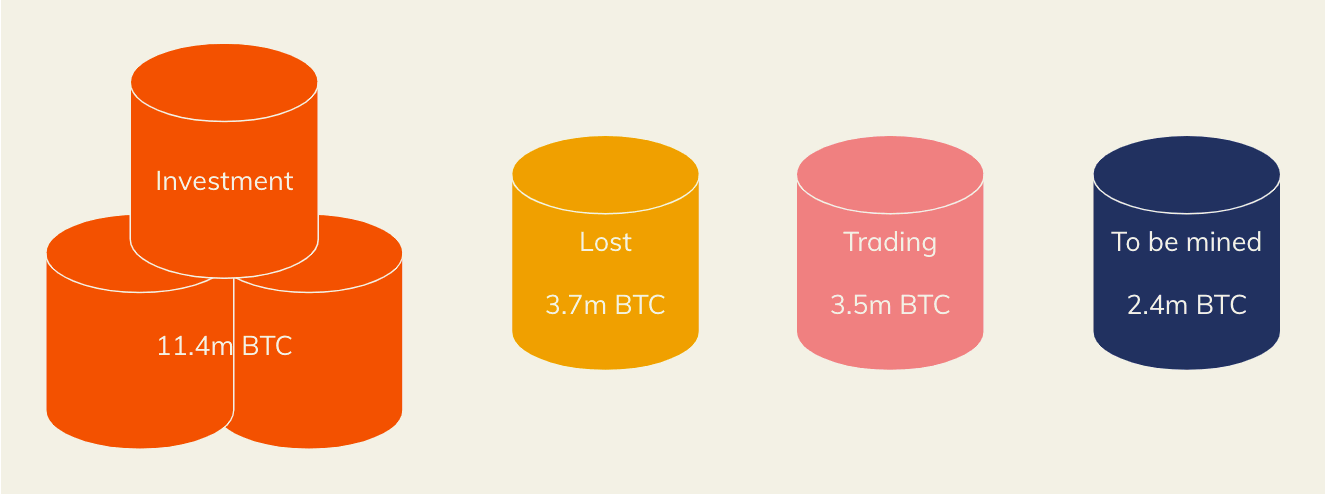
As some of you might already know, there is a total of 21 million bitcoins that will be mined ever. Of these 18.6 million have already been mined and these have been categorized into three buckets by the report — break up is as follows:
- 61.3% of the Bitcoin (Figure 1) is held by retail and institutional investors, who have never sold more than 25% of Bitcoin they have ever received, holding BTC often for many years — as a long term investment.
- The second bucket of 3.7 million bitcoin or 19.9%, that hasn’t moved from its BTC wallets in more than five years and is therefore considered as “lost bitcoin.”
- Finally, 3.5 billion BTC or 18.8% is the only bucket that is traded frequently — primarily between crypto exchanges.
USD value of Bitcoin Exchange flows
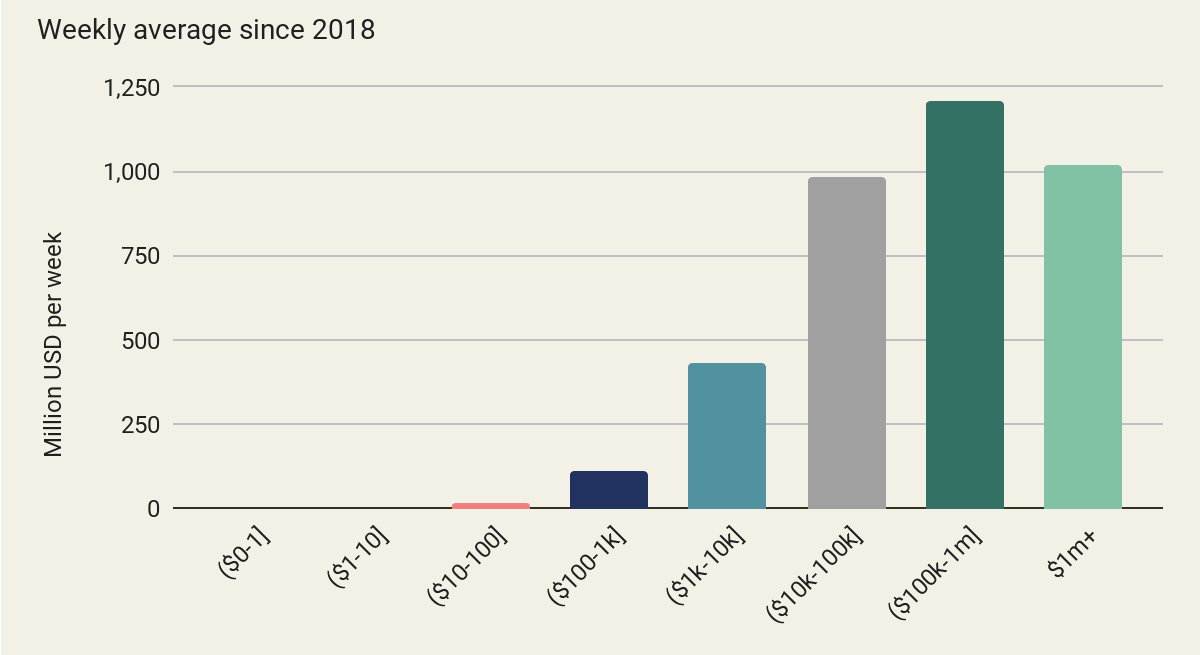
Although retail traders outnumber the institutional investors — making up 96% of all transfers sent to exchanges on an average weekly basis, the latter control 85% of the control the liquidity of the digital market (Figure 2). No wonder then that institutional investors precipitate large price movements as we saw in Bitcoin during the current pandemic. However, they only accounted for roughly 39,000 transfers per week among exchanges during 2020.
Typer of Business holding Bitcoin
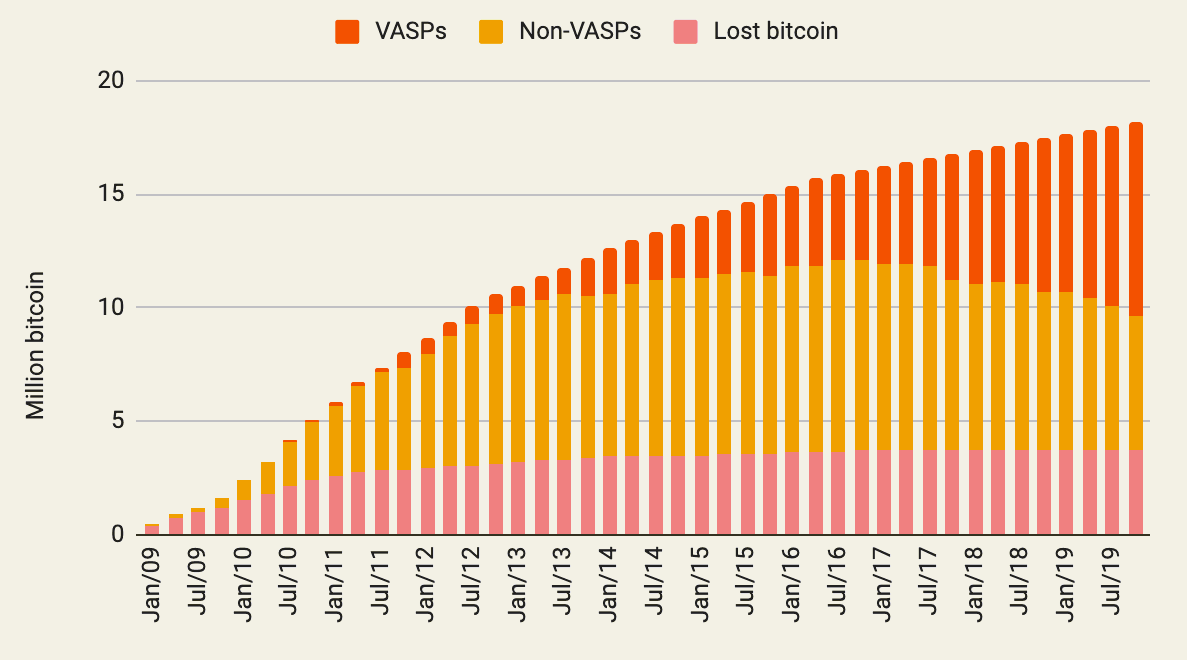
For the first few years, lost bitcoin was dominant as people held on to their investments, but slowly we began to see unlicensed custodial services begin to take control of this share (Figure 3). As the digital assets went mainstream, licensed custodial service, or Virtual Asset Service Providers emerged — VASPs as FATF would refer to them.
In the past few years, they have become the dominant segment as roughly 60% of Bitcoin that is not lost is held by a VASP. Most of the crypto exchanges fall in this category. According to the report, 40% of available Bitcoin, which is not currently held by VASPs — 87% has passed through a VASP at some point. Most people either hold their Bitcoin on VASPs or acquire their Bitcoin from VASPs.
For the year 2020, 1.8 million BTC worth $14.4 billion, is transferred per week in total — Of which 40% moved directly between exchanges, while 43% of BTC flowed through intermediary addresses between VASPs, primarily between exchanges.
Bitcoin share by Exchanges
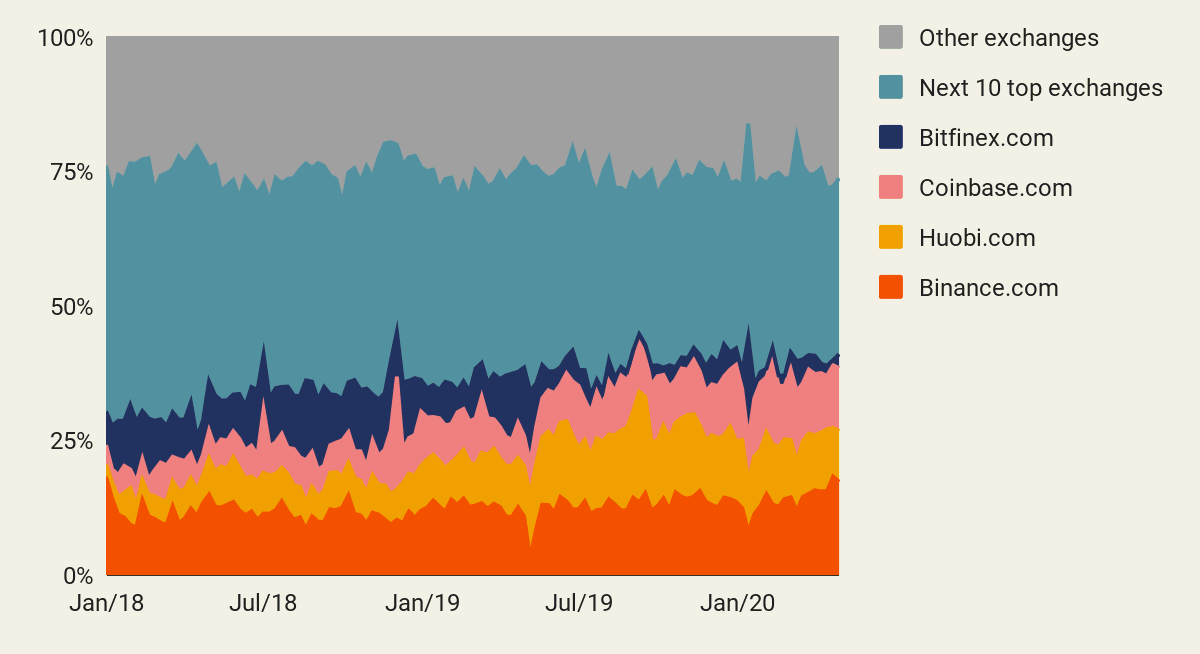
Taking the previous analysis a little further, this next chart (Figure 4) highlights the dominance of the major crypto exchanges in the share of bitcoin received. Four of the largest exchanges since 2018 — Binance, Huobi, Coinbase, and Bitfinex — took in 40% of all Bitcoin received by exchanges in 2020. The next ten exchanges together accounted for 36% of all BTC transfers among exchanges, leaving hundreds of smaller players to split the remaining 24% of transfer volume.
It is pretty evident that few major trends emerging from this analysis — investors increasingly consider Bitcoin as an investment with a long term potential and a bigger footprint of institutional investors and licensed custodial services is gaining it the credibility that it needs to be recognized as a valid asset in the mainstream financial markets.
Originally Published on Medium
Medium 📭| Twitter 📜 | LinkedIn 📑| StockTwits 📉 | Telegram 🔗







