
The AI economy is now paced by substations, megawatts, and durable contracts—not by clever code alone.
In Silicon Valley, partnerships are framed as whirlwind romances, marked by sweeping vows of exclusivity and grand declarations of shared destiny. But beneath the poetic language, the real currency of these relationships is power—measured not in passion, but in infrastructure, distribution, and leverage. OpenAI and Microsoft, the most closely watched couple in artificial intelligence, are quietly revising their arrangement. After two years of exclusivity, the ChatGPT maker has loosened its bond: Microsoft remains its main home, but OpenAI now has the freedom to train and deploy models on other clouds.
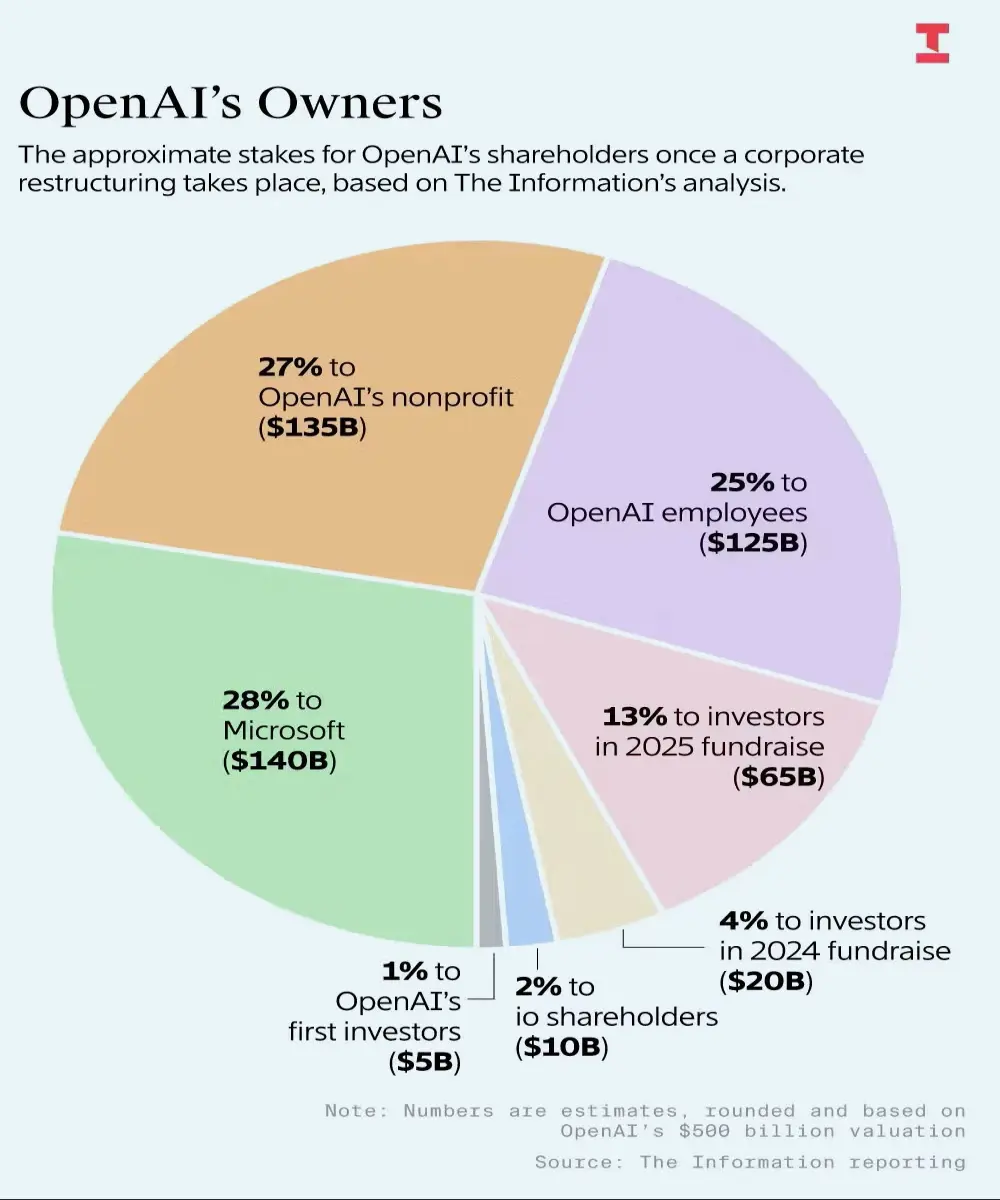
This restructured pact clears the way for OpenAI’s transformation into a for-profit entity, while leaving its nonprofit in control and holding a stake valued at over $100 billion, as shown in The Information’s analysis (see chart below). The agreement, however, still awaits regulatory approval. At first glance, this may sound like a technical footnote. But it marks a realignment with profound implications for the AI economy.
The Balance of Power is Shifting
In AI today, the scarcest resource isn’t clever code—it’s compute. Training a frontier model requires thousands of GPUs and massive amounts of electricity, sometimes costing hundreds of millions of dollars. Optionality, access to multiple providers, becomes a strategic weapon. OpenAI just bought itself exactly that. By freeing itself from strict exclusivity, it has gained the leverage to shop around for compute.
And it has already made its intentions clear: OpenAI recently signed a staggering $300 billion, five-year deal with Oracle to buy cloud compute, an unprecedented contract that dwarfs anything previously seen in the cloud market. This is not just diversification; it’s a signal. OpenAI will no longer be defined solely by its dependency on Microsoft’s Azure. Instead, it is positioning itself as a buyer with leverage, capable of playing giants against one another in a market where GPUs, electricity, and server racks are as valuable as oil fields once were.
Microsoft’s Quiet Strength
That might sound like a setback for Microsoft, but the company knows where its true moat lies. By giving up exclusivity, it risks losing some of OpenAI’s compute workloads. But the customer relationship, the more enduring prize, still runs through Microsoft. The daily work cycle remains rooted in Windows. MS Office continues to house the world’s documents, presentations, and spreadsheets. Teams, Outlook, and SharePoint still provide the connective tissue of enterprise communication.
And the Copilot button, now embedded across Microsoft 365, is the gateway through which employees interact with AI. Even if OpenAI trains on Oracle’s servers or Amazon’s GPUs, the final delivery often passes through Microsoft’s login screens, billing systems, and compliance rails. Microsoft has made a fortune from being the default, and this shift only reinforces the importance of those defaults. Distribution, not exclusivity, is its moat.
Who Really Owns OpenAI?
The restructuring also raises questions of ownership and governance. According to The Information’s breakdown, OpenAI’s $500 billion valuation is spread across a diverse set of stakeholders:
- 28% ($140B) to Microsoft
- 27% ($135B) to OpenAI’s nonprofit (retaining control)
- 25% ($125B) to OpenAI employees
- 13% ($65B) to 2025 investors
- 4% ($20B) to 2024 investors
- Smaller slices to early investors and other shareholders
This hybrid model is unprecedented. A nonprofit with a nine-figure stake still sets the mission, even as employees, venture backers, and Microsoft eye extraordinary returns. The unusual ownership structure underscores the tension at the heart of OpenAI: it is both mission-driven and profit-seeking, governed by ideals but powered by capital.

The Oracle Gambit
The Oracle deal crystallizes this duality. On one hand, it demonstrates OpenAI’s ambition to scale beyond any single partner, staking its claim as a sovereign actor in the AI economy. On the other hand, it signals the sheer capital intensity of this industry. No AI lab can remain mission-driven without simultaneously commanding vast financial resources.
For Oracle, the deal is nothing short of transformative. Long overshadowed by Microsoft, Amazon, and Google in cloud, Oracle now finds itself the infrastructure partner of the most important AI company on earth. For OpenAI, the deal is a hedge, ensuring it can meet demand for ChatGPT, API services, and future models without bottlenecking on a single supplier.
From Romance to Paperwork
The optics have changed. Gone are the days when the OpenAI–Microsoft partnership could be packaged as a sweeping romance. What remains is something less cinematic but far more enduring: contracts, service-level agreements, and multibillion-dollar invoices. This is how the AI industry now works. In a world paced by substations and megawatts, the real intimacy isn’t found in keynote demos or stagecraft, it’s in stable paperwork. Durable, not dazzling, is the new definition of strength.
The Broader Lesson
The OpenAI–Microsoft evolution illustrates a broader truth about today’s tech economy: innovation is no longer bottlenecked by ideas. It is bottlenecked by infrastructure. Chips, electricity, and distribution channels, not just algorithms, determine competitive advantage. This is why Microsoft’s distribution remains formidable, why Oracle can reinvent itself through compute contracts, and why OpenAI must maintain leverage by keeping its options open.
Closing Thought
The Silicon Valley romance between OpenAI and Microsoft may have lost some of its cinematic flair, but it has matured into something far more consequential: a durable, contract-driven partnership stitched together by necessity, not exclusivity. The industry’s future will be defined less by dazzling demos and more by who controls defaults, bills, and substations. In AI, durable is the new romantic.
Originally Published on LinkedIn.






