
Historical patterns show Ethereum often outperforms in the latter stages of a bull market—ETF inflows could make this cycle no different.
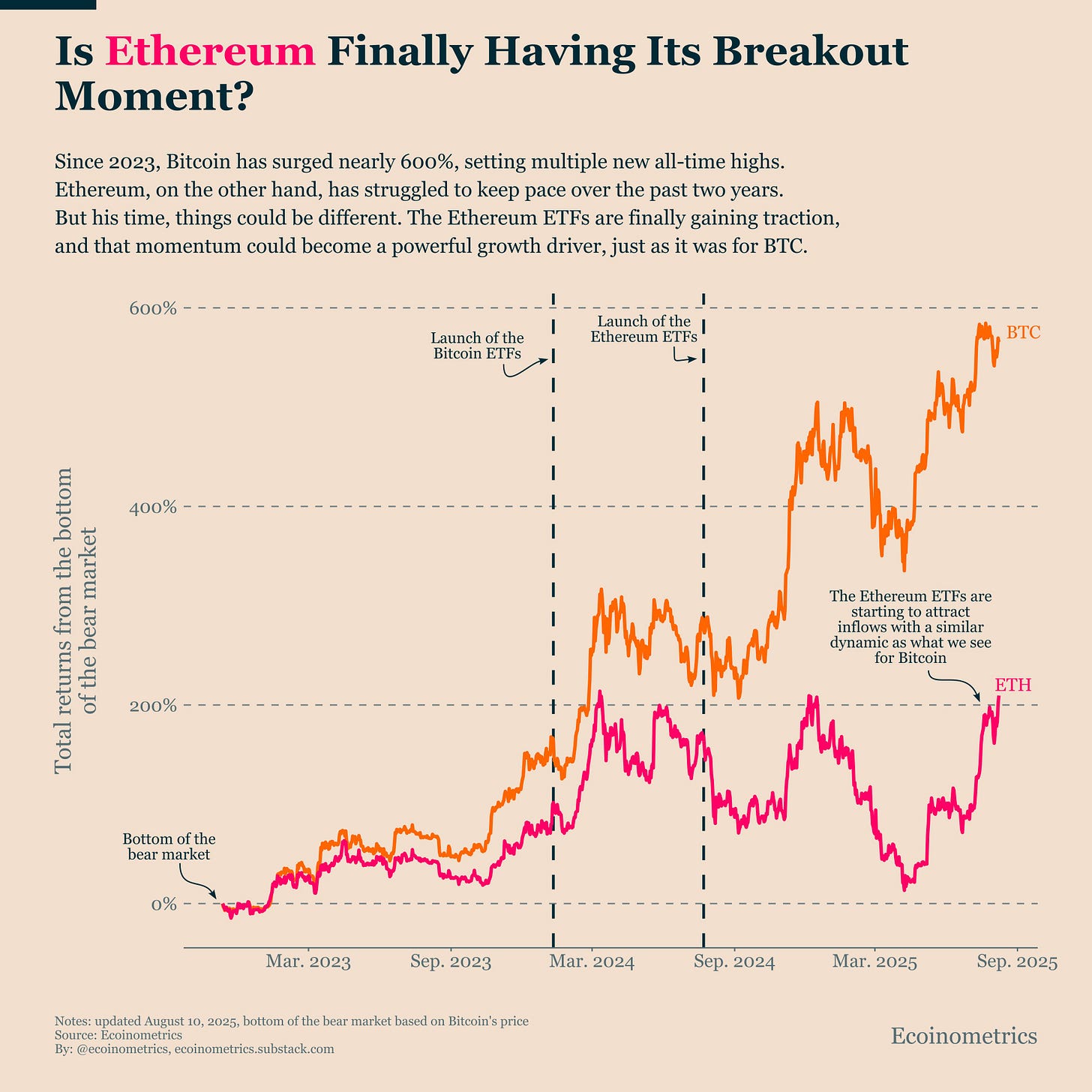
For much of the past two years, the cryptocurrency market has been dominated by one name: Bitcoin. Since bottoming out in the bear market of 2022–2023, Bitcoin has surged nearly 600%, setting multiple new all-time highs and solidifying its role as the market’s undisputed leader. In contrast, Ethereum (ETH)—often hailed as the silver to Bitcoin’s gold—has lagged noticeably, struggling to match Bitcoin’s pace and, in some periods, even losing relative ground.
Yet, as we move deeper into 2025, there are signs that the tides may be turning. Historically, Ethereum’s strongest relative performance tends to come in the second half of a bull market, when risk appetite expands and investors start moving capital further out on the risk curve. This is often when “altseason” begins—an era of strong performance for top-tier altcoins, with Ethereum leading the charge.
The chart from Ecoinometrics (below) provides a telling visual narrative. Since the launch of Bitcoin ETFs in early 2024, BTC experienced a powerful surge, followed by a period of consolidation and yet another leg higher, culminating in its recent dominance. Ethereum, meanwhile, saw an initial spike after the ETF news but faded as Bitcoin hogged the spotlight. But now, following the launch of Ethereum ETFs, ETH is showing early signs of repeating Bitcoin’s playbook—potentially setting the stage for a long-awaited breakout.
Bitcoin: The First Mover Advantage
Bitcoin’s performance since the 2023 bear market lows has been nothing short of spectacular. The introduction of U.S.-listed spot Bitcoin ETFs acted as a structural catalyst, opening the doors for institutional capital that had previously been restricted from accessing the asset. The result: billions in inflows, heightened liquidity, and a surge to fresh all-time highs.
The ETF effect did more than just pump prices—it changed Bitcoin’s market perception. Once seen largely as a speculative asset, Bitcoin is increasingly being treated as “digital gold”: a store of value, an inflation hedge, and an uncorrelated macro asset. This narrative has brought in pension funds, insurance companies, and conservative allocators—investors who may never touch smaller-cap cryptocurrencies.
Ethereum, by comparison, lacked this tailwind until now.
Ethereum ETFs: A Delayed Catalyst Arrives
The launch of spot Ethereum ETFs in 2024 was the most significant development for ETH since the network’s shift to proof-of-stake in 2022. While ETH ETFs don’t have the same “hard cap, digital gold” marketing simplicity as BTC ETFs, they carry a different value proposition: Ethereum is not just a currency—it’s the backbone of decentralized finance (DeFi), NFTs, and Web3 infrastructure.
Institutional investors, now familiar with the ETF vehicle thanks to Bitcoin, may be more willing to allocate to Ethereum without the operational and custody complexities of direct crypto holdings. According to recent data, inflow patterns into Ethereum ETFs mirror the early stages of Bitcoin ETF adoption, which could set up a similar demand-driven price acceleration. If history rhymes, this could be Ethereum’s moment to catch up.
Historical Patterns: Ethereum’s Late-Cycle Catch-Up
In past bull markets—2017 and 2021—Ethereum lagged Bitcoin during the early phases of the rally but eventually surged to outperform in percentage terms as the cycle matured. This catch-up phase is often driven by three intertwined forces:
-
Risk-On Sentiment
Once Bitcoin has proven the bull market’s durability, investors tend to seek higher returns further along the risk curve. Large-cap altcoins, starting with Ethereum, benefit first. -
Capital Rotation
Profits from Bitcoin gains are often rotated into Ethereum and other large-cap altcoins. This creates a self-reinforcing cycle of inflows and rising prices. -
Narrative Shifts
Late-cycle narratives—whether it’s DeFi booms, NFT mania, or Layer-2 adoption—often put Ethereum in the spotlight as the platform powering the action.
Looking at the chart, BTC’s initial surge post-ETF launch in early 2024 was unmatched by ETH. But with Ethereum ETFs now attracting interest, ETH could be entering its historical sweet spot—the second half of the bull run.
Macro and Market Context: Why Could It Be Different Now?
This cycle’s macro backdrop is unique. The past year has seen central banks signal a gradual pivot from aggressive tightening to easing, boosting risk assets across the board. If this trend continues, liquidity conditions could favor higher-beta plays—Ethereum included.
Moreover, Ethereum’s fundamentals are stronger than in previous cycles:
-
Deflationary Supply Dynamics: Since the EIP-1559 upgrade, Ethereum has periodically seen negative net issuance, especially during high network activity.
-
Scaling Solutions: Layer-2 networks like Arbitrum, Optimism, and Base are bringing more users and activity to the Ethereum ecosystem without overloading the main chain.
-
Institutional Integration: Major financial firms are already building tokenization platforms on Ethereum, signaling long-term adoption beyond speculative use.
With these tailwinds, ETF-driven inflows could ignite a virtuous cycle of higher prices, more attention, and further inflows.
The Bitcoin vs. Ethereum Allocation Question
Even if Ethereum outperforms in percentage terms from here, Bitcoin remains a critical anchor in crypto portfolios. Historically, the late stages of a bull market can be wildly profitable, but also highly volatile. The temptation to go “all-in” on Ethereum or smaller altcoins is strong, but Bitcoin’s relative stability and institutional support still make it a prudent long position.
For investors, the question isn’t Bitcoin or Ethereum—it’s how to balance both. A diversified allocation can capture Ethereum’s catch-up potential without abandoning Bitcoin’s safer profile.
What Could Go Wrong?
While the setup looks promising, several risks could derail Ethereum’s breakout:
-
Macro Shock: A sudden tightening in monetary policy or a global risk-off event could cut the bull cycle short.
-
Regulatory Action: Ethereum’s classification in U.S. markets is still a point of contention. Any adverse rulings could dampen ETF momentum.
-
Underwhelming ETF Demand: If Ethereum ETFs fail to sustain inflows, the narrative could weaken, and price momentum might stall.
-
Competition from Other Chains: Solana, Avalanche, and other smart contract platforms are vying for market share and mindshare.
The Road Ahead
The story of this cycle so far has been Bitcoin’s institutionalization. But the second half may belong to Ethereum. If ETF inflows continue to build, and if history’s pattern of late-cycle ETH outperformance holds, we could see Ethereum challenging its all-time highs—and perhaps even rewriting the narrative of market leadership.
For long-term crypto believers, the takeaway is simple: The market’s leadership baton doesn’t always stay with the same runner. Bitcoin’s dominance doesn’t preclude Ethereum from having its own explosive chapter.
Originally Published on Substack.






