
Despite a severe downturn caused by contagion events, hacking & bans — digital assets continued to gain traction among illicit players
Illicit activity has been a concern in the cryptocurrency market since its inception. The anonymity and lack of regulation in some aspects of the market have made it attractive to criminals for activities such as money laundering, fraud, and hacking. However, it should be noted that not all cryptocurrency transactions or activities are illicit, and the overall market has grown significantly over the years. The implosion of big names like Celsius, Three Arrows Capital, FTX, and others in the Cryptoverse made 2022 one of the most tumultuous years yet in its short history.
One of the most significant advantages of using blockchain technology offers is its transparency — something which is not possible at this scale in legacy finance. Taking advantage of this feature, the leading crypto analytics firm Chainalysis publishes annual illicit cryptocurrency activity estimates. Although the detailed 2023 Crypto Crime Report will be available in February, a teaser piece has highlighted how the previous year has been for illicit activity in the cryptoverse.
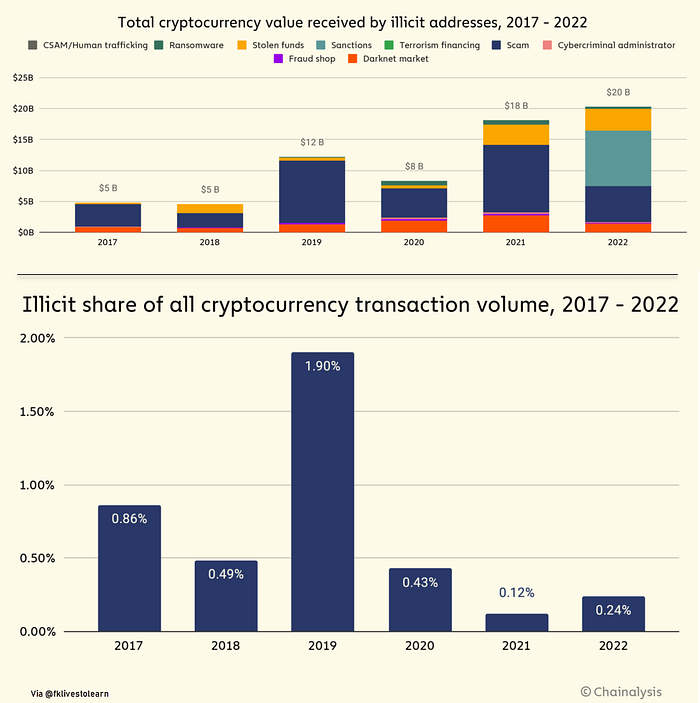
The numbers in the report only include the ones based solely on on-chain intelligence — off-chain criminal activity like fraudulent bookkeeping is not included. Although a major drop in crypto transactional volume was seen in 2022 with the onset of the bear market, the share of all cryptocurrency activity associated with illicit activity has risen for the first time since 2019, from 0.12% in 2021 to 0.24% in 2022 (bottom chart above). The increase was a bit of a surprise, since taking in less revenue during previous bear markets has generally led to less profitability due to declining interest.
According to the report, illicit transaction volume rose for the second consecutive year, hitting an all-time high of $20.1 billion (top chart above). Keep in mind though, that these estimates are lower bounds non-crypto native crime (e.g. conventional drug trafficking involving cryptocurrency as a mode of payment). As an example, the figure of $14 billion in illicit activity in 2021 has now been raised to $18 billion.
A key observation from the data highlights that legitimate transaction volumes were declining faster than illicit volumes. Having said that, overall illicit activity in cryptocurrency remains a small share of overall volume at less than 1%. Also worth noting is the fact that despite this year’s jump, crime as a share of all crypto activity is still trending downwards — a good sign for things in the blockchain space.
Nonetheless, the need for greater transparency remains, especially in the decentralized finance (DeFi) segment. There are also notable opportunities to improve the visibility of off-chain data and transactions. As more value is transferred to the blockchain, greater transparency will reveal potential risks and provide a more complete understanding of the industry—leading to a broader acceptance and inclusivity.
Originally Published on Medium
Email | Twitter | LinkedIn | StockTwits | Telegram | Newsletter






