
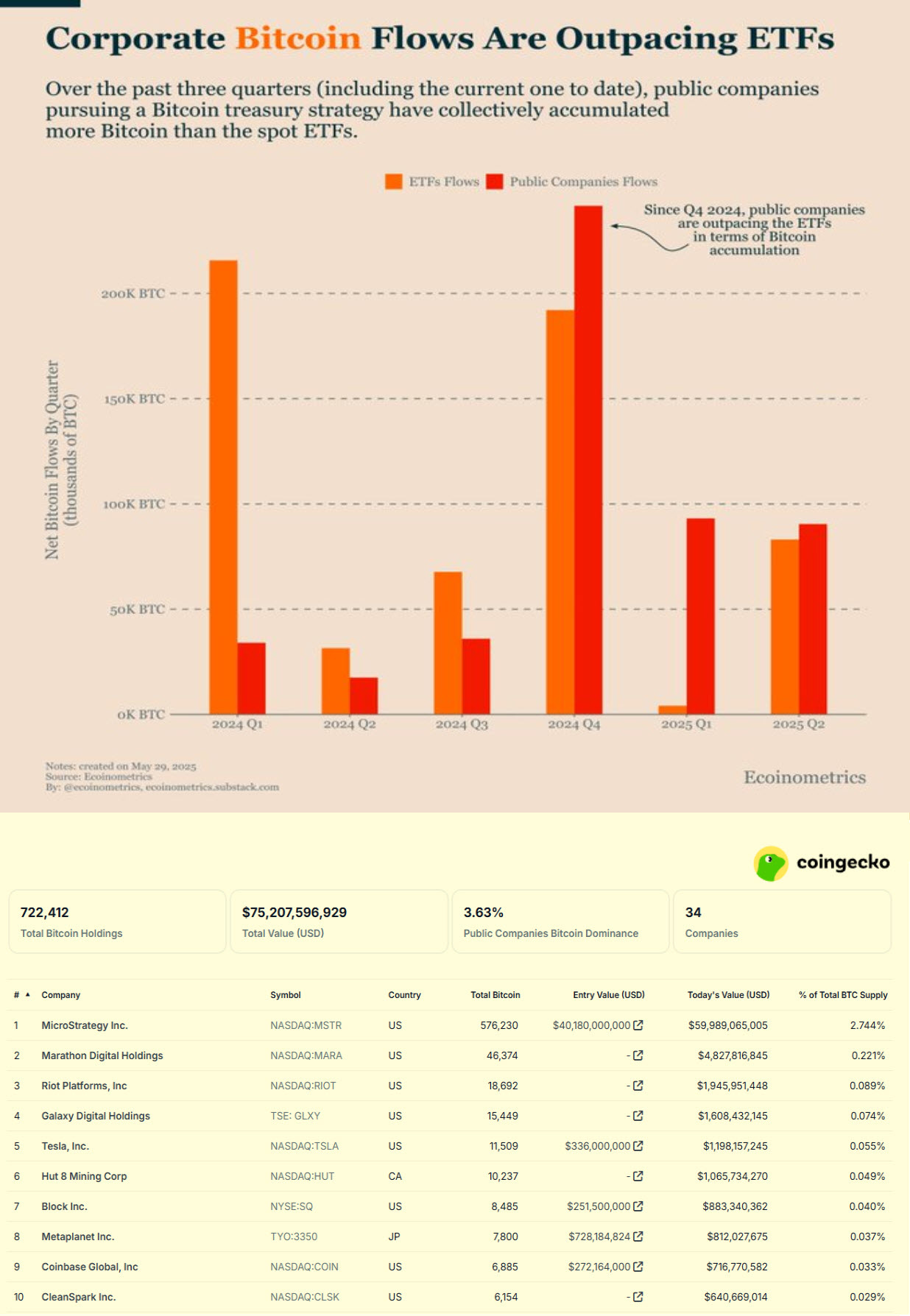
Over the past three quarters, public companies have acquired more Bitcoin than spot ETFs, signaling a long-term shift in institutional strategy.
A subtle but powerful shift is underway in the Bitcoin ecosystem—one that is being led not by the explosive volume of spot ETFs, but by the deliberate, measured actions of public companies that are turning Bitcoin into a core asset on their balance sheets. While ETFs have dominated headlines since their U.S. approval in early 2024, a closer look reveals a more compelling structural trend: corporate Bitcoin accumulation is now outpacing ETF inflows.
This divergence in accumulation patterns may signal a pivotal moment for Bitcoin’s role as a strategic reserve asset. According to recent data compiled by Ecoinometrics and visualized in a chart published on May 29, 2025, public companies have been net accumulators of more Bitcoin than spot ETFs for the past three consecutive quarters, including the current quarter-to-date.
Corporates Take the Lead
The first chart below starkly illustrates the turning point. In Q1 2024, ETFs dominated, absorbing over 200,000 BTC compared to a relatively minor inflow from corporate treasuries. However, by Q4 2024, a clear inversion took place: public companies acquired over 200,000 BTC, surpassing ETF flows for the first time.
That trend has held steady into 2025. As of Q2, corporate flows continue to match or exceed those of ETFs. Notably, this buying behavior isn’t spurred by price speculation or short-term trading. Unlike ETFs, which tend to see large, volatile inflows based on market sentiment and price momentum, corporate Bitcoin acquisitions are often methodical, long-term strategic decisions.
Strategy: The Archetype of Corporate Bitcoin Accumulation
No company exemplifies this approach better than Strategy Inc., whose Bitcoin holdings now sit at a staggering 576,230 BTC—by far the largest among public companies. This constitutes roughly 2.74% of the total BTC supply, valued at over USD 59 billion as of May 2025. Their aggressive and unwavering strategy has redefined what corporate treasury management can look like in the Bitcoin era.
MicroStrategy’s entry value of $40 billion indicates a long-term conviction unshaken by short-term volatility. CEO Michael Saylor has positioned the firm not merely as a software company, but as a de facto Bitcoin holding entity. And it’s not alone.
Other companies are following suit, albeit at more modest scales:
-
Marathon Digital Holdings: 46,374 BTC
-
Riot Platforms: 18,692 BTC
-
Galaxy Digital: 15,449 BTC
-
Tesla: 11,509 BTC
-
Hut 8 Mining (Canada): 10,237 BTC
In total, 34 public companies now collectively hold 722,412 BTC, worth over $75.2 billion, accounting for 3.63% of the total Bitcoin supply.
Why Corporate Bitcoin Accumulation Matters
ETF inflows are typically reactive. They swell during bull markets and dry up quickly during downturns. This behavior reflects investor psychology more than institutional conviction. Corporate flows, on the other hand, tend to be proactive and sticky.
Once Bitcoin is acquired for a corporate treasury, it is generally removed from circulation for years—if not permanently—unless there's a drastic change in the firm's financial strategy. This dynamic introduces a structural demand element to Bitcoin’s price action. When firms continuously accumulate BTC without regard for price, they effectively absorb supply, reducing circulating float and increasing scarcity.
This is fundamentally bullish for price over the long term. Moreover, these corporate purchases signal a shift in how Bitcoin is perceived. No longer just a speculative asset or a hedge against inflation, Bitcoin is becoming a strategic reserve asset—akin to digital gold—within corporate balance sheets.
Implications for Bitcoin’s Reserve Narrative
Bitcoin’s narrative has long revolved around scarcity, decentralization, and independence from traditional financial systems. What corporate accumulation adds is credibility and permanence. When publicly traded firms with fiduciary duties and shareholder oversight choose to hold Bitcoin, they validate its role as a durable, legitimate store of value.
This also has cascading effects. Institutional investors, including pension funds and insurance companies, are more likely to view Bitcoin favorably if it is seen not just as a volatile risk asset, but as a treasury reserve option embraced by credible firms. The “digital gold” thesis gains strength not only when Bitcoin's price rises, but also when the structure of demand evolves from speculative to strategic. And corporate holdings are the most concrete form of strategic demand.
Catalyst for Widespread Adoption
We are witnessing the early stages of what could become a broader movement. As more companies integrate Bitcoin into their balance sheets—whether for diversification, hedging, or long-term value preservation—the stigma around holding Bitcoin will continue to erode. What was once viewed as fringe behavior is rapidly becoming best practice among forward-thinking firms.
There’s also a reflexive component to this trend. As Bitcoin price appreciates due to supply absorption, more companies feel pressured to explore Bitcoin as an asset class, further driving demand and reducing float. This feedback loop could push Bitcoin into a new phase of adoption—not just among retail and ETFs, but across boardrooms worldwide.
A Tectonic Shift in the Making
The data does not lie. While ETFs have made a historic impact in legitimizing Bitcoin as an investable asset, the real structural power lies in the hands of public companies quietly reshaping the demand landscape. Their approach is not about hype. It’s about conviction.
It’s about engineering a balance sheet strategy that aligns with long-term monetary debasement, macroeconomic uncertainty, and the relentless digitization of Finance. In the years to come, this disciplined and sticky corporate demand may very well become the bedrock upon which Bitcoin’s next exponential price leg is built.
Originally Published on Substack.






