
Discover how AI-generated characters like ''Lu do Magalu'' and ''Nobody Sausage'' are reshaping brand influence.
In a world increasingly shaped by artificial intelligence and immersive digital experiences, a new wave of celebrity is quietly taking over our social feeds. They don’t age. They don’t eat. They don’t sleep. And yet, they are building empires, securing brand deals, and shaping culture—pixel by pixel. Welcome to the era of the virtual influencer.
A recent report by Kapwing lays bare the scale and economic impact of these AI-generated personalities. Far from being quirky digital curiosities, these avatars are commanding serious cash, generating millions in revenue and captivating tens of millions of followers across platforms like Instagram and TikTok. Let’s break down why this matters—and why every brand, creator, and consumer should be paying close attention.
From Avatars to Revenue Powerhouses
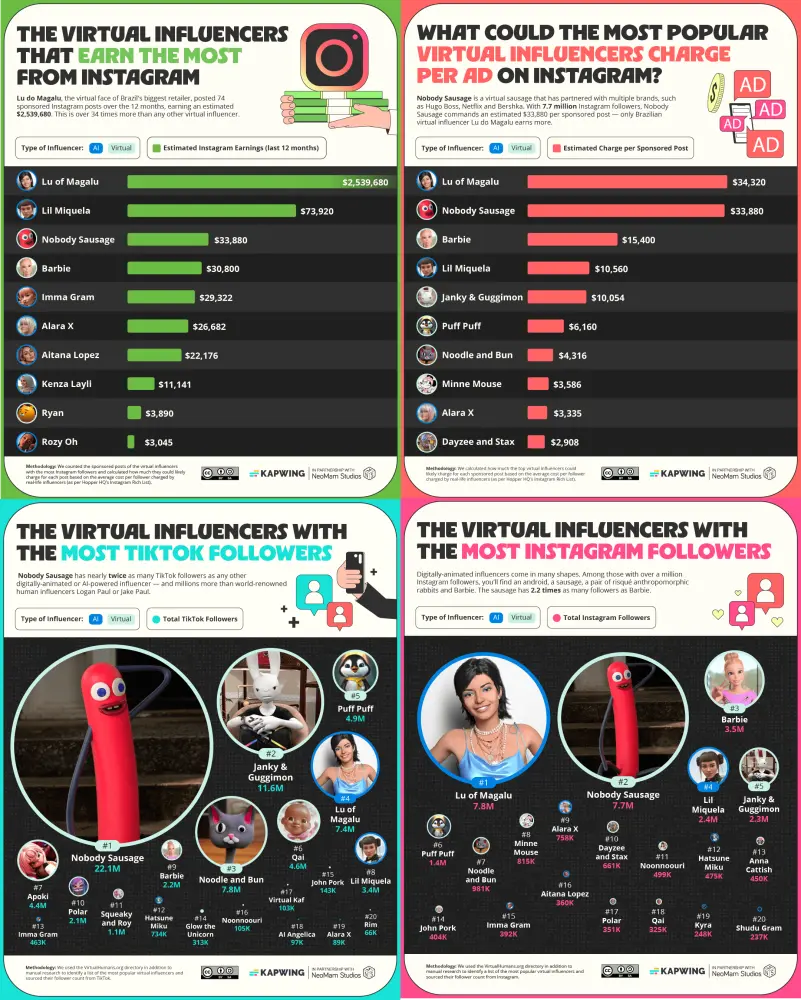
Kapwing’s research analyzed a host of virtual influencers and revealed eye-opening figures (pictured below). At the top of the list is Lu do Magalu, a Brazilian virtual influencer developed by retail giant Magazine Luiza. She earned an astonishing $2.54 million from Instagram alone over the last year, dwarfing her closest competitor, Lil Miquela, who brought in just under $74,000. This isn't a typo—it’s a more than 30x gap in revenue that underscores how deeply rooted virtual influencers can become in a regional market when paired with strong brand alignment.
Meanwhile, characters like Nobody Sausage—a surreal, brightly colored sausage with googly eyes—have become global sensations. With 22.1 million TikTok followers and an estimated $33,880 per Instagram post, this whimsical figure has outperformed many human influencers and even some celebrities in both engagement and monetization.
It’s easy to laugh off the absurdity of a dancing sausage as a serious business entity, but that would be a mistake. These virtual influencers aren’t just costumed animations; they are strategic marketing tools, tailor-made to embody values, aesthetics, and narratives that resonate with hyper-specific audiences.
Why Brands Are Betting on AI Avatars?
The appeal for brands is clear: Virtual influencers offer total creative control, zero risk of scandal, and the ability to appear "on brand" 24/7. They can be anywhere, anytime, promoting anything—from fast fashion to blockbuster films—without the logistical challenges of working with human talent.
Moreover, unlike traditional influencers who may experience fluctuations in reputation or availability, virtual characters are infinitely adaptable. Their storylines, personalities, and even physical appearances can be reprogrammed based on what resonates with their audiences. In essence, they represent the perfect storm of personalization and predictability.
This level of control also makes them ideal for global campaigns. Take Barbie, for instance, whose animated version commands 3.5 million Instagram followers and earns about $15,400 per post. She serves as both an extension of a globally recognized brand and a testbed for marketing innovation, reaching new audiences in fresh ways.
Virtual Fame in the Age of Deepfakes and AI Ethics
But with great power comes great responsibility—and great complexity. As virtual influencers blur the lines between fiction and reality, they raise important ethical questions. Should followers be made explicitly aware that they are engaging with AI-generated content? Who is responsible when a virtual character promotes harmful behavior or misinformation? And in an age of deepfakes, how do we preserve authenticity in our digital spaces?
The legal landscape is murky as well. Intellectual property rights, content ownership, and revenue-sharing models for virtual influencers are still largely unregulated. As these characters become more autonomous—potentially even generating their own content with generative AI tools—the debate around AI personhood and digital accountability will only intensify.
A Glimpse Into the Future of Influence
We are entering a new phase of media and marketing—one where virtual influencers are no longer gimmicks but legitimate players in the creator economy. For content creators, this is a wake-up call to adapt or collaborate. For brands, it’s a moment to rethink what authenticity and connection look like in an AI-driven world.
And for everyday consumers, it’s an invitation to become more media literate and critical of who (or what) we allow to influence our tastes, politics, and purchasing decisions. The numbers from Kapwing’s study make one thing clear: Virtual influencers are not a passing trend. They’re the new normal.
Originally Published on LinkedIn.






