Since mid-July, Bitcoin ETF inflows have gone flat while Ethereum’s surge is gaining speed. Can Ethereum build a long-term narrative beyond catch-up trading?
For much of the last year, the conversation around cryptocurrency exchange-traded funds (ETFs) has revolved around Bitcoin. As the first mover and the dominant digital asset by market capitalization, Bitcoin naturally attracted both the lion’s share of attention and capital flows once regulators opened the door to spot Bitcoin ETFs in early 2024. Billions of dollars poured in, driving demand, price appreciation, and legitimization for Bitcoin in traditional financial markets.
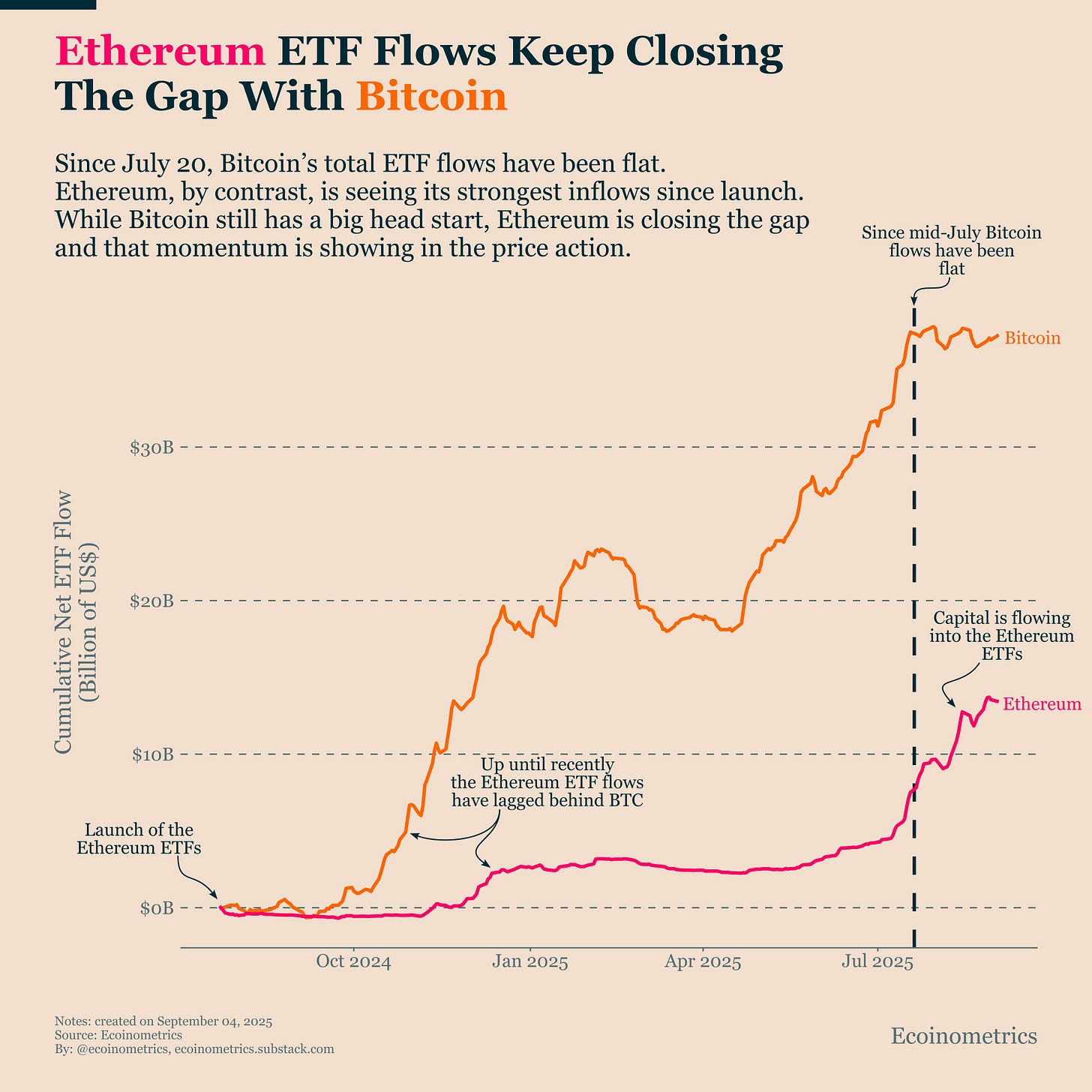
Ethereum (second-largest crypto), by contrast, lagged. Its ETFs launched later and started more modestly, attracting only a fraction of the inflows Bitcoin enjoyed. For months, Ethereum appeared destined to remain a distant second in the ETF race. But lately a new trend has emerged. As shown in the chart from Ecoinometrics (below), since mid-July, Bitcoin ETF inflows have essentially gone flat, while Ethereum is experiencing its strongest streak of net inflows since inception.
While Bitcoin maintains a substantial lead with cumulative net ETF flows still around $30 billion, Ethereum has begun to catch up quickly, surpassing $10 billion and climbing. This shift raises important questions about investor sentiment, market dynamics, and the long-term role Ethereum can play in a world that has so far largely framed crypto investment through a Bitcoin-centric lens.
Bitcoin’s Plateau: A Pause or a Peak?
From July 20 onward, the cumulative net flows into Bitcoin ETFs have stagnated. This flattening comes after an extraordinary run earlier in the year that saw tens of billions of dollars flood into Bitcoin products. The rapid growth underscored Bitcoin’s appeal as a “digital gold” and inflation hedge narrative—an asset class increasingly adopted by both retail investors and institutions.
Yet, markets rarely move in a straight line. Bitcoin’s stall could reflect several overlapping dynamics:
-
Exhaustion of pent-up demand. After the ETF launch, many investors who wanted exposure to Bitcoin rushed in, leaving less incremental demand in the short term.
-
Macro uncertainty. Shifts in interest rate expectations, inflation readings, or regulatory developments can dampen appetite for risk assets.
-
Relative valuation concerns. Bitcoin’s price appreciation outpaced Ethereum’s in early 2025, creating an imbalance that some investors are now correcting through portfolio reallocation.
Whether this plateau marks a temporary pause before the next wave of inflows, or the beginning of a more sustained cooling-off period, remains to be seen.
Ethereum’s Catch-Up Story
Ethereum’s narrative has been very different. For months after launch, its ETFs saw relatively modest uptake. The Ecoinometrics chart shows that until mid-2025, Ethereum ETF flows consistently lagged behind Bitcoin’s. That dynamic changed this summer. Since July, capital has begun to flow aggressively into Ethereum ETFs, marking the asset’s strongest period of inflows since launch. Several factors help explain the timing:
-
Relative Value Rebound. Ethereum had underperformed Bitcoin significantly throughout late 2024 and early 2025. For investors seeking value, ETH appeared cheap relative to BTC, sparking rotation into Ethereum ETFs.
-
Regulatory Clarity. U.S. regulators have become more comfortable with Ethereum’s ETF framework following the approval of Bitcoin products. The removal of uncertainty has opened the door for greater institutional participation.
-
DeFi and Tokenization Narrative. While Bitcoin is seen as a store of value, Ethereum underpins the broader decentralized finance (DeFi) ecosystem and tokenization of real-world assets. Institutional investors are increasingly recognizing Ethereum as the backbone of blockchain-based applications.
The Relative Price Trade: Short-Term Catalyst, Long-Term Question
At present, Ethereum’s surge in ETF inflows looks largely like a relative price trade. Investors are rebalancing their crypto exposure to bring ETH back in line with what they see as fair value relative to BTC. Historically, Ethereum and Bitcoin have traded in cycles of relative performance.
When Bitcoin runs too far ahead, Ethereum eventually catches up, and vice versa. This dynamic appears to be playing out again: Bitcoin’s explosive ETF-driven gains created a gap, and Ethereum is now narrowing it. But this raises a crucial point. Relative trades can only go so far. Once Ethereum regains equilibrium with Bitcoin, what sustains the inflow momentum?
What’s Missing: Ethereum’s Long-Term Narrative
For Bitcoin, the long-term story is clear: it is increasingly seen as a form of digital gold, a scarce store of value in a world of monetary uncertainty. Institutions, family offices, and even sovereign wealth funds can justify allocating to Bitcoin under this simple, powerful thesis.
Ethereum, however, faces a narrative challenge. Its value proposition is multifaceted—smart contracts, decentralized finance, NFTs, tokenization, and scalability solutions—but it lacks the singular clarity of Bitcoin’s “digital gold” branding. For Ethereum to sustain long-term ETF inflows beyond the current catch-up trade, it needs an equally compelling narrative that resonates with mainstream investors.
Potential candidates include:
-
The Settlement Layer of the Internet. Ethereum could be positioned as the base infrastructure for the next-generation digital economy.
-
Programmable Money. Unlike Bitcoin, Ethereum is programmable, opening possibilities for automated financial systems and corporate governance.
-
Green Blockchain. With its proof-of-stake consensus, Ethereum is significantly less energy-intensive than Bitcoin, appealing to ESG-conscious investors.
-
Tokenization Leader. If tokenized real-world assets (bonds, equities, real estate) scale significantly, Ethereum could become the global settlement layer for trillions in financial assets.
Yet none of these narratives has yet crystallized into a widely accepted story on par with Bitcoin’s. Without one, Ethereum risks being seen as a “tech play” within crypto, valuable but harder to fit into traditional portfolio frameworks.
A Shifting Landscape
This dynamic also suggests that the crypto ETF race is evolving from a single-asset phenomenon into a multi-asset market. Investors are no longer content with Bitcoin-only exposure; they are broadening portfolios to include Ethereum and, potentially, other digital assets down the line.
But the bigger story is still unwritten. Ethereum has room to run, but sustaining growth requires a unifying narrative that can capture institutional imagination. If Ethereum can position itself as the infrastructure layer for the future of finance, its ETF flows may not just catch up to Bitcoin’s; they could eventually rival them. The race is no longer about whether Ethereum belongs in portfolios. It’s about what story it will tell to stay there.
Originally Published on Substack.