
With Ethereum lagging and altcoins collapsing, the crypto narrative, under institutional pressure, shifts to a Bitcoin-centric future.
At first glance, 2025 looks like a banner year for crypto. Headlines trumpet Bitcoin’s historic rally - up nearly 500% from the bottom of the 2022–23 bear market. Institutional capital is pouring in. Bitcoin ETFs are hitting record inflows. The mainstream financial press is awash with renewed optimism. But beneath the surface, a different and more sobering reality is taking shape: the crypto market is undergoing a profound structural transformation—and not necessarily one that bodes well for the broader digital asset space.
Bitcoin's Decoupling from Ethereum: A Paradigm Shift
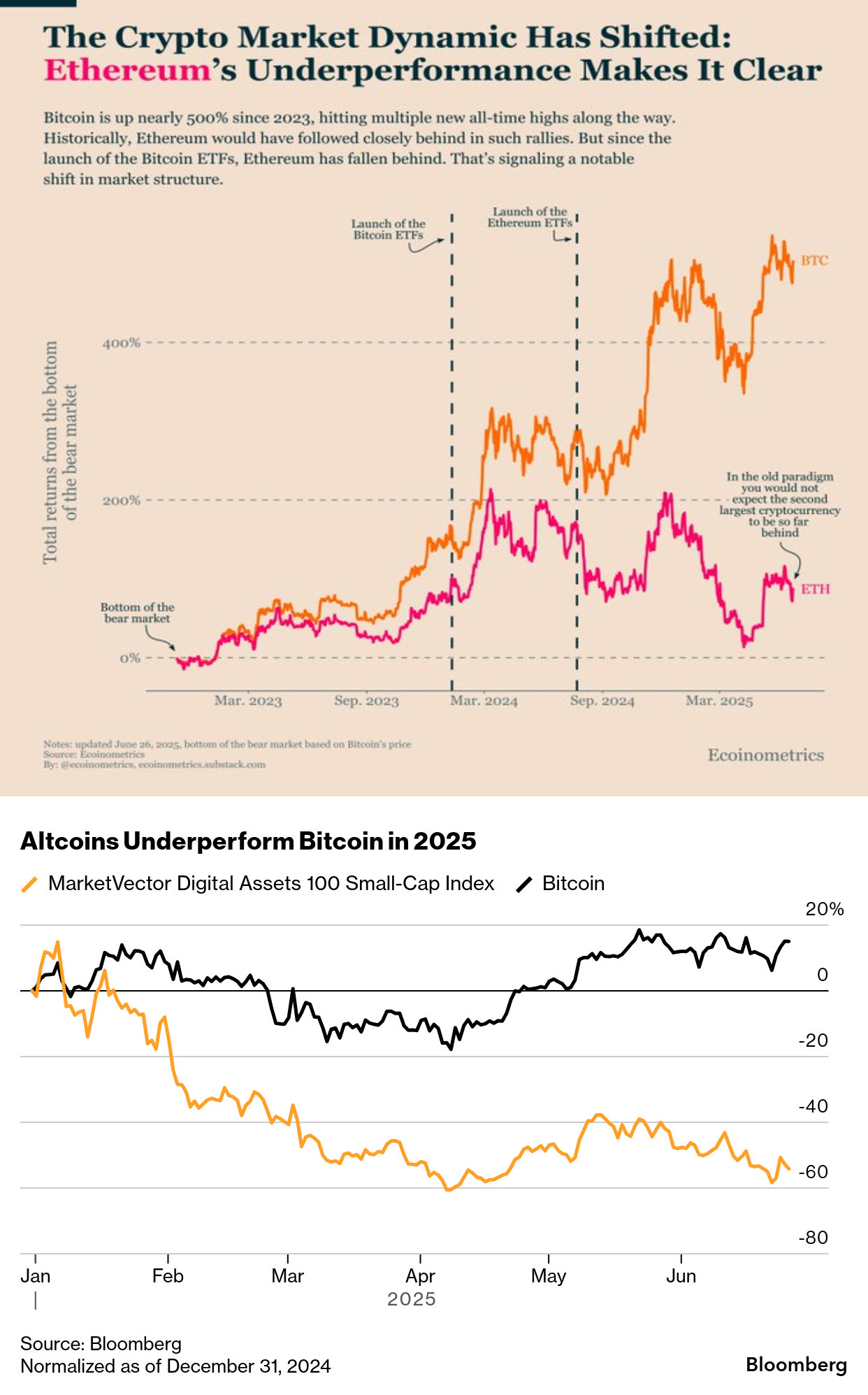
In every previous crypto bull cycle, Ethereum (ETH) would have followed Bitcoin (BTC) closely, sometimes even outperforming it during high-momentum phases. But this time is different. As the chart from Ecoinometrics shows (below), BTC’s price performance since the launch of U.S.-listed spot Bitcoin ETFs in early 2024 has been staggering, reaching new all-time highs.
In contrast, ETH has diverged sharply, underperforming at nearly every stage of the rally. Despite the launch of Ethereum ETFs later in 2024, the token has failed to regain momentum or investor confidence. This deviation is not a mere fluctuation—it marks a structural shift in crypto’s capital flows and narrative.
The ETF Catalyst: A Bitcoin-Only Onramp
The turning point came with the approval and launch of spot Bitcoin ETFs in January 2024. These financial vehicles, spearheaded by asset management giants like BlackRock and Fidelity, created a compliant, familiar onramp for traditional investors into crypto, but only into Bitcoin. This is not retail enthusiasm or tech-savvy crypto native investing.
This is institutional capital entering the market through tightly regulated channels. They are not “buying crypto.” They are buying Bitcoin, and only Bitcoin. The Ethereum ETFs that followed several months later failed to garner the same attention or inflows. Whether it’s the lack of a clear monetary policy narrative, its more complex valuation metrics, or regulatory ambiguity around staking, Ethereum hasn't captured the same institutional mindshare.
This explains the stark divergence in performance. As of June 2025:
-
Bitcoin has surged nearly 500% from its bear market lows.
-
Ethereum, in contrast, remains well below its 2021 all-time highs.
-
Altcoins (represented by the MarketVector Digital Assets 100 Small-Cap Index) are down more than 60% on the year, per Bloomberg data.
The Collapse of the Altcoin Dream
This new market structure has not only sidelined Ethereum but also cast a shadow over the broader altcoin ecosystem. The once-vibrant world of small-cap digital assets—tokens built around speculative use-cases, governance models, and decentralized applications—is now facing an existential reckoning.
As the second chart from Bloomberg shows, altcoins have consistently underperformed Bitcoin throughout 2025, plunging into double-digit losses while Bitcoin has climbed steadily. More than $300 billion in market value has been wiped out in the altcoin sector so far this year. Prominent projects have either faded into irrelevance or been delisted from major exchanges. Liquidity has dried up. Developer activity is declining. Trading volumes are anemic. What’s driving this shift?
The End of the "Everything Crypto" Thesis
For much of the last decade, the crypto market operated on a rising tide lifts all boats model. Bitcoin would rally, and other tokens would follow. Investors assumed that as blockchain adoption grew, the entire digital asset class would flourish. That assumption no longer holds. The current cycle suggests we are witnessing the end of the "everything crypto" thesis.
What’s taking its place is a far more selective market—one where only assets with clear, institutional-grade narratives are rewarded. And Bitcoin, with its scarcity-based monetary model, decentralized governance, and growing recognition as “digital gold,” fits the bill. Other assets—whether smart contract platforms, DeFi tokens, or governance coins—are struggling to justify their value in this new paradigm.
In this context, Ethereum’s underperformance becomes emblematic of the larger issue. While Ethereum remains technologically significant and fundamental to the Web3 ecosystem, its investment case is muddied. It does not offer the same store-of-value clarity that Bitcoin does, nor does it benefit from the same regulatory simplicity.
A Digital Wasteland?
If current trends persist, the crypto landscape of the late 2020s may bear little resemblance to the vibrant, experimental world of the 2017 and 2021 cycles. Instead of a multitude of competing layer-1s, yield-bearing DeFi protocols, and NFT-powered ecosystems, we may end up with a Bitcoin-dominated universe—augmented perhaps by select infrastructure tokens or real-world asset plays.
This raises uncomfortable questions:
-
Is crypto evolving into a Bitcoin-only ecosystem?
-
What happens to innovation if speculative capital and developer talent flee altcoins?
-
Is Ethereum's role as the "world computer" still viable without price performance to support its ecosystem?
These are not rhetorical questions. They speak to the heart of crypto’s identity crisis in 2025.
Crypto's Narrowing Future
To many observers, 2025 may appear as a resounding success for crypto. But that perception rests largely on Bitcoin’s shoulders. The rest of the market tells a different story—one of contraction, underperformance, and fading promise. Ethereum's inability to track Bitcoin’s performance in this cycle is more than a footnote; it’s a flashing red light for the entire non-Bitcoin crypto sector.
The ETF-driven inflows that were once seen as a tide to lift all crypto assets have instead clarified a hard truth: traditional finance isn’t buying “crypto.” It’s buying the Bitcoin thesis—and leaving the rest behind. As we look ahead, the question is no longer whether crypto will be adopted. That battle is being won. The question now is: what kind of crypto world are we building? Will it be a pluralistic ecosystem of innovation, or a Bitcoin-centric future with a trail of abandoned tokens in its wake?
Originally Published on Substack.






