
Exploring the economic, political, and industrial consequences of China’s export surge.
China’s trade engine has once again defied predictions of a slowdown. According to newly released data, China’s trade surplus surged 32.7% year-over-year, reaching an unprecedented $1.14 trillion in the twelve months through June 2025. This milestone not only represents the largest trade surplus ever recorded by a single country, but it also underscores the deep structural shifts occurring in the global economy.
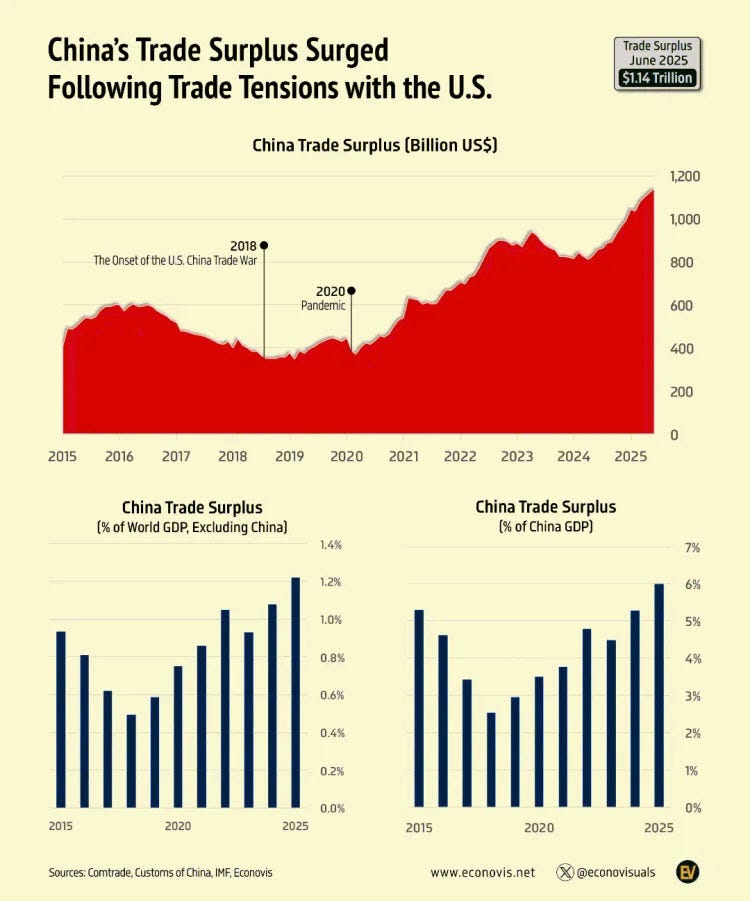
Since the onset of the U.S.-China trade war in 2018, China’s surplus has more than tripled, climbing from just under $400 billion to its current level. What was initially expected to weaken Beijing’s export dominance has instead highlighted the resilience and adaptability of China’s export machine, even amid tariffs, supply chain disruptions, and mounting geopolitical frictions.
This development, however, is not without consequence. The sheer scale of the surplus signals widening global trade imbalances, rising dependence on Chinese goods, and growing pressure on governments around the world to respond with protectionist policies.
The Making of a Record Surplus
The trade war, paradoxically, acted as a catalyst for China’s export resilience. The 2018 U.S.-China tariff battle, aimed at narrowing the American trade deficit with China, prompted Chinese firms to diversify their markets and deepen their integration with emerging economies. Simultaneously, the 2020 pandemic shifted global demand patterns in favor of China, as its factories reopened earlier than competitors and became the primary supplier of everything from medical equipment to electronics.
The chart below highlights these turning points clearly. After dipping during the early phase of the trade war, China’s surplus began climbing sharply in 2020. By 2021, the rebound was so pronounced that it exceeded pre-trade-war levels, and the trajectory has continued upward ever since.
Three key drivers stand out:
-
Robust Export Growth:
Chinese manufacturers have maintained global dominance in key industries such as electronics, machinery, textiles, and increasingly, electric vehicles (EVs) and renewable energy equipment. China’s ability to move up the value chain while scaling production capacity has kept its exports competitive. -
Sluggish Import Demand:
Imports into China have not kept pace with exports. Weak domestic consumption, combined with government policies aimed at bolstering self-reliance in critical industries, has curbed demand for foreign goods. -
Global Dependence on China:
China’s share of global exports has risen steadily. As the graph of trade surplus relative to global GDP shows, China’s surplus is now equal to over 1.2% of world GDP (excluding China), a sharp increase from less than 0.8% a decade ago.
Trade Surplus in Context: Domestic and Global
From a domestic perspective, China’s surplus is enormous even relative to its own economy. The data shows that in 2025, the surplus accounted for nearly 6% of China’s GDP. This is a remarkable figure, especially for an economy of China’s scale, and one that reflects a heavy reliance on external demand rather than domestic consumption for growth.
From a global perspective, such imbalances have worrying implications. Large trade surpluses are often mirrored by trade deficits elsewhere. For instance, the United States remains the largest counterparty, running persistent and widening deficits. But beyond the U.S., many emerging economies are also feeling the weight of cheap Chinese goods undercutting local industries.
Global Repercussions: Rising Tensions and Protectionist Risks
The surge in China’s surplus carries several implications that stretch beyond the numbers:
-
Strain on Trade Relations: The United States has already signaled frustration at its widening deficit with China. Similar concerns are emerging in Europe, where the influx of Chinese EVs and solar panels is prompting investigations and potential countermeasures. Protectionist responses, whether in the form of tariffs, quotas, or subsidies, are becoming increasingly likely.
-
Erosion of Industrial Competitiveness: Economies that cannot compete with China’s scale and efficiency risk deindustrialization. For instance, European automakers are struggling to match the price competitiveness of Chinese EVs. This raises difficult questions about how advanced economies can protect high-value industries without stifling trade.
-
Pressure on Global Economic Stability: The persistence of large global imbalances has historically been linked to financial instability. In the early 2000s, for example, global imbalances contributed to unsustainable capital flows that preceded the 2008 financial crisis. Today, China’s outsized surplus could act as a destabilizing force if it triggers trade conflicts or capital account pressures.
Why Has China Defied Expectations?
Many analysts predicted that rising wages, supply chain diversification, and geopolitical headwinds would erode China’s export edge. Yet, the opposite has happened. Several structural advantages explain why China continues to dominate:
-
Scale and Infrastructure: China’s vast manufacturing clusters, logistics infrastructure, and supply chain integration are nearly impossible to replicate.
-
Technological Upgrading: Investments in robotics, artificial intelligence, and green technologies have allowed China to maintain productivity gains despite rising costs.
-
Policy Support: Strategic state subsidies, industrial policy, and currency management have bolstered competitiveness.
-
Global Shifts: Rising geopolitical risks in other regions, from energy insecurity in Europe to political gridlock in the U.S., have reinforced reliance on Chinese supply chains.
What Lies Ahead?
Looking forward, several scenarios could shape the trajectory of China’s trade surplus:
-
Escalating Protectionism: If major economies respond aggressively, China could face a new wave of tariffs, anti-dumping measures, and industrial policy aimed at reducing dependence.
-
Domestic Rebalancing: China has long pledged to boost domestic consumption as a growth driver. Success in this area could reduce the trade surplus, but progress has been uneven.
-
Technological Decoupling: Moves by the U.S. and allies to restrict China’s access to advanced technology could alter its export composition, though not necessarily its overall trade advantage.
-
Global Supply Chain Realignment: The push for “China+1” strategies may diversify production over time, but near-term results suggest that China remains irreplaceable for many industries.
A Balancing Act for the World
China’s record $1.14 trillion trade surplus is more than just an economic milestone; it is a signal of profound structural imbalances in the global economy. While it reflects China’s enduring manufacturing dominance, it also highlights the risks of overdependence on a single exporter. For policymakers worldwide, the challenge is balancing legitimate concerns about competitiveness and fairness with the need to maintain open trade flows.
Overreaction risks triggering a cycle of protectionism that could harm global growth. Yet inaction risks eroding domestic industries and deepening imbalances. As the global economy navigates an uncertain future, China’s trade surplus stands as both a testament to resilience and a warning of fragility. The world must now confront the uncomfortable truth: trade imbalances of this magnitude are unsustainable, and the longer they persist, the greater the risk to global economic stability.
Originally Published on Substack.






