
Despite rivalries, Eurasia’s biggest powers are finding common ground as Washington doubles down on coercive trade policy.
Over the weekend, the city of Tianjin, China, played host to a significant geopolitical event: the 25th Heads of State Council meeting of the Shanghai Cooperation Organization (SCO). While such summits often pass quietly in Western media, this year’s gathering drew international attention—not merely for its size or symbolism, but for what it signals about the future trajectory of global power.
At the center of the stage stood Chinese President Xi Jinping and Russian President Vladimir Putin, projecting unity as their nations deepen strategic cooperation. More strikingly, Indian Prime Minister Narendra Modi joined them hand-in-hand, putting aside his country’s strained border relations with China. The gesture sent a message that reverberated far beyond Tianjin: in an era of growing trade and geopolitical tensions with Washington, Eurasia’s largest powers are willing to set aside old disputes in the name of “close cooperation.”
For the White House, this moment is impossible to ignore.
A Counterweight to American Power
For decades, U.S. foreign policy has relied on both hard power (military alliances such as NATO) and economic leverage, particularly under President Trump, whose flagship diplomatic tool is coercive trade policy. Through tariffs, sanctions, and restrictions, Washington sought to bend both allies and rivals to its will.
Although this approach has succeeded with countries dependent on American markets, supply chains, or security guarantees, but for others, it has been a catalyst for change. The harder Washington leans on coercion, the greater the incentive for independent powers to band together and build alternative frameworks. The SCO is one such framework.
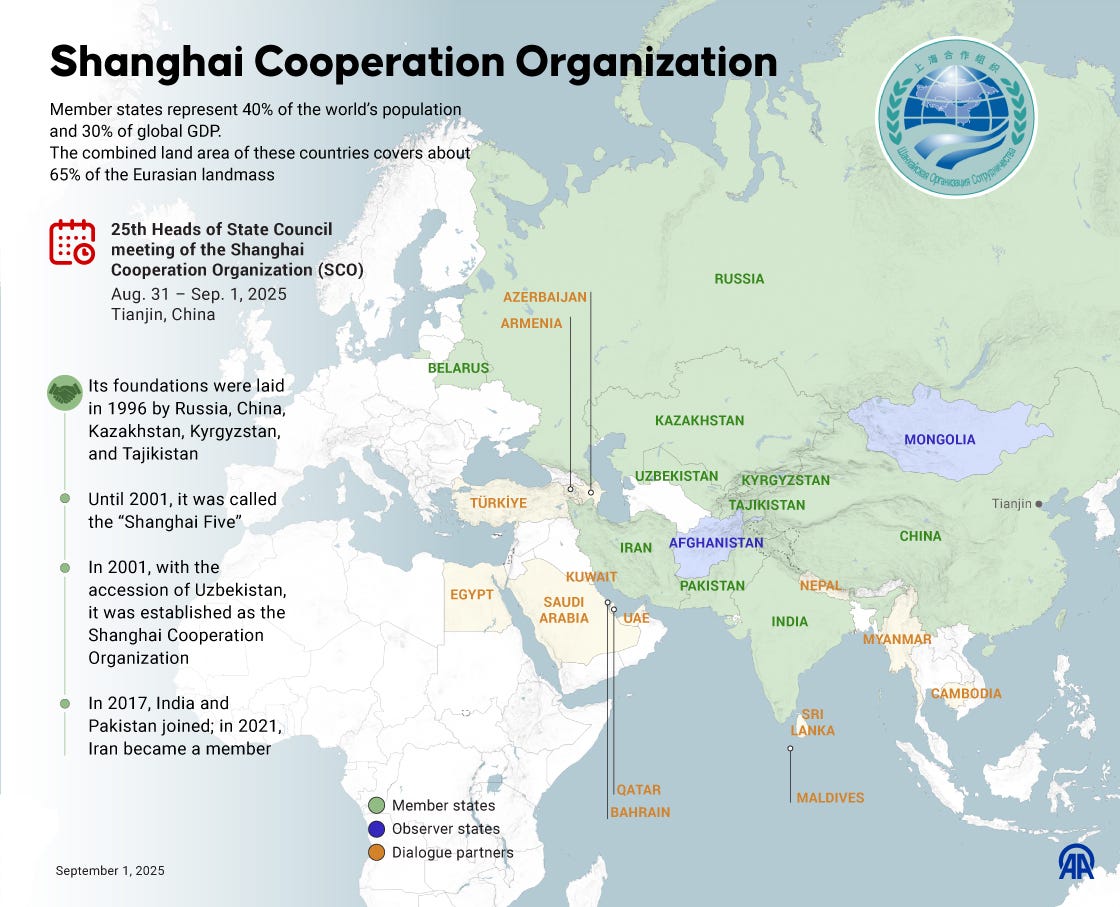
Founded in 2001, with its roots in the “Shanghai Five” established in 1996, the SCO has evolved into a massive regional bloc. Its current membership includes China, Russia, India, Pakistan, and several Central Asian republics, with Iran joining in 2021. The organization also counts observer states such as Belarus and Mongolia, and dialogue partners including Turkey, Saudi Arabia, and Egypt.
Collectively, SCO member states:
-
Represent 40% of the world’s population.
-
Account for nearly 30% of global GDP.
-
Cover 65% of the Eurasian landmass.
By sheer scale, it dwarfs most regional organizations, including the European Union.
Xi’s Vision of “True Multilateralism”
In his address to the gathering, President Xi Jinping seemed to take a jab at U.S. dominance:
“We must continue to take a clear stand against hegemonism and power politics, and practice true multilateralism. The SCO must oppose the Cold War mentality, bloc confrontation, and bullying practices.”
The message was clear: Beijing seeks to frame the SCO as an alternative to U.S.-led alliances. Where Washington projects influence through security pacts and financial institutions like the IMF and World Bank, the SCO aims to present itself as a champion of sovereignty, equality, and multipolarity.
One initiative under discussion is the creation of an SCO Development Bank, which would join the Asian Infrastructure Investment Bank (AIIB) and BRICS’ New Development Bank in offering financing options outside the U.S.-dominated global system. In a world where dollar dominance is increasingly challenged, such initiatives matter.
India’s Balancing Act
Perhaps the most intriguing actor at Tianjin was India. As one of the world’s fastest-growing economies, India has increasingly aligned with the United States on technology, defense, and trade. However, the relationship has turned sour with Trump’s imposition of 50% tariffs on India. By joining Xi and Putin at the SCO summit, Modi signaled that India will continue to pursue strategic autonomy—cooperating with Washington where interests align, but also deepening ties with Eurasian partners when circumstances demand. This balancing act is not without contradictions, though.
India’s delegation avoided close engagement with Pakistan, highlighting the deep fault lines that still run through the SCO. Furthermore, Modi departed before China’s Victory Day parade, an event intended to showcase Beijing’s military might alongside leaders like North Korea’s Kim Jong Un and Iran’s President Masoud Pezeshkian. India’s partial distancing suggests that while it values economic and security cooperation within the SCO, it is not ready to fully endorse China’s projection of power.
Russia’s Pivot to the East
For Russia, the SCO provides a crucial platform at a time when Western sanctions have limited its options. By strengthening ties with China, India, and Central Asia, Moscow demonstrates that it is far from isolated. Energy exports, military cooperation, and joint infrastructure projects ensure that Russia retains influence in Eurasia even as it is cut off from European markets. The SCO thus represents more than a regional bloc; it is a lifeline for Russia’s geopolitical ambitions.
The Promise and the Limits
The SCO’s potential is undeniable:
-
It could serve as a powerful forum for energy cooperation, linking producers (Russia, Iran, Central Asia) with major consumers (China, India).
-
Financial independence through new banking structures could gradually erode the global dominance of Western-led institutions.
-
Shared security concerns, from terrorism to cyber threats, provide a foundation for cooperation.
Yet limitations are equally visible:
-
Intra-bloc tensions: India and Pakistan remain deeply mistrustful, often clashing diplomatically within the SCO forums.
-
China-India disputes: Border conflicts along the Line of Actual Control remain unresolved.
-
Divergent agendas: Central Asian states may resist domination by China and Russia, preferring to hedge their bets.
These fractures make the SCO a complex and sometimes unwieldy organization, raising doubts about whether it can truly act as a unified counterweight to the West.
Why It Matters?
Nonetheless, the Tianjin summit highlights a broader trend: the rise of multipolarity in global politics. American dominance, which followed the Cold War, is giving way to a more fragmented system in which multiple centers of power compete for influence. For businesses, policymakers, and global citizens alike, this shift has real consequences. Supply chains, financial flows, and trade policies are increasingly shaped by geopolitics.
The SCO’s initiatives, if realized, could accelerate the diversification of global finance, deepen energy interdependence across Eurasia, and further challenge U.S. leverage. While challenges remain, especially internal rivalries, the symbolism of Xi, Putin, and Modi standing together cannot be overstated. It reflects the shifting gravitational pull of global politics from West to East, from Atlantic to Eurasia. The coming years will test whether the SCO can evolve from a symbolic coalition into a true counterweight to U.S.-led structures.
Originally Published on Substack.





