
Let’s decode the power struggle between Bitcoin and Ethereum using a relative strength chart
Ever wondered how digital currencies like Bitcoin and Ethereum navigate the financial seas without any traditional anchors? Well, here’s the scoop — these cryptocurrencies operate in a realm where supply, demand, buying power, and selling pressure dictate their value. In simpler terms, investing in digital assets is like diving into the deep end of behavioral finance — it’s all about understanding market psychology.
Now, let’s talk charts. Forget about Bitcoin or Ethereum for a moment; we are diving into something called a “Relative Strength Chart.” Pictured below, It is not your typical price graph, instead, it provides a comparison between these two titans of crypto — Bitcoin and Ethereum.
Take a peek at the top left corner where you’ll spot the first symbol, $BTCUSD. When the chart trends upwards, it means Bitcoin is flexing its muscles with higher relative strength (RS). Conversely, a downward trend suggests Ethereum is outshining Bitcoin in terms of RS, making it a potentially better investment choice at that time.
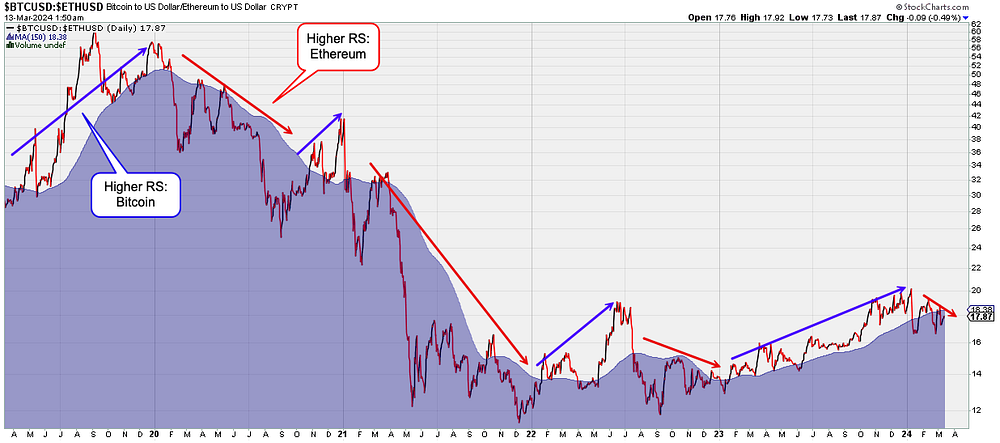
But deciphering trends on an RS chart can be like navigating a maze. To simplify things, a 150-day moving average (150MA) was added to help identify strength pivot points. Picture this — when the chart dips below the blue zone, Ethereum takes the RS crown. When it’s cruising above the blue, Bitcoin steals the spotlight.
So, what’s the big deal about relative strength? Well, it’s like staying on the winning team in a game — studies show that strong performers tend to keep their momentum for 6–12 months on average. Of course, it’s not foolproof, but it’s a handy tool to gauge which of these crypto giants is leading the pack at any given moment.
In the wild world of crypto, knowing when to ride the waves of strength and dodge the underperformers can make all the difference. So, buckle up, and let’s navigate these digital seas with a keen eye for strength and momentum! I will sign off by reiterating that nothing in this article is to be construed as investment advice and that you should always do your due diligence before making any investment decision.
Originally Published on Substack.






