
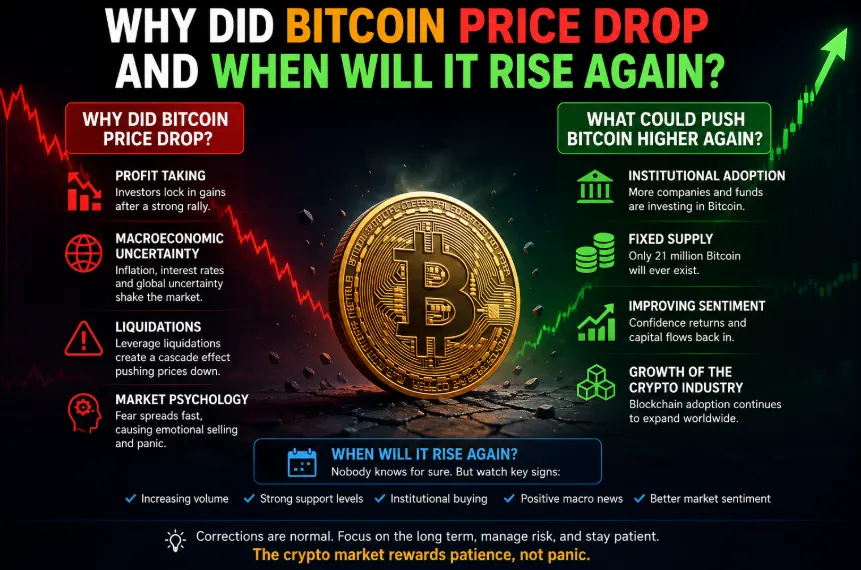
Bitcoin has once again reminded investors that volatility is part of the game. After reaching new highs and attracting massive attention from retail and institutional investors, the world's largest cryptocurrency experienced a significant pullback.
So why did Bitcoin fall, and more importantly, when might it start climbing again?
Why Did Bitcoin's Price Drop?
1. Profit Taking After a Strong Rally
One of the most common reasons for Bitcoin corrections is simple: investors take profits.
After a major rally, many traders decide to lock in gains. When enough investors sell at the same time, the market experiences downward pressure.
2. Macroeconomic Uncertainty
Cryptocurrencies do not exist in a vacuum. Interest rate expectations, inflation data, economic growth concerns, and central bank policies all affect investor sentiment.
When uncertainty increases, many investors move money away from risk assets, including Bitcoin.
3. Liquidations in Leveraged Markets
Many crypto traders use leverage to amplify gains.
Unfortunately, when prices begin to fall, leveraged positions can be automatically liquidated. This creates a cascade effect, pushing prices even lower in a short period of time.
4. Market Psychology
Fear spreads much faster than optimism.
Negative headlines, sudden price drops, and social media panic often cause investors to sell emotionally. This can turn a normal correction into a larger decline.
Is Bitcoin's Bull Market Over?
Not necessarily.
Historically, Bitcoin has experienced numerous corrections of 20%, 30%, and even 50% during long-term bull cycles.
Many of Bitcoin's strongest rallies occurred after periods of fear and uncertainty.
While no one can predict the future with certainty, temporary pullbacks have often been a normal part of Bitcoin's growth story.
What Could Push Bitcoin Higher Again?
Institutional Adoption
The continued involvement of large financial institutions remains one of the strongest bullish factors.
As more companies, funds, and investors gain exposure to Bitcoin, long-term demand may continue to grow.
Bitcoin's Fixed Supply
Only 21 million Bitcoin will ever exist.
As adoption increases and supply remains limited, basic supply-and-demand economics could support higher prices over time.
Improving Market Sentiment
Markets move in cycles.
When confidence returns and investors become more optimistic, capital often flows back into Bitcoin and other cryptocurrencies.
Long-Term Growth of the Crypto Industry
Blockchain technology continues to expand across finance, gaming, payments, and digital ownership.
Many investors view Bitcoin as the primary beneficiary of this long-term trend.
When Could Bitcoin Rise Again?
The honest answer is that nobody knows exactly when.
Short-term price movements are extremely difficult to predict. However, investors typically watch several key indicators:
- Increasing trading volume
- Strong support levels holding
- Institutional buying activity
- Positive macroeconomic developments
- Improving investor sentiment
When these factors align, Bitcoin often begins its next upward move.
Final Thoughts
Bitcoin's recent decline may feel alarming, but corrections have been a recurring part of its history.
Whether the next rally starts in weeks or months, many long-term investors continue to focus on Bitcoin's adoption, scarcity, and growing role in the global financial system.
As always, investors should do their own research, manage risk carefully, and avoid making decisions based solely on short-term price movements.
The crypto market rewards patience far more often than panic.
Thanks for reading me.. Brighter days coming, just believe..
My latest earning sites:






