
Volatile daily inflows mask a deeper trend of persistent capital outflows, underscoring why patience is essential in a grinding crypto downturn.
If there is one discipline investors must internalize in a bear market, it is this: slow down. Bull markets tend to climax quickly. Momentum accelerates, valuations stretch, and reversals are often abrupt. Near market tops, there is a narrow window where reducing exposure can meaningfully preserve capital. The challenge is execution, but at least the logic is straightforward: when euphoria peaks, risk is elevated.
Bear markets operate differently. They do not collapse and recover in a symmetrical fashion. They grind. They fluctuate. They deliver intermittent rallies that briefly revive optimism. Yet durable regime shifts rarely appear overnight. They require sustained changes in capital allocation, positioning, and demand. Understanding that distinction is critical. And nowhere is it more evident than in recent Bitcoin ETF flows.
The Illusion of Daily Volatility
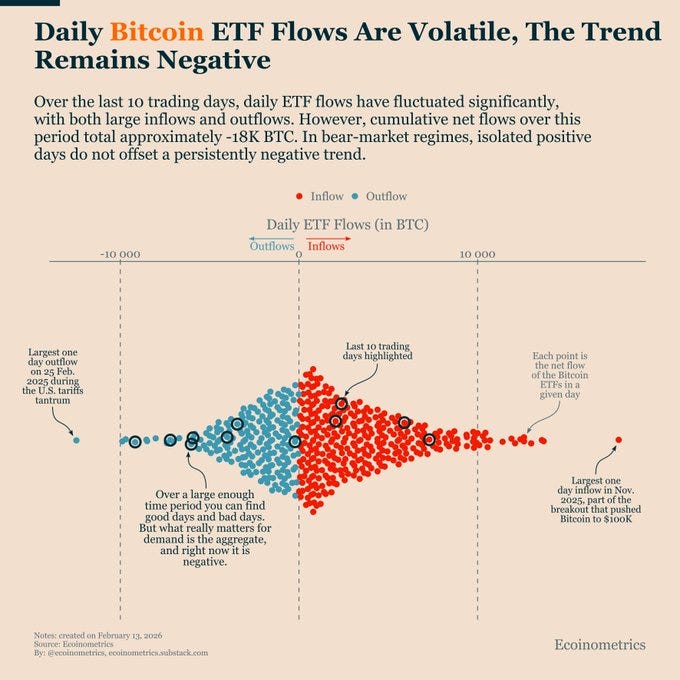
The attached data (chart below) on daily Bitcoin ETF flows offers a textbook example of why scale matters. Over the last 10 trading days, flows have been volatile. There have been meaningful inflows and significant outflows. Some sessions show strong demand. Others register heavy selling pressure.
Viewed in isolation, a cluster of positive days can appear encouraging. A sharp inflow may even feel like confirmation that institutional appetite is returning. However, zooming out slightly changes the narrative. Cumulative net flows over the last 10 trading days total approximately –18,000 BTC. In aggregate, capital has exited Bitcoin ETFs, not entered them.
This distinction is not trivial. In bear-market regimes, the aggregate direction of capital matters far more than individual sessions. Markets are adaptive systems. Short-term countertrend rallies are common. What defines regime change is sustained participation on the buy side. Without that persistence, volatility is simply noise.
Regime Shifts Require Sustained Capital Allocation
History reinforces this point. During prolonged drawdowns in equities, commodities, and digital assets alike, positive daily or weekly inflows frequently occur before the ultimate bottom is established. These episodes often represent short covering, tactical positioning, or temporary optimism driven by headlines. What they do not represent is structural demand.
For a genuine recovery phase to take hold, capital allocation must become persistent. Institutional flows need to shift from net outflows to consistent net inflows across multiple weeks, not isolated days. That shift reflects portfolio rebalancing, long-term conviction, and strategic exposure adjustments.
In the context of Bitcoin ETFs, a durable recovery would require cumulative inflows turning positive over meaningful time horizons. Until that occurs, the presence of occasional strong inflow days does not invalidate the prevailing trend. A –18,000 BTC net flow over 10 days is not ambiguous. It signals that, despite volatility, aggregate demand remains negative.
Why Bear Markets Grind?
The grinding nature of bear markets reflects psychology and liquidity conditions. In bullish environments, capital chases momentum. Flows are self-reinforcing. In bearish regimes, capital becomes selective and defensive. Risk tolerance contracts. Liquidity providers widen spreads. Investors demand stronger confirmation before committing capital.
As a result, markets oscillate. Prices rise on optimism, then retrace on skepticism. ETF flows mirror this behavior. One day of optimism does not erase broader caution. This pattern is visible not only in digital assets but across asset classes.
During prior downturns in the S&P 500 and Nasdaq Composite, sustained inflow trends did not materialize until macroeconomic conditions stabilized and earnings expectations bottomed. Bitcoin, while structurally distinct, is not immune to cyclical capital dynamics. The same principle applies: trend change requires consistent demand.
Zooming Out Changes the Interpretation
Investors often misinterpret turning points because they analyze data at the wrong frequency. Daily flows, daily candles, and intraday volatility amplify noise. When zoomed out even slightly, patterns become clearer. The scatter plot of daily ETF flows highlights both inflows and outflows, but the clustering reveals a net negative bias over the recent period. The aggregate direction is what matters.
Bear markets reward those who adopt a higher-level perspective. Patience becomes a strategic advantage. Slowing down allows investors to differentiate between tactical rallies and structural shifts. In practical terms, this means monitoring cumulative flows, not just daily prints. It means observing multi-week trends rather than reacting to single-session strength. It also means recognizing that true regime transitions build gradually.
Patience as a Competitive Edge
There is an instinct in volatile markets to act. To respond. To anticipate the inflection point before it becomes obvious. Yet in bear markets, premature conviction is costly. The data suggests that institutional capital, as measured through ETF flows, has not yet decisively shifted. Until sustained inflows emerge, volatility alone does not constitute a signal.
This does not imply pessimism. It implies discipline. The turning point will not be defined by a single strong inflow day. It will emerge in the cumulative data. It will be visible in persistent positive net flows, reflecting sustained allocation rather than episodic enthusiasm.
Bear markets test conviction not through dramatic collapses alone, but through prolonged ambiguity. They challenge investors to distinguish noise from signal. The lesson, then, is straightforward. Slow down. Zoom out. Let the aggregate data guide interpretation. When demand truly returns, it will be visible in sustained capital flows, not fleeting volatility. Until that shift occurs, patience remains the most rational strategy.
Originally Published on Substack.






