
Renewed ETF inflows, bullish macro conditions, and strong tech market momentum suggest Bitcoin could hold above $120K into September.
Bitcoin’s price surged to $124,457 this week, and in the process pushed its total market capitalization above that of Alphabet—the parent company of Google (5th largest in the world)—marking a significant milestone in its 15-year history. This leap not only reinforced Bitcoin’s bullish momentum but also sent a strong signal to traditional markets: the world’s largest cryptocurrency is entering a new phase of institutional adoption, macroeconomic alignment, and financial market integration.
A Perfect Storm of Bullish Catalysts
Several intertwined factors powered Bitcoin’s latest rally, and analysts see a confluence of short-term momentum and long-term structural support.
1. Growing Correlation with Gold
One of the most intriguing developments in Bitcoin's recent performance has been its growing correlation with gold, traditionally viewed as the ultimate store of value during uncertain times. This correlation represents a maturation of Bitcoin's investment thesis, suggesting that market participants increasingly view the cryptocurrency through the lens of portfolio diversification and wealth preservation rather than pure speculation.
2. Favorable Macroeconomic Conditions
The Federal Reserve’s shift toward a more dovish policy stance has reignited risk appetite across asset classes. Falling bond yields, slowing inflation metrics, and renewed expectations for rate cuts starting next month have all created a backdrop conducive to speculative and growth-oriented assets. The Nasdaq 100 (tech-heavy index) has been steadily rising in recent weeks, and is a testament to the return of risk-on sentiment, and Bitcoin appears to be riding that same wave.
3. Renewed Institutional Demand
Perhaps most importantly, Bitcoin ETFs, after a period of sustained outflows, are now seeing robust inflows again. Institutional investors, ranging from asset managers to corporate treasuries, have been gradually increasing exposure to Bitcoin, treating it as both a portfolio diversifier and a growth asset. This renewed participation is pivotal, as it brings deep-pocketed, long-term buyers into the market.
The ETF Flows Model: Why $120K is Just the Starting Point
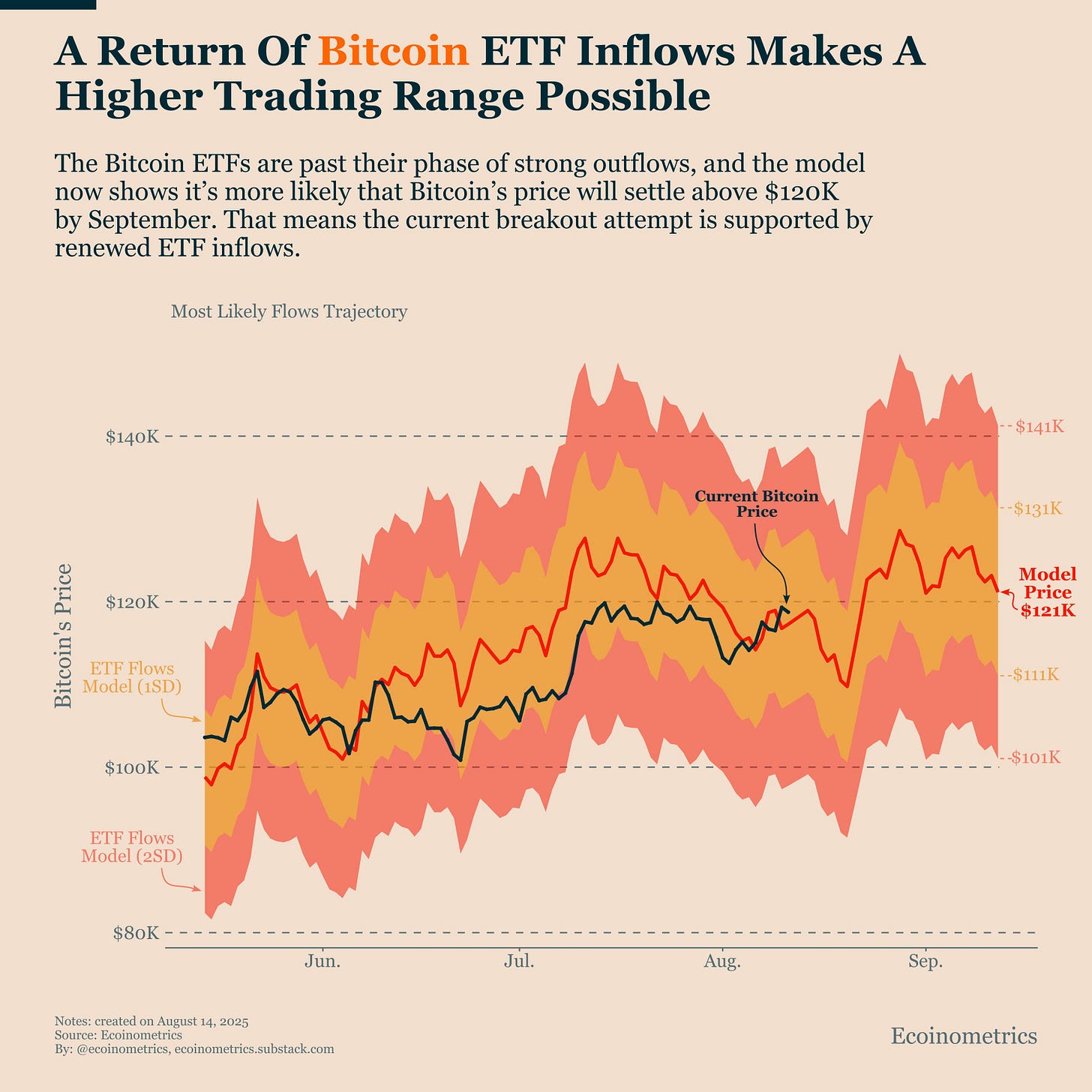
The latest data from Ecoinometrics offers a compelling framework for understanding Bitcoin’s near-term price trajectory. The firm’s ETF flows model, updated on August 14, 2025, suggests that Bitcoin is likely to settle just above $120K by September. The upper bound of the model’s one-standard-deviation range is $131K, with an extreme scenario reaching $141K.
In the chart below, the red line represents the model’s median projection based on ETF inflow patterns, while the shaded orange and pink bands capture one- and two-standard-deviation ranges, respectively. The current Bitcoin price, shown in black, is now comfortably within the upper half of the one-standard-deviation band—a bullish technical positioning.
The key takeaway? The market’s recent breakout is backed by real capital flows from ETFs, suggesting structural support for higher prices.
ETF Flows: From Headwind to Tailwind
When U.S.-listed Bitcoin ETFs first launched in late 2024, they experienced enormous hype followed by a period of aggressive outflows as early traders took profits and macro uncertainty weighed on speculative assets. By mid-2025, however, the selling pressure had subsided, and inflows began to stabilize.
Now, in August, we are seeing a decisive shift: ETF inflows have turned positive on a sustained basis. This is critical for two reasons:
-
ETFs Create a Base of Sticky Demand – Unlike retail traders who may chase short-term swings, institutional ETF buyers often allocate with multi-quarter or even multi-year horizons. This creates a steady accumulation effect.
-
Flows Drive Price – In Bitcoin’s relatively illiquid market (compared to traditional equities), large ETF inflows can meaningfully push prices higher, especially when supply is constrained by halving cycles and long-term holders refusing to sell.
Risk-On Sentiment Returns
Broader market conditions are providing an important tailwind for Bitcoin’s rise. The Nasdaq 100 index has been grinding higher in recent weeks, reflecting renewed optimism in tech and growth sectors. This “risk-on” environment typically benefits Bitcoin, which, despite its growing reputation as digital gold, still behaves like a high-beta asset during bullish market phases.
In addition, volatility indexes remain subdued, and liquidity conditions across global markets have improved, further supporting speculative flows into crypto. This alignment between Bitcoin’s internal drivers (ETF inflows) and external drivers (macroeconomic trends) strengthens the bullish case.
Breaking the $120K Resistance
From a technical perspective, $120K had been a formidable resistance level. It represented both a psychological barrier and a price zone where selling pressure historically intensified. Bitcoin’s clean break above this level—and its ability to hold gains—suggests a shift in market structure. Traders are increasingly viewing pullbacks as buying opportunities, not exit points.
If the ETF flows model holds true, Bitcoin’s next key levels are likely:
-
$131K – Upper bound of the one-standard-deviation projection
-
$140K–$141K – Extreme bullish scenario by early Q4 2025
These levels are not just arbitrary price targets; they reflect a statistical probability derived from current capital flow dynamics.
The Alphabet Comparison: Symbolism Matters
While surpassing Alphabet in market capitalization is largely symbolic, it’s a powerful narrative driver. At its current price, Bitcoin’s market cap exceeds $2.3 trillion, placing it alongside the world’s largest companies. This comparison reinforces the perception of Bitcoin as a legitimate macro asset, not a speculative niche product.
For institutional investors who may have been hesitant to treat Bitcoin seriously, milestones like this create peer pressure. If your portfolio already holds Apple, Microsoft, and Alphabet, the argument for adding Bitcoin—now comparable in market size—becomes harder to ignore.
What Could Go Wrong?
No bullish case is complete without a sober assessment of risks. For Bitcoin, the key challenges ahead include:
-
Regulatory Shocks – Any adverse regulatory action in major markets like the U.S. or EU could disrupt institutional flows, although highly unlikely.
-
Macro Surprises – A sudden shift toward higher interest rates or a liquidity crunch could reverse the current risk-on mood.
-
ETF Fatigue – While inflows are currently strong, they could stall if performance expectations aren’t met, leading to renewed outflows.
It’s worth noting, however, that the ETF flows model inherently adjusts for changes in inflow patterns, making it a dynamic rather than static projection tool.
The Bias Remains to the Upside
Taking all of this into account—the renewed institutional demand, positive ETF inflows, favorable macro backdrop, and technical breakout—the bias for Bitcoin remains firmly to the upside. Short-term pullbacks are likely in any trending market, but the weight of evidence suggests higher levels are more probable than a sustained reversal in the months ahead.
If Bitcoin does indeed settle above $120K into September and pushes toward $131K or beyond, it would represent one of the fastest trillion-dollar wealth creations in market history. And unlike past parabolic moves, this rally is increasingly anchored in institutional adoption and capital market integration.
Bitcoin’s New Phase
Bitcoin’s journey from a niche experiment to a trillion-dollar asset class has been anything but smooth. Yet, each cycle brings it closer to the mainstream financial system. The current rally—marked by ETF-driven flows, macroeconomic alignment, and growing correlations with traditional safe-haven assets—feels different from the retail-driven surges of the past.
The story from here will hinge on whether ETF inflows can sustain momentum and whether the macro environment remains favorable. If they do, the market may look back at $120K not as a peak, but as the foundation for the next leg higher.
Originally Published on Substack.






