With correlations to NASDAQ holding steady, Bitcoin is positioned to ride the next wave of market optimism.
Bitcoin has long defied easy categorization. Is it digital gold, a tech stock in disguise, or an anti-fiat insurgent? Over the past decade, it has been called all three—and more. But if recent data tells us anything, it’s this: Bitcoin continues to behave like a risk-on asset. And in today’s market environment, that’s not a bug—it’s a feature.
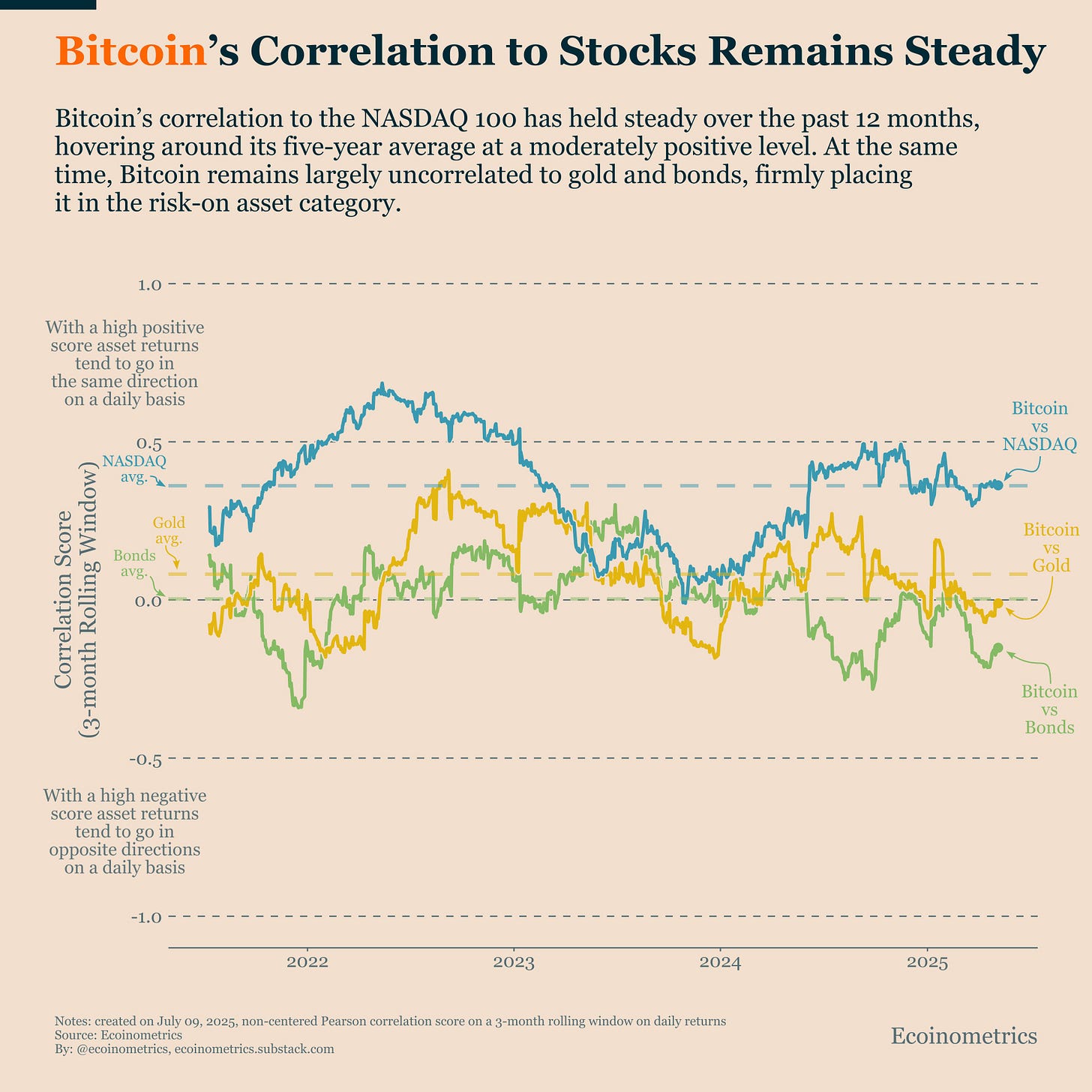
A fresh chart from Ecoinometrics, dated July 9, 2025, illustrates this point vividly. It tracks Bitcoin’s 3-month rolling correlation to three major asset classes: the NASDAQ 100 (equities), gold (precious metals), and bonds (fixed income). What emerges is a compelling picture of Bitcoin as a hybrid asset that moves with risk but refuses to be bound by traditional safe-haven logic.
Breaking Down the Chart: Understanding the Baselines
Before diving into the correlations themselves, it’s important to understand what these other assets represent in the broader portfolio universe:
-
NASDAQ 100: This is the quintessential growth benchmark, heavily tilted toward tech and innovation stocks. When markets are bullish and investors crave upside, the NASDAQ tends to surge. It’s the very definition of a risk-on play.
-
Gold: Often referred to as a safe haven, gold shines brightest in times of uncertainty—economic slowdowns, geopolitical tension, or currency debasement. It stores value but doesn’t yield it, thriving when fear outweighs greed.
-
Bonds: Particularly sovereign bonds like U.S. Treasuries represent the traditional risk-off play. In downturns or crises, money flees into these debt instruments seeking safety and stability. Their correlation with equities is often negative, especially during market panics.
Bitcoin is plotted against each of these on a 3-month rolling correlation basis. The correlation score ranges from -1 (perfectly inverse) to +1 (perfectly aligned), with 0 indicating no correlation. Let’s examine how Bitcoin stacks up against each.
Bitcoin & NASDAQ: A Comfortable Companion in Risk-On Climates
The most striking line in the Ecoinometrics chart is the blue line, representing Bitcoin’s correlation with the NASDAQ 100. Over the past 12 months, this correlation has remained positive and stable, hovering close to its five-year average of around 0.4 to 0.5. This moderate yet persistent correlation underscores a consistent behavior: when tech stocks do well, Bitcoin tends to follow.
This is no accident. Bitcoin has, especially since 2020, traded like a high-beta tech asset. It reacts positively to liquidity, low interest rates, and investor appetite for growth. As central banks pivoted to more dovish postures in early 2025 and U.S. tech rebounded strongly, Bitcoin mirrored those gains. The asset is behaving like a levered version of the innovation economy—more volatile, yes, but directionally aligned.
This correlation doesn’t diminish Bitcoin’s uniqueness—it highlights its role in a portfolio as a growth enhancer. Like the NASDAQ, Bitcoin thrives in environments where future cash flows are valued more highly and risk is priced attractively. It might not be a stock, but it sure acts like one.
Bitcoin & Gold: Divergence in Philosophy and Behavior
If Bitcoin is a “digital gold,” someone forgot to tell the market. The yellow line in the chart—Bitcoin’s correlation to gold—rarely breaches the 0.2 level, and often dips below zero. In fact, over the past year, the correlation has hovered around 0.0 to slightly negative, reaffirming the lack of consistent directional movement between the two. This uncoupling is philosophically and practically significant.
While both assets are touted as hedges against fiat debasement, they respond to macro signals in fundamentally different ways. Gold appreciates when investors grow risk-averse; Bitcoin appreciates when they’re optimistic about risk-adjusted growth, particularly in tech or emerging markets. This divergence matters for institutional allocators. Gold sits in the “safety” bucket. Bitcoin doesn’t. And that’s okay—it allows Bitcoin to behave more like a growth accelerator than a capital preserver.
Bitcoin & Bonds: Negative to Neutral, and Consistently Risk-On
Then there’s the green line, which tracks Bitcoin’s correlation to bonds—another classic safe-haven asset. The relationship here has been mostly negative to flat, frequently dipping below zero in early 2023 and again in late 2024. This negative correlation is exactly what you’d expect in a risk-on environment.
As bond prices rise (often during economic slowdowns or rate cuts), Bitcoin either drifts or declines—unless, of course, liquidity injections lift all boats. But the two rarely move in tandem. This supports the view that Bitcoin is not a capital preservation asset. It is not a store of safety when markets turn fearful—it’s a speculative growth asset that feeds off liquidity, innovation, and risk sentiment.
The Bigger Picture: Bitcoin’s Identity Crisis is Over
What we see in the chart above is not an identity crisis—it’s identity confirmation. Bitcoin is:
-
Not a safe haven like bonds or gold.
-
Not fully a stock, but behaves similarly to high-beta growth assets.
-
A unique hybrid: a growth asset with hard-money properties, an inflation hedge with startup-like volatility.
This has implications for investors. When risk-on sentiment dominates, Bitcoin offers one of the highest upside exposures. It’s volatile, yes, but so is any early-stage technology or monetary experiment. If you want something that acts like digital cash or decentralized collateral, you buy it for its long-term thesis. But you hold it through risk cycles because it thrives when markets are buoyant.
Why Now Might Be the Setup for a New All-Time High
In 2025, macro conditions are aligning in a way that could strongly favor Bitcoin. Inflation is easing but still above central bank targets. The Federal Reserve, now more tolerant of structural inflation, has begun a mild easing cycle. Tech stocks are resurgent. Geopolitical pressures are exposing the fragility of fiat regimes.
And Bitcoin? It’s sitting comfortably in the risk-on camp, benefiting from capital rotation out of cash and bonds and into tech, AI, and digital innovation. If the NASDAQ continues its rally—and history suggests that liquidity-fueled tech booms can be persistent—Bitcoin could not only participate but lead.
You Can’t Be Everything—and That’s Bitcoin’s Strength
Bitcoin isn’t a safe haven, and that’s okay. It’s not supposed to move like gold or act like bonds. Its strength lies in being a new category—one that marries digital scarcity with growth-market behavior. The Ecoinometrics data supports this: Bitcoin is a high-volatility, risk-on asset with asymmetric upside, deeply uncorrelated to traditional hedges.
As long as risk appetite holds and macro tailwinds continue to blow, Bitcoin is well-positioned for a breakout. The only thing it can’t do is play it safe. But then again, revolutions never do.
Originally Published on Substack.