
A short historical review.
After the Japanese invasion in Korea, which was allied with China, the Chinese-Japanese war began in 1894. China suffered a defeat and had to cede Taiwan to Japan. Until 1945, i.e. for 50 years, the Japanese flag blew over the "beautiful island" (Ilha formosa). Under colonial rule, Taiwan experienced a huge economic upswing, but also lost part of its cultural identity.
After the Japanese defeat in World War II, Taiwan was returned to China in October 1945. The republic of China was ruled by nationalist President Chiang Kai-shek. The conflict between communists and nationalists, which had been smouldering since the 1920s, grew into a civil war, at the end of which Mao Zedong proclaimed the People's Republic of China. Chiang Kai-shek fled with his army and supporters to Taiwan. The doctrine of regaining power in Beijing was not officially abandoned until 1991.
Chiang Kai-shek established an authoritarian regime in Taiwan. Under dictatorial leadership, the economy and education were strongly promoted. Taiwan developed from an agrarian state to a leading producer of consumer goods. The people had to pay a high price for this. Taiwanese language and culture were repressed. Open criticism of the government meant not rarely a death sentence in the police and informer state. Until 1987 it was still necessary to obtain a permit to leave the country. But the propaganda stylized the "Generalissimo" to a superhuman and saviour of the people from communism.
Chiang Kai-shek Memorial Hall
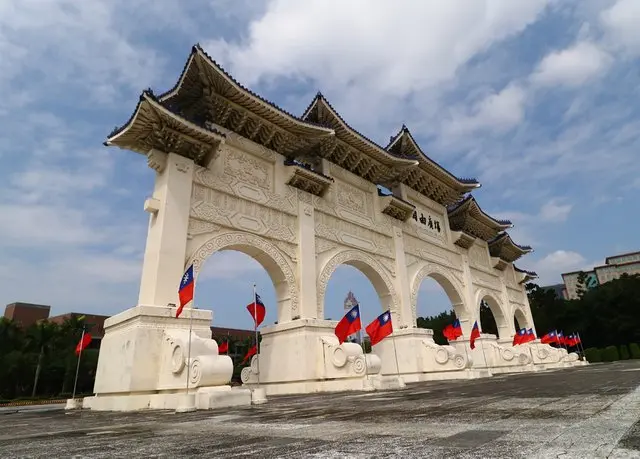
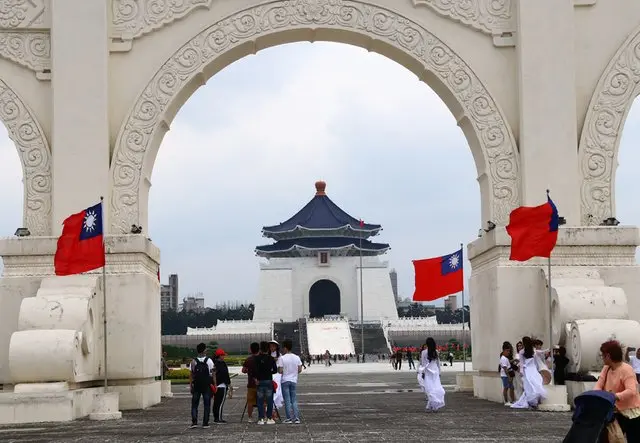
The cult of personality also manifested itself in the national memorial that was opened to the public on 5th april 1980, at the fifth anniversary of the death of Chiang Kai-shek. The main entrance is at the 30-meter-high, five-arched gate of the "Great Centrality and Perfect Uprightness". The imposing building with its marble façade and the eleven roofs with blue glazed tiles was built in the style of the Ming dynasty (imperial house in China from 1368 to 1644).
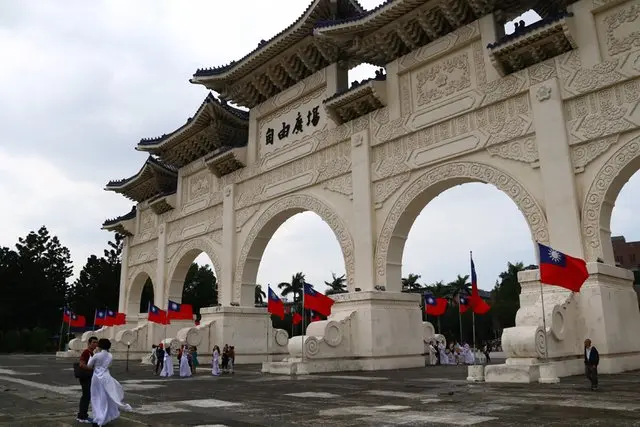

Behind the gate, a paved memorial square and a boulevard of honour lined with flower beds lead to the memorial site.
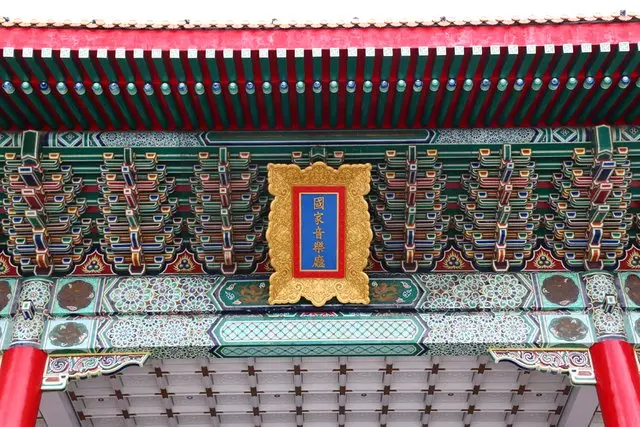
The plaza is flanked on the north side by the National Concert Hall and on the south side by the National Theatre. The two almost identical buildings are built in the style of Chinese palaces.

Red columns stand on white concrete pedestals which are carrying the colorful, richly decorated structures with the yellow roofs.


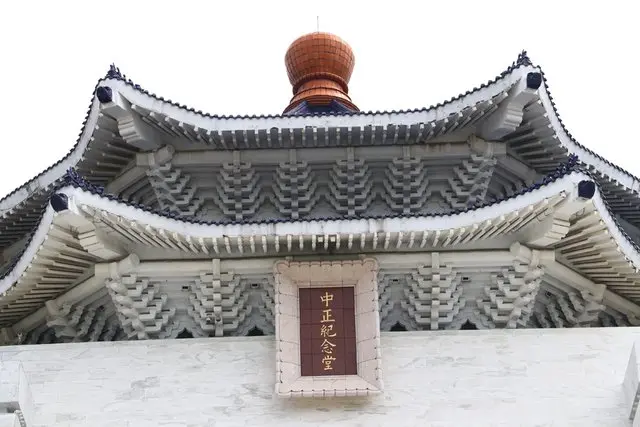
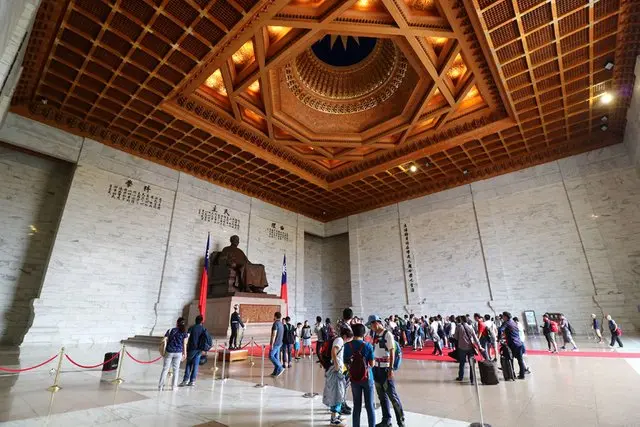
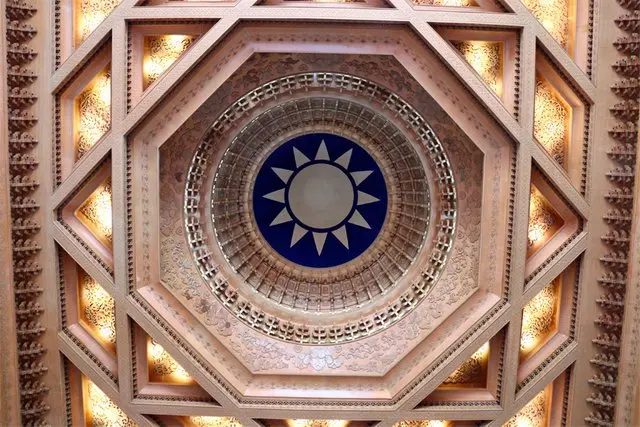
The memorial is kept in white marble. The octagonal shape of the blue roof with the dome symbolizes the number 8, which is traditionally considered a lucky number in China.
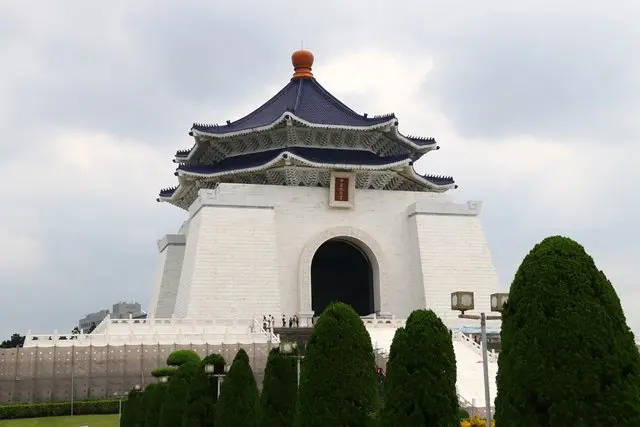
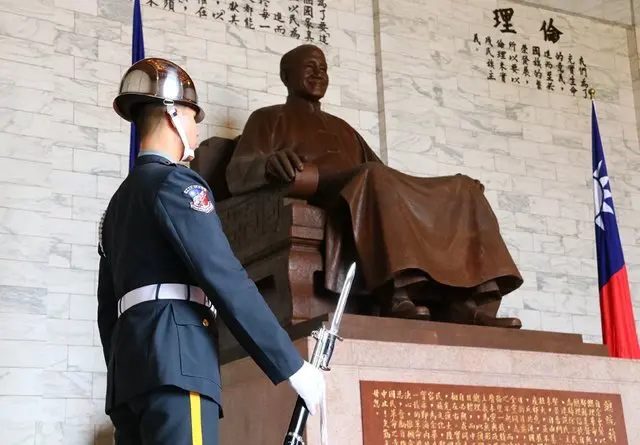
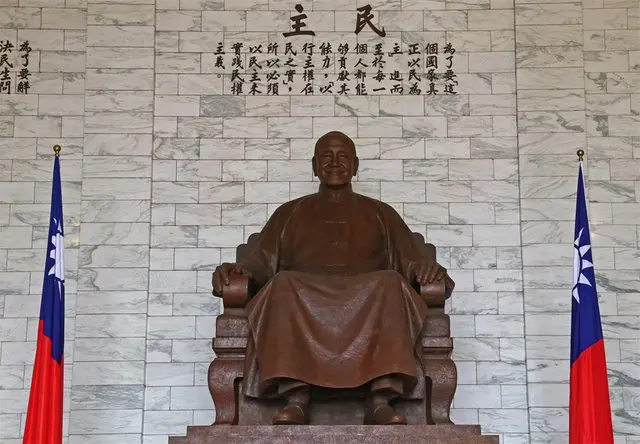
89 steps, representing the age of the former president, lead to the basement, which houses a large exhibition hall with exponents from Chiang's life and the history of Taiwan. In front of the entrance to the Memorial Hall there is a bronze statue of the father of the nation, about 16 metres high.
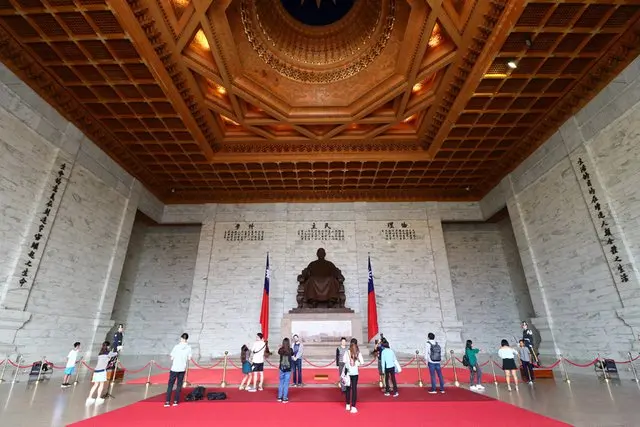
Every full hour the guard of honour patrols in front of it and theatrically celebrates the changing of the guard. A spectacle for the tourists.

Worth seeing is the ceiling, in which the emblem of the Republic of China is integrated.
Chiang Kai-shek Memorial / Chiang Kai-shek GedächtnishalleNo. 21, Zhongshan South RoadTaipei City, Taiwan 100






