The elections are impacting global markets, spanning geopolitics, investments, digital assets, and the inherent risks of changes in the White House's foreign and fiscal policies. This is especially true regarding spending cuts, regulation, and the potential for peace in conflict zones.
Let’s review the facts:
On November 5, the U.S. presidential election concluded, and Donald Trump was elected President of the United States, defeating Kamala Harris.
He secured 295 Electoral College votes and also won 50.7% of the popular vote.
- Trump’s Peace (Geopolitics)
Trump’s well-known statements demanding that United Nations members increase financial contributions to defense have already influenced countries like Poland, which raised its defense spending throughout 2023 and 2024.
- With the Republican victory, uncertainties among Ukrainian authorities about continued U.S. support are growing. During the campaign, Trump promised to quickly end the war in Ukraine, raising concerns about potential concessions to Russia, which adds a new layer of tension to international relations.
Moscow expressed skepticism about Trump’s claim of ending the conflict "in a day," calling it unrealistic and stating there had been no prior contact with the candidate. Nonetheless, the Russian government congratulated Trump on his election and indicated an openness to renewed diplomatic relations.
Economic Optimism
The “Trump Effect” raised spirits to such an extent that global growth expectations shifted.
- From -10% in October 2024, it moved up to +23% in November.
- Similarly, U.S. growth expectations soared from -22% to +28%.
- However, analysts worry this enthusiasm could overvalue assets, leading to speculative bubbles that could undo efforts by monetary councils to maintain high interest rates since mid-2022.
- Despite this optimism, the probability of a recession in the next 12 months remains at 8%.
- However, the expectation for a “soft landing” dropped from 76% to 55%, balancing against an increase in optimism, with the chance of sustainable growth rising from 14% in October to 33% in November.

Additionally
- With a emphasis on Low market cap, the Russell 2000 index might be more benefited than then SPX.
- The percentage of investors exposed to U.S. stocks jumped from 10% to 29% — the highest level since August 2013!

Are there pessimists?
Yes, fund managers argue that excessive optimism, combined with widespread monetary easing and deglobalization, could accelerate inflation. This, they believe, represents the biggest global risk until November 2025.

Dollar Dominance
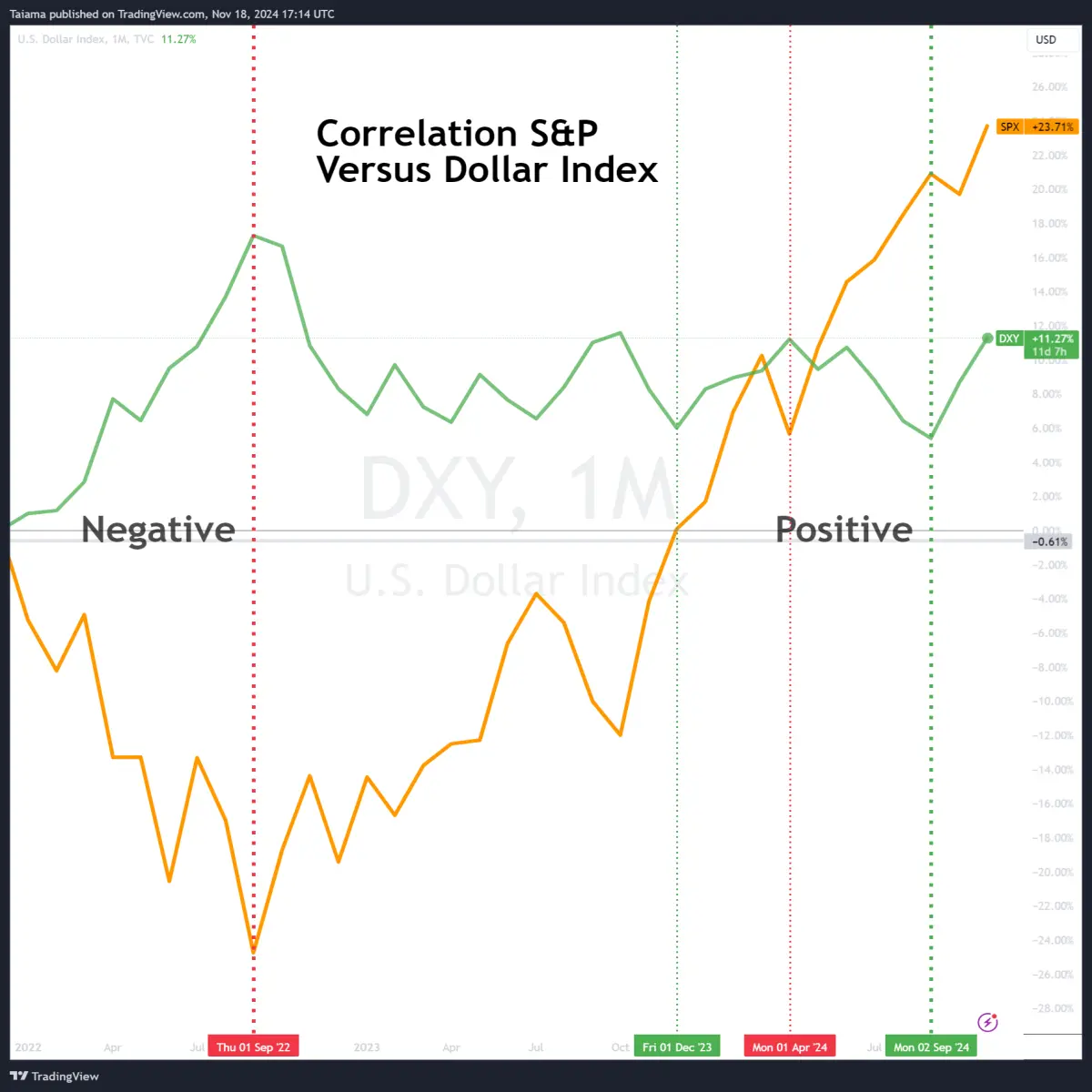
One immediate impact has been the strength of the U.S. dollar. The DXY, or U.S. Dollar Index, reached its highest level since October 2023, reflecting global investors' confidence in the U.S. economy and their caution regarding global tensions.
Interestingly, the DXY and the U.S. stock market index (S&P) have risen together since September, when interest rate cuts were announced, keeping both indices climbing.
Bitcoin and Governments
What about The Crypto Market and the Elected politicians ?
We cannot only look at absolute numbers, so I broke down the numbers according to all the US candidates that will take office in 2025
- 272 representatives (62.29% of the House) are pro-crypto
- In the Senate, only 20% are pro-crypto, against 12% of the 100 total Senators in the U.S..
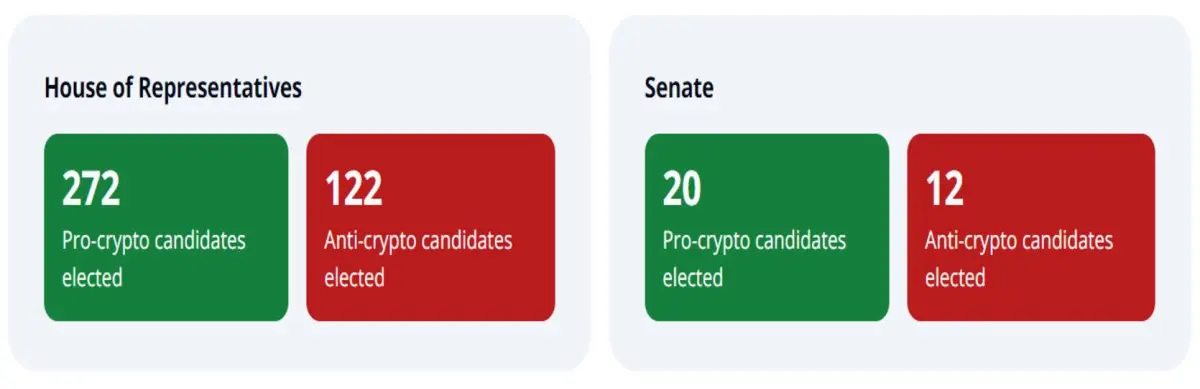
This suggests federal-level impacts on crypto assets may remain limited, but state-level initiatives could gain momentum. For instance, several states are introducing legislation to add Bitcoin to state reserves.
- Texas and Wyoming already have regulatory frameworks for digital asset commerce.
- Arizona is pushing to recognize Bitcoin as legal tender.

Treasury and Bitcoin
After losing the bid to retain more than $18.93 billion in Bitcoin seized by the U.S. government, the attempt to hold onto these assets was denied, leaving open the possibility that the U.S. could sell the digital gold obtained from the Silk Road related seizures.
But is this the end?
Bitcoin Act 2024
No it's not, because Senator Cynthia Lummis is proposing the “Bitcoin Act 2024,” aiming for the U.S. to acquire 1 million Bitcoins within five years and hold them for an additional 20 years. This measure is intended to reduce the impact of U.S. debt, given the infinite supply of fiat currency compared to the mathematical scarcity of digital gold.
- However, for the act to pass, it must go through the House of Representatives (where 62.29% are pro-crypto) and face greater difficulty in the Senate (20% pro-crypto) before reaching future President Donald Trump.
- Currently, the United States holds over 200,000 Bitcoins in custody, making it the leading nation in combined analog and digital gold reserves. The second position is held by China, followed by the United Kingdom and Ukraine.
The first three primarily hold Bitcoin obtained from money laundering seizures or illegal operations, whereas Ukraine's holdings belong to public officials. Bhutan and El Salvador are exceptions, as they actively mine or invest in Bitcoin, positioning themselves as the leading governments proactively supporting digital gold.

SEC and Regulatory Changes
The SEC is expected to undergo significant changes in 2025 due to political pressure from the Senate, Congress, and the presidency. However, Gary Gensler’s term ends only on June 5, 2026, making a complete overhaul unlikely. Still, Trump’s administration is expected to weaken the current SEC leadership by appointing a new team starting January 3, reducing harmful impacts on the digital asset industry.
- A notable contender for SEC chair is Hester M. Peirce, also known as “Crypto Mom,” who has previously served in SEC roles under the Obama administration.
Clearer regulations could boost demand for some assets such as:
- Poof of Stake blockchains
- Venture capital and US-based web3 companies
- Ethereum ETFs, benefiting investors and managers
Possible upcoming ETFs that could get benefited:
- Solana (SOL)
- Ripple (XRP)
- Cardano (ADA)
- Avalanche (AVAX)
- Chainlink (LINK)
- Uniswap (UNI)