
Photo by Nick Fewings on Unsplash
Initial Public Offerings (IPOs)
Initial Public Offerings (IPOs), the process in which private companies offer shares to the public in exchange for shares in a public-listed company, have been around for hundreds of years. IPOs have long been the key means through which private companies try to raise capital (in fiat currencies). To protect the investing public, most countries have enacted regulations for the operation of stock exchanges and the listing of shares on these exchanges.
Initial Coin Offerings (ICOs)
As blockchain technologies rose in prominence in 2016 and 2017, along came a surge in Initial Coin Offerings (ICOs). Under ICOs, token issuers offer cryptocurrency to the public for the first time through a direct issuance typically conducted on the project website.
Most ICO issuers take the position that they need not comply with national securities regulations if their tokens do not grant investors the right to share in the profits of the companies but merely grant access to the company’s products and services (“utility” tokens). The US’s securities regulator, the Securities Exchange Commission (SEC) takes the position that merely labeling a token a utility token or structuring it to provide some utility does not mean that the tokens are not securities and that most ICOs do in fact need to be registered. In a Senate hearing on Feb. 6, 2018, SEC Chairman Jay Clayton quipped:
“I believe every ICO I’ve seen is a security.”
In April 2019, SEC released guidance to token issuers explaining a digital asset is likely to be a security if (1) it gives the holder the right to share in the enterprise’s income or profits or to realize gain through capital appreciation; (2) it is transferable through a secondary market; or (3) it will appreciate based on the efforts of a centralized organization.
According to a 2018 Bloomberg report, some 80% of ICOs in 2018 turned out to be scams. China cited scam percentages of 90% and has moved to ban ICOs outright.
From the ashes of the ICO rose two new fundraising trends geared towards winning back the confidence of the investing public.
Initial Exchange Offerings (IEOs)
Unlike ICOs which are administered by the token issuer directly, IEOs are administered by cryptoccurrency exchanges. To conduct an IEO, the project team must meet and comply with the exchange’s requirements in order to launch the token sale. Investors have to be users of the hosting exchange to participate in the token sale.
Whilst the interposition of a third party who has an interest in maintaining its reputation is an improvement over ICO’s direct issuance model, it should be borne in mind that many cryptocurrency exchanges are themselves unregulated. Security is also an issue given that many exchanges have become victims of hacks (Mt Gox and most recently Upbit).
On 13 January 2020, the SEC issued an advisory warning investors of risks involved in IEOs.
“Be cautious if considering an investment in an IEO. Claims of new technologies and financial products, such as those associated with digital asset offerings, and claims that IEOs are vetted by trading platforms, can be used improperly to entice investors with the false promise of high returns in a new investment space. As described below, IEOs may be conducted in violation of the federal securities laws and lack many of the investor protections of registered and exempt securities offerings.”
Securities Token Offerings (STOs)
Unlike ICOs which mostly seek to avoid compliance with securities regulations, STOs seek to comply with securities regulations and wear it as a badge of approval. In April 2019, the London Stock Exchange granted permission to 20|30 to issue its first STO. The Swiss Stock Exchange brands itself as a leading regulated marketplace for products with cryptocurrencies as underlying assets.
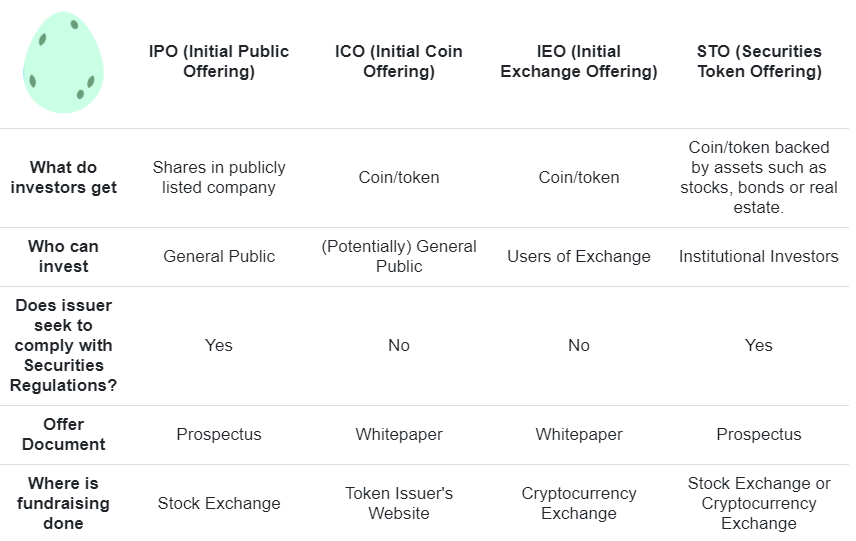
IPO vs ICO vs IEO vs STO
Here’re the key deets TABUL8TED!
Enjoyed this post?
- CLAP👏, SHARE🤲 & FOLLOW👣
- READ MORE:
- Read TABUL8TOR’s beginner’s guide to blockchain, cryptocurrencies, cryptoccurrency exchanges, cryptocurrency wallets.
- Read TABUL8TOR’s posts on other blockchain use cases: Kleros, CryptoKitties and Blockchain Cuties.
***Disclaimer: This post is for informational purposes only. It does not constitute legal advice, financial advise or a recommendation to buy cryptocurrencies whether through ICOs, IEOs or STOs. Please do your own due diligence before taking any action.