In Part 1 I looked at user intent. In Part 2 I looked at user Gestalt grouping. In Part 3 I looked at Operant conditioning. In Part 4 I looked at schemata. This penultimate article will build upon the previous four, so I recommend you check those out before proceeding.
Part 5: Semiotics
Semiotics is the study of signs and signalling (semiosis), and ranges across a multitude of areas, such as linguistics, rhetoric, and many more. Communication through semiotic processes varies, as signs can present in many forms, such as linguistically, in symbols, icons, archetypes, aural cues, grouped elements, analogues, and otherwise still.

Consider the image above. Chances are you’re either familiar with this particular pair of symbols, or have a schema that allows you to recognise the meaning immediately as gender indicators. Looking closely, we see that both the circles and triangles are congruent—evenly shaped and sized—with the only geometrical difference being rotational. The only other difference between them is in the colouration. The triangles representing the trunks are inversely positioned, with the red female having the breadth in what would be the hips, and the male in the shoulders. The designs utilise trending minimalistic designs, boiling down the forms of the feminine and masculine to maintain a minimum for widespread recognition.
The importance of signs comes from their ability to quickly communicate information to others without the need for complex explanations or demonstrations. Chimes can signify a correct answer or button entry. Flashing red lights can indicate a problem or condition change in need of attention. A Yellow light can indicate caution. Seeing these, we aren’t forced to think to reach an understanding, but instead react unconsciously to the stimulus—at least as far as deciding how to proceed. Sometimes these signals are learned, like the chimes, and sometimes they rely on hard-wired evolutionary responses we share as a species, such as to the colour red, a strongly influential hue in colour psychology.
The grouping of signs can influence meaning also. When looking at those above, the flashing red light paired with a siren can signify an emergency. A yellow light when grouped with a red and green light (or sometimes blue in Japan) in a particular order changes meaning as part of a traffic signal array. Red paired with green can signify Christmas to a good portion of the world. This is important to keep in mind.
So as you may see, it is in signs we see many cases of prägnanz from Part 2, conditioning from Part 3, and schemata from Part 4 all working in harmony. By understanding these we’re able to return to Part 1’s 3 don’t Ds (Don’t’ Distract. Don’t Detract. Don’t Digress) and carefully craft an experience that uses these psychology principles to our advantage.
Context is king
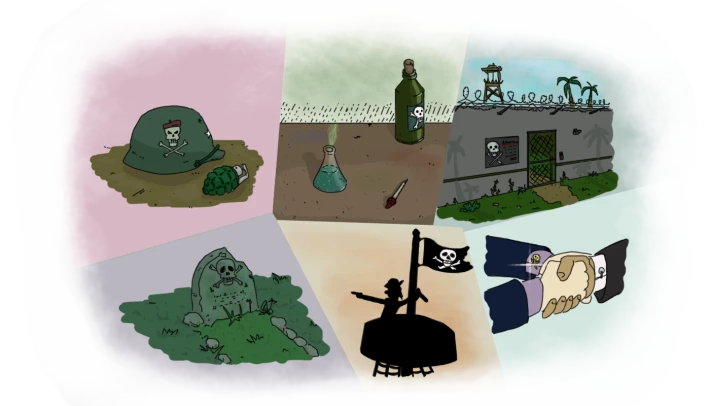
When dealing with signs, symbols, and colour psychology, there are scenarios in which the generally expected interpretation will change. Consider the skull and crossbones; while the general symbolism attributed to it is that of death, there are subtleties in how we perceive the meaning dependent on the scenario it’s presented in. An old grave could signify the deceased died of plague. A bottle or gas cylinder will likely be taken as meaning ‘poisonous’ or ‘noxious’. If it’s found on a black cloth, we’d probably think of it as a Jolly Roger of pirate fame. On a gate we’re expected to interpret it as dangerous to enter or trespass. We may also associate it with military insignia on a vehicle, uniform, or tattoo, or Yale’s Skull and Bones society when on a piece of jewellery. So as you can see, though the general symbolism is well defined, a great deal of nuance also exists.
Like with that Jolly Roger above, colour, too, plays a strong role in interpretation of signs. A red heart on a white field will probably elicit the suit from playing cards, where a red heart on a pink field may be more likely to evoke a message of love or romance.
So just like many dictionary entries have multiple meanings that must be ascertained by context, signs, too, can often convey a range of messages. Consider your cryptocurrency wallet, the audience it will reach, and the mindset they will have when using your software. If there’s any chance your audience can misinterpret something, reconsider it! The amount of harm carelessness can cause is more than worth whatever extra time and effort reconsidering requires.
Sociocultural considerations
A point of significance in semiotics studies is that of sociocultural considerations. When attempting to harness signs, insufficient consideration for your audience may mean they lack an expected schema through which you wish to have them assimilate information. Alternatively, the user may possess a conflicting schema, and your implied communication through sign may thus bring about cognitive dissonance—a conflict in concepts valued as true within the mind that causes psychological discomfort.
Let’s consider the West and East to demonstrate cultural differences—specifically luck and good fortune symbols. In the British Isles, 7 is considered particularly lucky due to the Christian belief God created the world in six days and rested on the seventh; in China, it’s 8 that holds that distinction, as it shares a strong linguistic similarity with the word for fortune. Horseshoes, four-leaf clovers, and white heather are symbols of good luck in the British Isles; where certain fish such as goldfish, jade charms, and laughing Buddha statues are considered lucky in China. There exists little overlap in these between the two cultures.
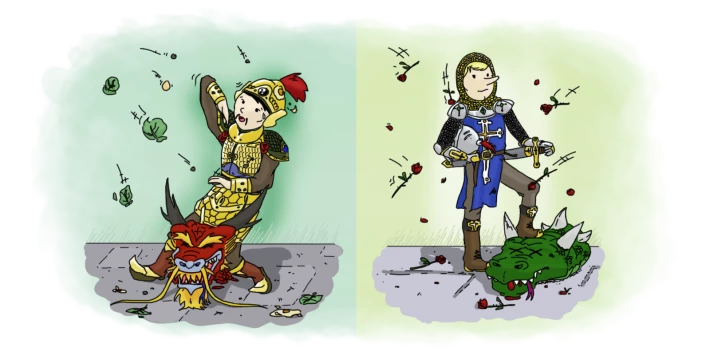
In the legend of Saint George, as appropriated by Christendom, the saint slays a terrible dragon with the aid of his weapon, Ascalon. Saint George has held renown and been celebrated as a heroic figure for generations; just one instance of the ‘dragonslayer’ archetype that has perpetuated and spread in Western cultures since time immemorial. Conversely, in Chinese mythology dragon slaying is heavily considered a heinous act, as dragons are overall viewed as supporters, rather than takers, of life. Instances of evil dragons being slain, generally for causing flooding or droughts, do exist, though are not the common conception.
Colours, too, may hold conflicting meaning. In the West, green is a colour associated with growth, wealth, good fortune, and being correct, where red is quite the opposite, used for errors, loss, and violence. As a quick aside, should we really then be using red for spends? I’d suggest rethinking that, as they’re neither incorrect nor unintended. China celebrates red as a colour of good fortune, celebration, and happiness, where green is linked to anger, ill-health and death, adultery, and shameful acts. There are exceptions here too, such as ‘green with envy’, or ‘romance red’ in the West, which only highlights why it is that context is king, and why localisation is an important step in catering to different cultures.
There are also social considerations to be made, such as gender marking colours and their storied history, luxury colours such as Tyrian purple and Ultramarine blue, or any number of signs that may not be recognisable to lower class audiences, such as letters from the Greek alphabet, most of which are rarely encountered outside of further education by any but well-read individuals.
How then can we harness this for our wallet? I spoke in Part 1 about language options upon first running wallet software. This would be the perfect opportunity to toggle additional cultural considerations, such as alternate icons, colour schemes, and even analogue choice should your target culture have fundamentally different schematic concepts than those you’ve used in your primary language. Social considerations such as class are something you should make depending on your target audience, and audiences you believe you may also snag moving forward, lest avoidable reworks be required.
So, to summarise, use signs, symbols, and colours to quickly communicate information and save on lengthy explanations. Consider your audience and what these signals will mean to them. Don't be affraid of changng more than the language in your wallet when altering it for different cultures.
In the upcoming final part I’ll tie together everything we’ve gone through.