
The End of the Era of Rose-Tinted Glasses
We are living through a tectonic shift that future historians will likely call “The Great Sobering.” For decades, the West has built a fragile illusion of a perfect world—a world where borders are arbitrary, cultural differences are negligible, and history can be rewritten to suit modern trends.
We were “spoon-fed” Black King Arthurs and elves in Netflix series, convinced that historical truth matters less than inclusivity. We were told that if we were kind enough to everyone, the whole world would be kind in return. It was a beautiful, humane, but fatal utopia.
Today, that bubble has burst. Reality has barged into cozy European living rooms not through television screens, but through the streets of Stockholm, the suburbs of Paris, and the squares of Berlin. And it turns out that reality has nothing to do with the playbooks of liberal ideologues.
Social Physics: The Effect of the Compressed Spring
History is cyclical, and it does not forgive the ignorance of its laws. The most important of these resembles Newton’s third law: action always begets a reaction.
For years, the European establishment artificially held back this spring. Anyone who dared to speak about problems with migrant integration, the rise of ethnic crime, or the threat of losing national identity was instantly branded a pariah, a racist, or a xenophobe. Problems were not solved—they were swept under the rug of political correctness.
But you cannot fool social physics. When you press a spring too hard to the left for too long, it inevitably shoots back to the right with ferocious force. What we are seeing now—the right coming to power in the Netherlands, the policy shift in Sweden, the rise of the AfD in Germany—is not a sudden “disease.” It is a natural immune response of an organism that has realized it is being destroyed.
The Mirror Principle: The Crisis of Absent Reciprocity
Europeans are beginning to ask themselves a question that was long considered indecent: “Why is this a one-way street?”
This is a question of fundamental justice, or, as they say in diplomacy, reciprocity. European civilization is built on respect for the law and the guest. But hospitality works only when the guest respects the host.
We understand perfectly well: if a white European went to, say, Iran, Saudi Arabia, or Somalia and began demanding they change their age-old traditions, build churches on every corner, or disrespect local shrines, they would face prison or deportation. And this would be considered normal: “Their country, their rules.”
Why, then, has Europe allowed its cities to turn into enclaves where the laws of the state do not apply, but the laws of diasporas do? These are double standards that can no longer be justified by humanism. Society demands a return to basic logic: either you accept the rules of our home, or you return to yours. This is not cruelty; it is the instinct of self-preservation.
The Three-Year Window: Either Discipline or Chaos
We are at a bifurcation point. My forecast as an analyst is grim but realistic: Europe has 2–3 years left to restore order through systemic methods.
Time is working against the “Old World.”
If the current governments—“moderate rights”—do not show real results by 2028–2029 (the time of decisive electoral cycles in key EU countries), the situation will spiral out of control.
“Result” in this case means concrete, harsh measures:
-
Zero tolerance for ethnic gangs.
-
Real deportations of those who refuse to integrate.
-
Restoration of the state’s monopoly on violence.
If systemic politicians fail, the voter will become disillusioned with democracy itself. And then, true radicals will step into the arena. The street may answer lawlessness with its own brutality, and we will see a Europe plunged into civil conflicts and pogroms.
Ukraine and Europe: Why Do We Need a “New Sparta”?
Against the backdrop of the war with Russia, the problems of migrants in Marseille may seem distant. But this is a mistake. Europe is our rear guard. And our survival depends on the condition of that rear.
Let’s be cynical pragmatists.
We do not need a weak, disjointed, “kind” Europe drowning in endless discussions about tolerance while its factories lack shells. Such a Europe is easy prey for predators like Putin. Russians despise weakness. When they see uncertainty and chaos in the West, they push forward.
We vitally need the “New Sparta” scenario (or, if you prefer, “Fortress Europe”).
What does this mean?
-
It is a Europe that remembers it is the cradle of warrior civilizations, not just bureaucrats.
-
It is a Europe that militarizes, placing security above comfort.
-
It is a Europe where wartime laws function, where borders are locked, and the military-industrial complex runs in three shifts.
Yes, such a scenario frightens many liberals. It is the end of the era of carelessness. But only such a Europe—strong, “toothed,” armed, and tough—can become a real ally for Ukraine.
We stand guard against the horde from the East. But to stand firm, we need a reliable arsenal guarded by a strong army behind us, not a thoroughfare blazing with the fires of internal strife.
Conclusion
History teaches harsh lessons. Rome fell not because the barbarians were stronger, but because Rome lost the will to resist and forgot who it was.
Today’s turn to the right is Europe’s last attempt not to repeat the fate of Rome. It is painful chemotherapy, necessary to kill the tumor that is corroding society.
We can only hope that this process remains managed. That instead of chaos and ruin, we will see the birth of a new power. A power that respects itself, defends its borders, and is capable, together with us, of defending civilization from the darkness.
The pendulum has swung. And it is impossible to stop it now.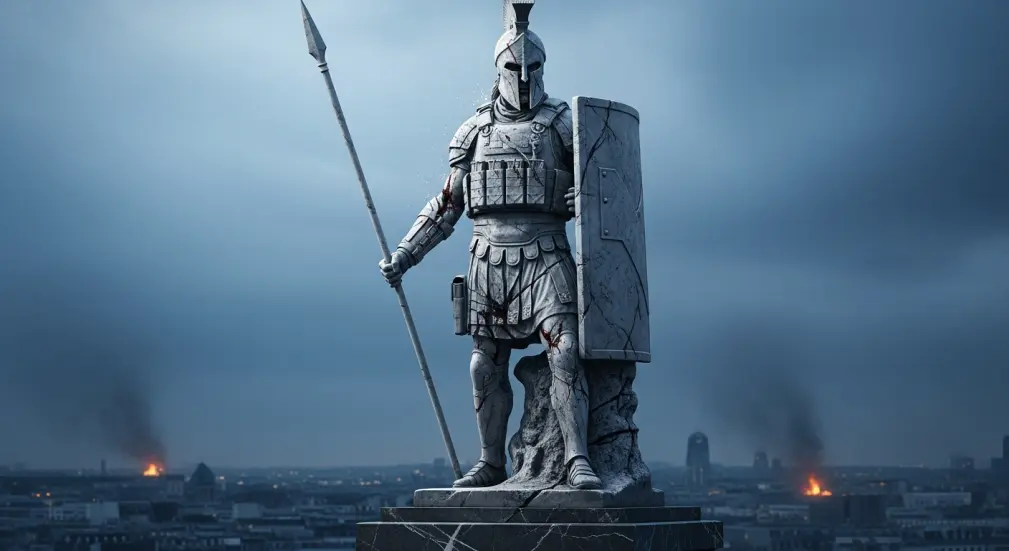
Bogdan Karasiov, Ukraine, February 6, 2026.
Follow me on Facebook >>>






