
In this blog series, I will write about decentralization, what I mean by it and what I think about it.
For those who have not yet read the first part:
Since we thought in the last post about how centralization can arise from decentralization, this time I will present the forms of decentralization.
Preliminary consideration
Decentralization in general is the division of decision-making powers into several places, so that no central determines everything.
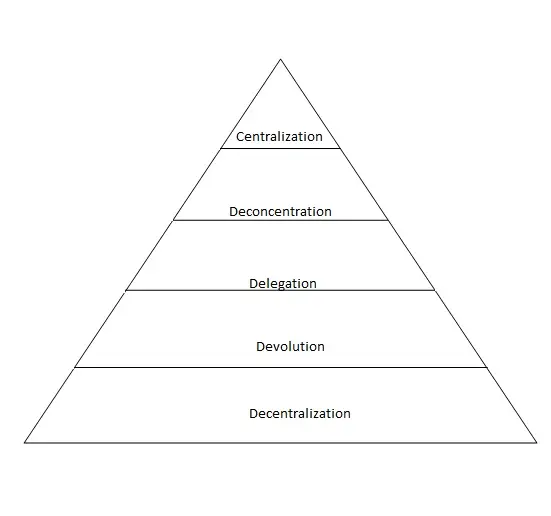
According to the number of downgrade or the number of digits and there rights, different levels of decentralization can be described.
First stage
Centralization is the least decentralization and is also called the opposite. I presented the functionality in the first blog of the series, but to name it again briefly: one place has absolute decision-making power.
Second stage
Deconcentration gives some subordinates the opportunity to carry out administrative activities. They are only allowed to make independent decisions in a few specific situations, otherwise it must be coordinated with the head office.
Third stage
The level of delegation is in principle a further development of deconcentration, in which the subordinates are granted more rights. However, the head office is still above the subordinate, can overrun the decision or revoke the rights.
Fourth stage
Transmission is the last stage before complete decentralization. The subordinates now also have decision-making power and are independent of the headquarters in most decisions.
Fifth stage
After all, the last stage is decentralization, where there is no longer a headquarters in this sense. Everyone has the same decision-making rights and are equal.
Here is another classification:

Considerations
After briefly listing the different levels, I would like to think about the transitions from top to bottom.
The first stage, i.e. centralization, can be compared to a king who holds all power, makes all decisions and acts without subordinate decision-makers. Now, of course, it is quite exhausting to always be responsible for everything. We start in consideration of a king who recognizes this and wants power, but recognizes advantages in having certain tasks done by others. He therefore hires consultants who take on administrative tasks in their areas for him. This brings us to the second stage of deconcentration. However, these advisers have very limited executive power and the decisions are in most cases made by the king.
If this is to develop into the third stage, delegation level, the advisers or say ministers must be given more of their own decision-making power. However, the king retains the opportunity to revoke the decisions of the ministers or to dismiss them and convene new ones. This stage can also be compared to many governments around the world. There is usually a president or chancellor who in turn appoints ministers who are then responsible for certain areas.
The fourth stage is again a further development of the previous situation in which the headquarters is becoming increasingly unimportant. To stick to the scenario: no more ministers who now make decisions together while the headquarters has given them more and more rights.
For complete decentralization, the fifth stage, there must then no longer be a headquarters, but neither must the ministers. The decisions must now be made by everyone together.
In this way, this scenario can also be transferred to other areas. For example, from a central bank to more and more co-acting financial bodies. However, there is the problem here that some have more than others and would therefore have an advantage or superior, which would harm decentralization. But more about that in another blog.
What do you think about that?






