
In this block entry series, I will write about decentralization, what I mean by it and what I think about it.
Preliminary consideration
Decentralization:
This term is used in various areas of politics and economics. In general, the division of responsibilities and responsibilities into several positions is meant. Not everything should be done "centrally", i.e. by one body, but "decentralized", i.e. independently of a headquarters.
Centralization:
This term refers to the summary of similar or similar tasks in business and in the political field the desire to concentrate state competences in one position.
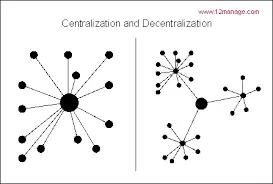
To visually support the descriptions, here is this picture.
In summary, one can say: Centralization is that a central office decides things. Decentralization is that many places together decide these things.
Considerations
I will do my best to avoid leaps in thought as much as possible and to keep a common thread.
At the beginning, a few properties of the two forms:
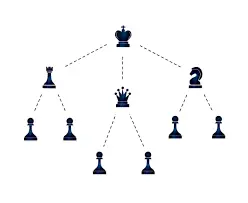
Centralization:
- Crucial from top to bottom
- Strong leadership and control
- Fast decision-making and response
- Responsibility and participation of a few
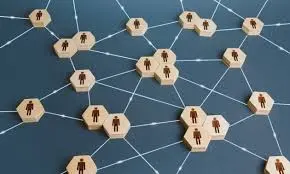
Decentralization:
- From bottom to top
- Democratic or discussing majority leadership
- Slower detailed decision-making
- Participation and responsibility of many
The two systems turn out - not surprisingly - as opposites.
One question arises as to why from the first decentralized decision-makers, e.g. Democracy in ancient Greece, central decision-makers emerged, such as the Rome Empire or then the European monarchies.
I think that for decentralization, many must have an interest in participating in decisions and then accepting them. If individuals believe that their and only their direction is the right one, you are already on the path of centralization again.
Education also plays a major role. You can only make meaningful decisions if you know about the topics concerned. If you don't do that, there are individual people who do it and who you can ask.
This can be compared to the central structure of the Internet or with the client-server principle prevailing there. A central point, e.g. the Netflix server, provides its knowledge. In order to access it, you have to pay, he can do that because he is a central point.
The decentralized example would be a peer-to-peer network where everyone makes films available and anyone can watch movies.
If I transfer this to society, the monarchs/dictators would be the servers and all other clients.
In a democracy, the whole thing looks a little different. These are in a way more decentralized, as the population elects deputies or presidents from bottom up, who then act in the interest of their voters. However, it would be really decentralized that everyone can decide everything and make suggestions.
Decentralization therefore depends heavily on people. Whether they want to get involved, can do it or not. Also whether they have the necessary knowledge to have a say or not, because if you act in the opinion of the knowledgeable, it is also towards centralization.
This entry is the beginning of a series and continues in relation to other topics such as economy or opportunities and problems. Since this is the first, it should only lay a foundation and stimulate further reflection.






