
The emergence of Bitcoin especially after the 2008 global economic crisis was quite significant. Then, the growing crypto money ecosystem met the Ethereum project, which opened doors to different worlds, and the change accelerated.
For some projects, friends who are not new to the cryptocurrency market have witnessed the word "killer" used especially after Ethereum: "Ethereum Killer!" I'm talking about.
Killer means "murderer" in its most basic sense, but what is meant here is the idea that "This is such a project that it will end and destroy Ethereum".
Yes, Ethereum Killer for Tezos! one of the fairly common descriptions. Before I begin to explain the project, I have to state clearly that no project has ever been able to finish or destroy Ethereum. This is not so easy.
Tezos; It is a blockchain-based project, the foundations of which were laid by Arthur and Kathleen Breitman couple in 2014, aiming to be a platform for smart contracts and decentralized applications.
In an interview with Arthur, it was stated that the word Tezos means "smart contracts" in Ancient Greece. Moreover, the Investopedia site has taken this seriously. Although it sounds funny to me, I researched it without ignoring it and could not reach such information.
What makes Tezos different?
Tezos is one of the unique projects created from scratch without being built on any platform, but I would definitely put the way of management and decision making in the first place in terms of what makes it different. Tezos is one of the most democratic projects you can see in the crypto money ecosystem and perhaps the most prominent one.
Management is completely in the community. Tezos community votes for any changes planned in the protocol, if the idea is accepted, the change is made and the fee is paid as a token.
This makes the possibility of hard fork in Tezos almost impossible because, as I said, every issue is put to vote and what the majority says.
The aim of the project is to improve and develop Bitcoin and Ethereum blockchains. This idea belongs to Arthur. Arthur, who has been following Bitcoin from the beginning, sees it as "undeveloped".
The project realized ICO in June 2017 and raised $ 232 million in two weeks. This was a record for that period. However, after this record, Tezos, which was praised, had ironically governance problems in those early periods.
The source of the problem was the Swiss Tezos Foundation. The purpose of the foundation was to distribute funds to promote, develop, promote and support the Tezos protocol and related technologies. The intention was good, but things did not go well.
There were disagreements between the Breitman couple and the foundation's president, Johann Gevers. I don't want to go into detail here. As a result of this dispute, the launch of Tezos was postponed, the American Securities and Exchange Commission launched an investigation and many lawsuits were filed by XTZ investors.
But later Johann Gevers resigned, the environment calmed down and Betanet was released in June 2018. When there was no problem in Betanet, Mainnet took place in September 2018.
Despite the adversities experienced, XTZ performed very well in terms of price and even in some periods compared to Bitcoin and Ethereum.
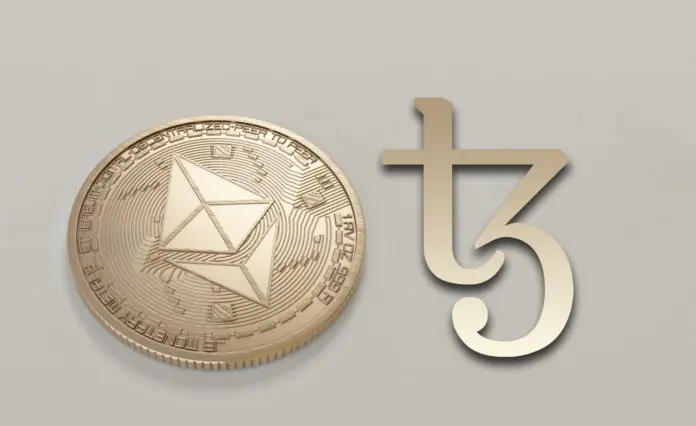
Difference between Tezos and Ethereum
There are three important differences between Tezos and Ethereum protocols: These are; governance, consensus mechanism, and programming language of smart contracts.
The first item, Governance:
In terms of decentralization and governance structure, Tezos is ahead of me. Because Ethereum Foundation and its development team decide all changes in Ethereum.
The second item, Consensus Mechanism:
As you know, Ethereum is in the transition process from Proof of Work to Proof of Stake. Tezos has been using the Delegated Proof of Stake algorithm from the very beginning. Although DPos, the algorithm of Tezos, has Proof of Work and similarities, it differs greatly from Proof of Stake. It has a more democratic and faster structure than POS.
The third item, Programming Language:
Ethereum uses the Solidity programming language invented by co-founder Gavin Wood in smart contracts - a very important name like Vitalik - and Tezos uses the language of Michelson developed by his team.
Michelson provides additional tools for developers to program safer and higher quality smart contracts. It is claimed to be more useful than Solidity because of the convenience it provides.






