
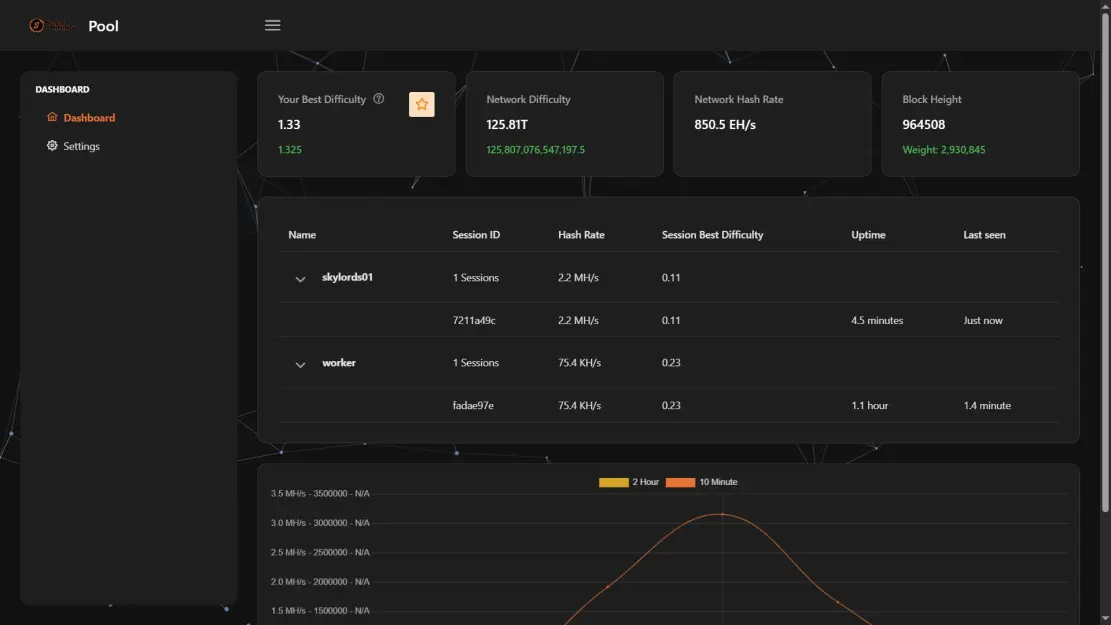
Why Am I Interested in CPU Mining?
Reading articles about mining may explain some things. But when I try it myself, I experience very different things, feelings, and emotions. My goal here is not to make money from mining. I want to see how hashing, share submission, pool communication, difficulty changes, and solo mining actually work on a real network. This curiosity led me to develop my own small CPU mining application.
Actually, my mining journey goes back to 2017. In 2017, when GPU mining was becoming more popular, I built a system with 4 graphics cards. Of course, since I had built it together with a friend, my mining journey was short lived when my friend wanted to leave the project.
Later, I saw a Jingle Mining Solo Bitcoin Lottery device on the internet and bought one. Of course, it stayed on a shelf for quite a long time. I had actually forgotten that I had bought such a device. About 1 or 2 weeks ago, I found it again.
I checked its hash rate. It was producing a very low hash rate. In other words, this device would only find a block after trillions of years. Even my laptop had a better hash rate than this device.
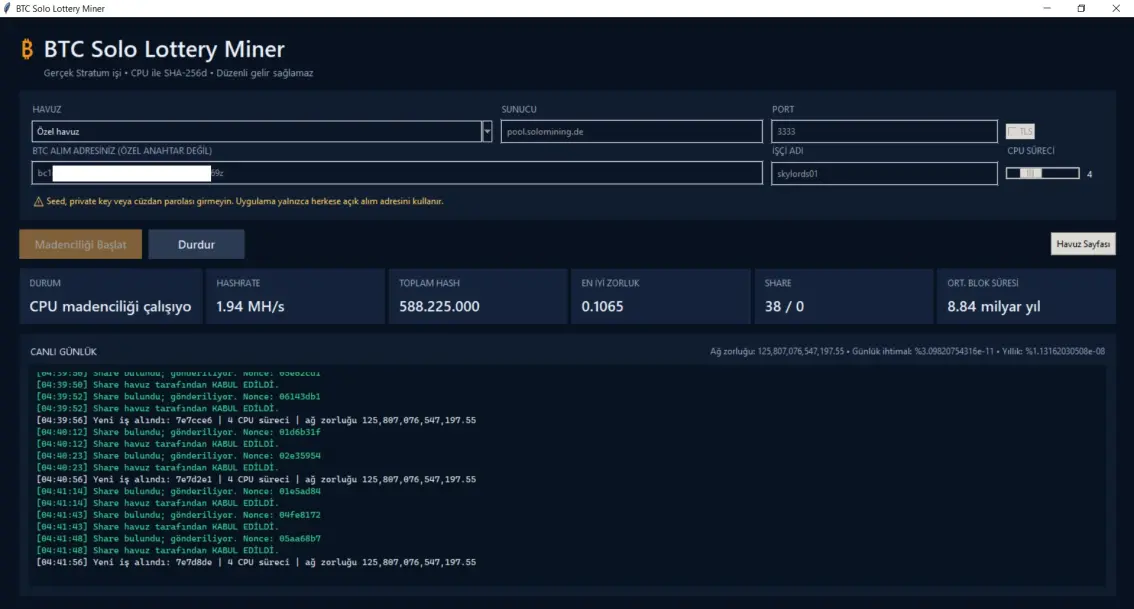
Just imagine, my computer was calculating that it would finda block in 8.6 billion years (The place that says "ORT. BLOK SÜRESİ"). The values in this section may vary depending on Bitcoin's mining difficulty.
That was when the idea of making a small CPU Bitcoin Mining Lottery application came to my mind.
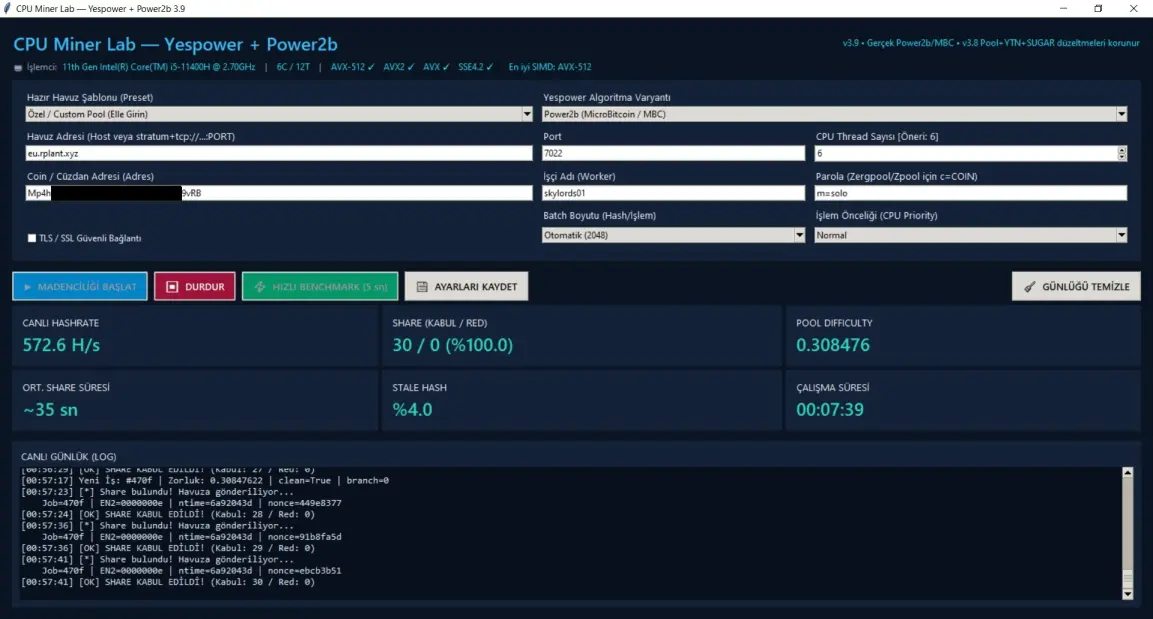
CPU Miner Lab
As I mentioned, I created a simple CPU mining program for Windows for my personal experiments, which I named CPU Miner Lab. The interface is in my native language, Turkish. My goal was to learn by experimenting with different mining algorithms. Since the expected time to find a Bitcoin block with my CPU was astronomically long, I wanted to try a network where finding a block with a CPU was more realistic.
While researching algorithms suitable for CPU mining, I started testing the Power2b algorithm on MicroBitcoin with CPU Miner Lab.This application is not a commercial product. It is simply a small mining lab where I run my own experiments and try to understand how the technology works in practice.
Real Pool Test
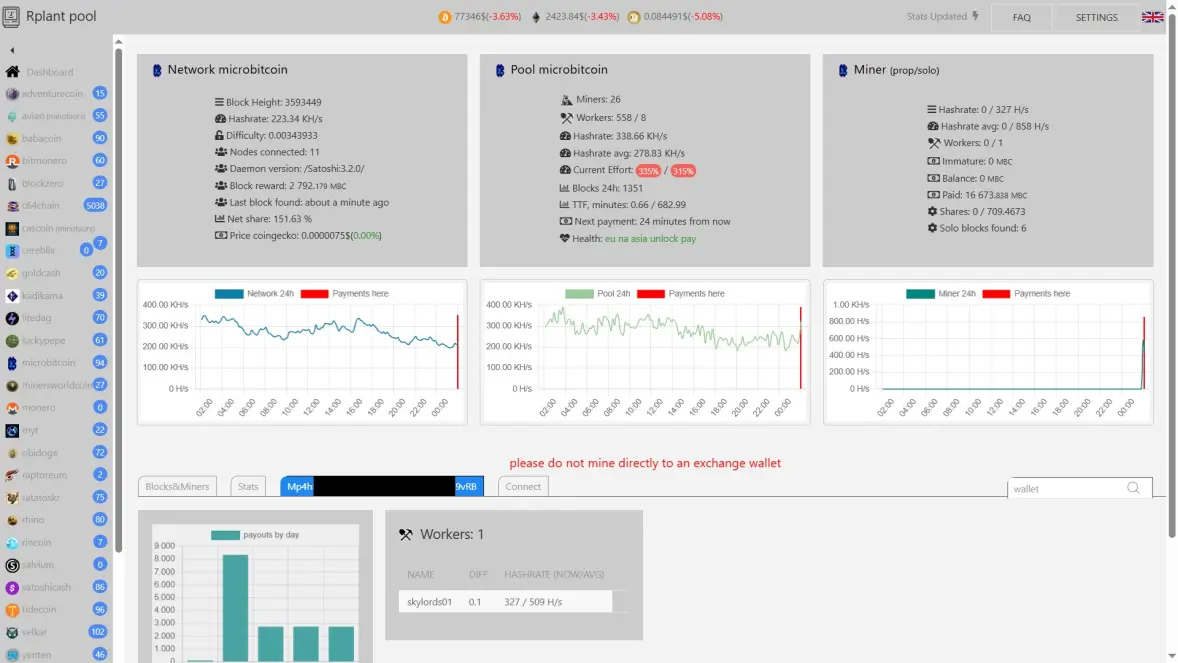
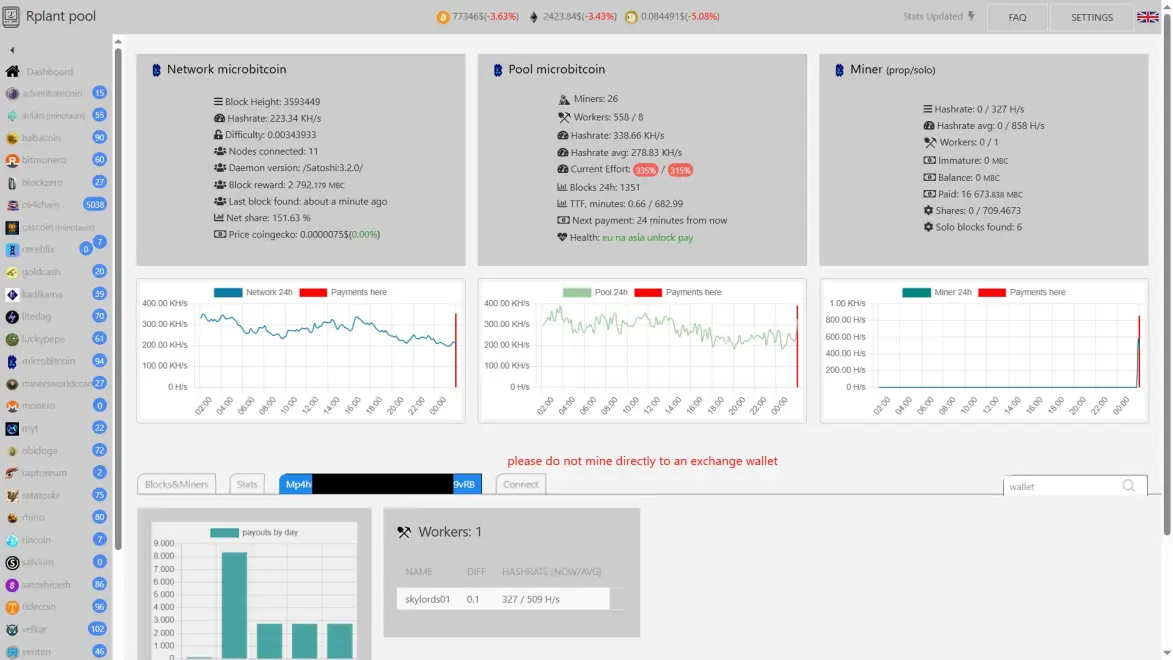
When I tested the CPU Miner Lab application on a real mining pool, the results were consistent.
6 CPU Thread
Approximately 572.6 H/s
30 Accepted Share
0 Rejected Share
The worker appearing active on the pool interface without any issues.
The fact that the hashes and shares I generated on my own computer were accepted without errors in the pool was a solid step for the project.
Then the Solo Blocks Started Appearing
During my tests, I found my first solo block. As the process continued, the number of blocks I found increased, and eventually I saw “Solo blocks found: 6” on the pool dashboard. The mining rewards were paid to my wallet in full by the pool. The amount shown on the pool had successfully arrived in my MicroBitcoin wallet. Seeing my application and tests go beyond simply having a share accepted, and actually watching the software find a valid block on a real blockchain network and have that block added to the chain, gave me a very different kind of satisfaction and emotion.
Not About the Money, About the Experience
To be honest, I have to say that the financial value of the MicroBitcoin blocks does not provide any significant return. Maybe if MicroBitcoin gains value like Bitcoin someday, only then could I say that I made money from this. But that was never my motivation for starting this journey in the first place.
What I really gained from this process was the following:
- Understanding the CPU mining architecture from end to end
- Experiencing solo mining probability under real world conditions
- Sending valid shares to the network and monitoring pool synchronization
- Verifying that the software I developed could find a block on a live network
In short, it was never about, How much did I earn?
The real question was:
Did the experiment I designed actually work?
The answer is: Yes.
I’m Still Going
I’m continuing to develop CPU Miner Lab, try new parameters, and observe how the algorithms behave. I want to say that learning a new detail about the data flow and mining architecture with every run has become the part of the project I enjoy the most.
Have you ever experimented with CPU mining before, or have you ever developed your own mining software?
If anyone is interested in CPU Miner Lab, wants to try it, or would like to help with the software side of the project, feel free to contact me. And don’t forget to follow me and check out my other articles as well.






