
USDT is issued on both Ethereum and TRON. The tokens represent the same dollar-denominated Tether product, but they exist on different blockchains, each with its own fee structure, address format, and settlement model. Here are the differences between TRC20 and ERC20 and how to avoid sending funds on the wrong network.
Updated: September 10, 2026
Reviewed by: Rick Cramer, Head of Analytics at SimpleSwap
Short answer
TRC20 and ERC20 are fungible-token standards on two different blockchains: TRON and Ethereum. USDT issued as TRC20 and USDT issued as ERC20 are treated by Tether as equivalent versions of the same dollar-denominated token, but they exist on separate ledgers and cannot simply be sent from one network to the other.
TRON produces blocks more frequently and typically reaches its solidified state in about a minute. Ethereum uses 12-second slots and normally reaches protocol-level finality in roughly 13–15 minutes, although a transaction can be included and visible much sooner.
Fees work differently. Ethereum charges gas in ETH, and the cost varies with network demand. TRON uses Bandwidth and Energy: users can obtain resources by staking TRX or receiving delegated resources, while insufficient resources result in TRX being burned. TRON is often attractive for USDT transfers, but it is not guaranteed to be cheaper than Ethereum under all market conditions.
In practice, the first question is simpler: which network does the receiving wallet, exchange or service support?
What is ERC20?
ERC-20 is the fungible token standard on Ethereum, originally proposed as EIP-20 in November 2015. USDT and USDC, both issued on Ethereum, use the ERC-20 interface.
Ethereum addresses are commonly represented as 42-character hexadecimal strings that begin with 0x.
Transaction fees are paid in ETH. A standard ERC20 transfer therefore normally requires the sending account to have enough ETH to pay gas. Ethereum's own documentation uses roughly 65,000 gas as an illustrative figure for an ERC-20 transfer, although actual gas consumption depends on the token contract.
Some smart-account or gas-sponsorship systems can abstract gas payments from users, so the claim that “zero ETH means USDT can never move” is too absolute. At the Ethereum protocol level, however, gas is ultimately denominated and paid in ETH.
What is TRC20?
TRC20 is the fungible-token standard on TRON. It runs on the TRON Virtual Machine and is compatible with Ethereum's ERC-20 standard.
TRON launched its MainNet in May 2018. Tether and TRON announced the introduction of TRC20-USDT on March 4, 2019; the current TRC20 USDT contract was deployed the following month.
TRON's user-facing Base58Check addresses are 34 characters long and begin with T.
TRON does not use a conventional gas-fee model. Transactions consume two main resources:
-
Bandwidth covers transaction size.
-
Energy covers smart-contract execution, including TRC20 transfers.
Bandwidth has a limited free daily allowance. Energy does not. Both can be obtained through staking or delegated from another account. If the sender lacks sufficient resources, TRX can be burned to cover the shortfall.
TRC20 vs ERC20: side by side
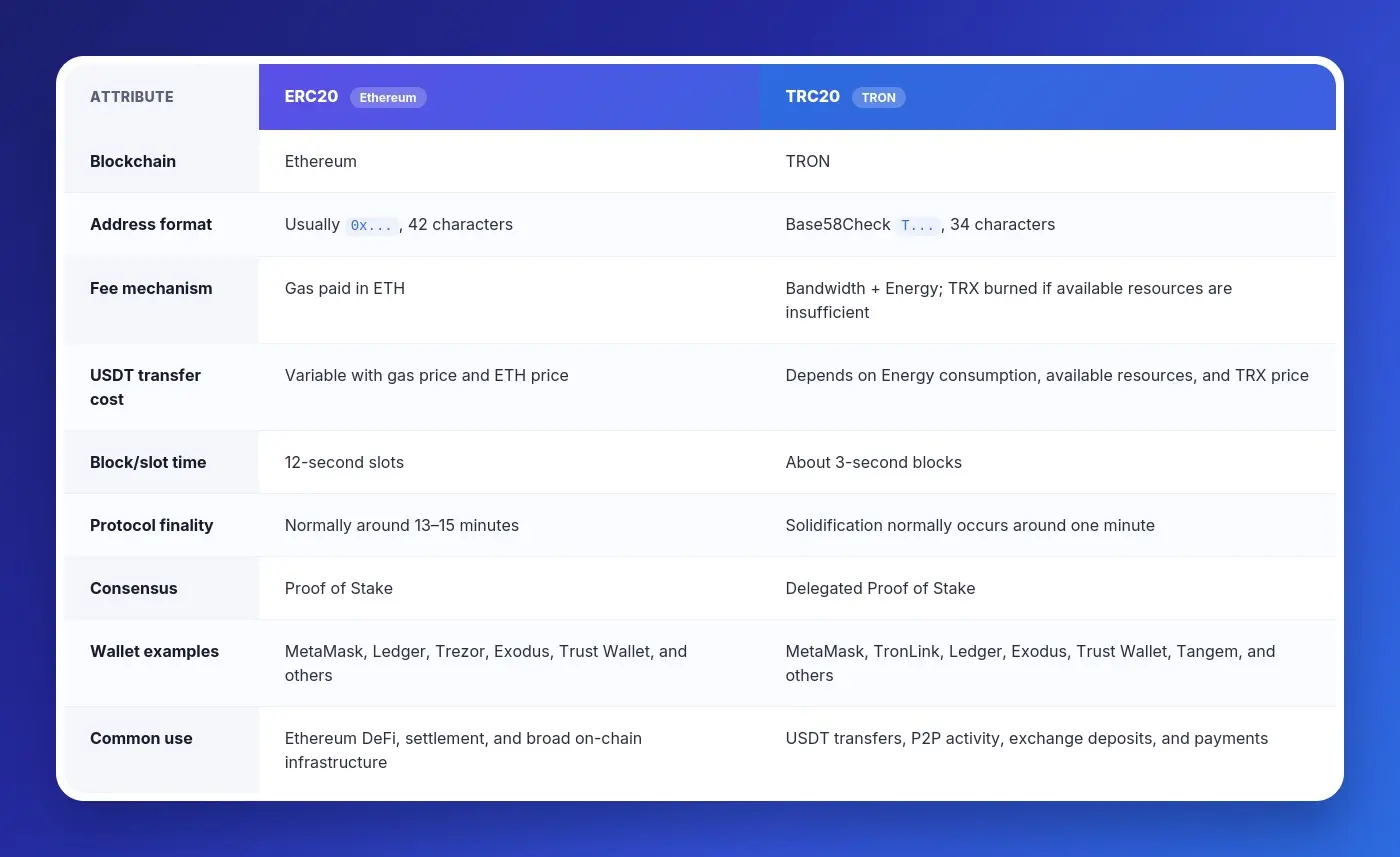
Fee figures should always be treated as snapshots rather than permanent network characteristics.
An Ethereum ERC-20 transfer consumes gas, and its dollar cost depends on the current gas price and the price of ETH.
On TRON, even the Energy requirement for a USDT transfer is not fixed. Current TRON documentation gives approximate examples of around 64,000 Energy when the recipient already has a positive USDT balance and around 130,000 Energy when the recipient's USDT balance is zero. The exact figure can also change under TRON's Dynamic Energy Model.
Check the amount shown by your wallet immediately before confirming the transfer.
Fees: why the answer is no longer simply “TRC20 is cheaper”
Ethereum prices transactions according to gas consumption and current demand for block space. ERC-20 transfers use more gas than standard ETH transfers because they involve interacting with a smart contract.
When demand for Ethereum is low, mainnet token transfers can become inexpensive. When demand rises, the same transaction can cost considerably more. The price, therefore, cannot be summarized with a durable dollar range.
TRON works differently. A USDT transfer consumes Bandwidth plus Energy. If the sender has sufficient resources from staking or delegation, little or no TRX needs to be burned for those resources. Without sufficient resources, TRX is burned according to the network's rules. Another complication: a USDT transfer to an address with a zero token balance generally requires more Energy, due to the additional storage write, than a transfer to an address with a positive USDT balance. TRON's Dynamic Energy Model can further alter the cost.
That means TRC20 is often an efficient transfer rail, especially for users or services with sufficient Energy resources, but “TRC20 is cheaper in almost all conditions” is no longer a safe general rule.
Compare the live fees before sending.
Speed and finality
TRON produces a block approximately every three seconds.
However, saying that a TRON transaction becomes final “after 19 blocks” is technically inaccurate. TRON's solidification mechanism looks for confirmation from at least 19 distinct active Super Representatives out of 27, rather than simply counting a fixed number of blocks. Under healthy network conditions, this normally takes about one minute.
Ethereum uses 12-second slots. A transaction can therefore be included in a block quickly, but block inclusion and protocol finality are not the same thing.
Ethereum finality typically takes about two epochs, or 13–15 minutes. Exchanges and other services may credit Ethereum deposits earlier or later, depending on their own confirmation policies.
For users, both networks usually show an incoming transaction well before full protocol finality. How long a deposit takes to become spendable on an exchange is a policy of that exchange, not a universal property of ERC20 or TRC20.
Wallet compatibility
Both networks now have broad wallet support.
One important update for 2026 is MetaMask. Older comparisons often say that MetaMask only supports Ethereum/EVM networks and that TRON requires TronLink. That is no longer accurate: MetaMask now supports TRON by default, including TRX, USDT, and other TRON assets.
TronLink remains a TRON-focused wallet. Multi-chain products, including Ledger, Exodus, Trust Wallet, and Tangem, also support TRON assets, depending on the specific product and version.
Wallet support can change, so confirm that the wallet supports both the asset and the network before sending.
Wrong-network mistakes and how to avoid them
Sending on a network the destination does not support.
If an exchange gives you a USDT TRC20 deposit address or explicitly requires the TRON network, do not send USDT over Ethereum instead. Recovery policies vary by platform: some custodial services may be able to recover unsupported deposits, sometimes for a fee, while others may not.
Confusing EVM networks that share the 0x format.
Ethereum, BNB Smart Chain, Polygon, Arbitrum, and many other EVM-compatible networks use the same basic hexadecimal address format. A destination address, therefore, only needs to be syntactically valid on several networks, even though the recipient only supports one of them. Always verify the network separately from the address.
Not having enough TRON resources or TRX.
Sending USDT TRC20 requires Bandwidth and Energy. Those resources can come from staking, delegation or, when insufficient, a TRX burn. A transaction with insufficient resources and insufficient TRX may fail. Simply holding USDT does not guarantee that the wallet can send it.
Not having enough gas for ERC20.
A conventional Ethereum ERC20 transfer requires ETH for gas. If the wallet does not use a gas-sponsorship mechanism and no ETH is available, the transfer cannot execute successfully.
Trusting a pasted address without checking it.
Clipboard-hijacking malware can replace an address during copy-and-paste, while address-poisoning attacks try to place visually similar addresses in the transaction history. Do not rely only on the first and last few characters when transferring a large amount. Verify the address carefully, confirm the network, and use a trusted address book or a hardware wallet display when available.
One more check on the other side of the address. Everything above is about verifying your own actions. If you have a SimpleSwap account, you can also check the counterparty: paste the address into Address Check in your Customer Account to see whether it is associated with sanctioned entities or other flagged categories. The screening is run by third-party services and does not catch everything, and a low result is not a character reference. It is one more data point before the funds move, and the checks are free within your loyalty level's monthly allowance.
Which should you choose?
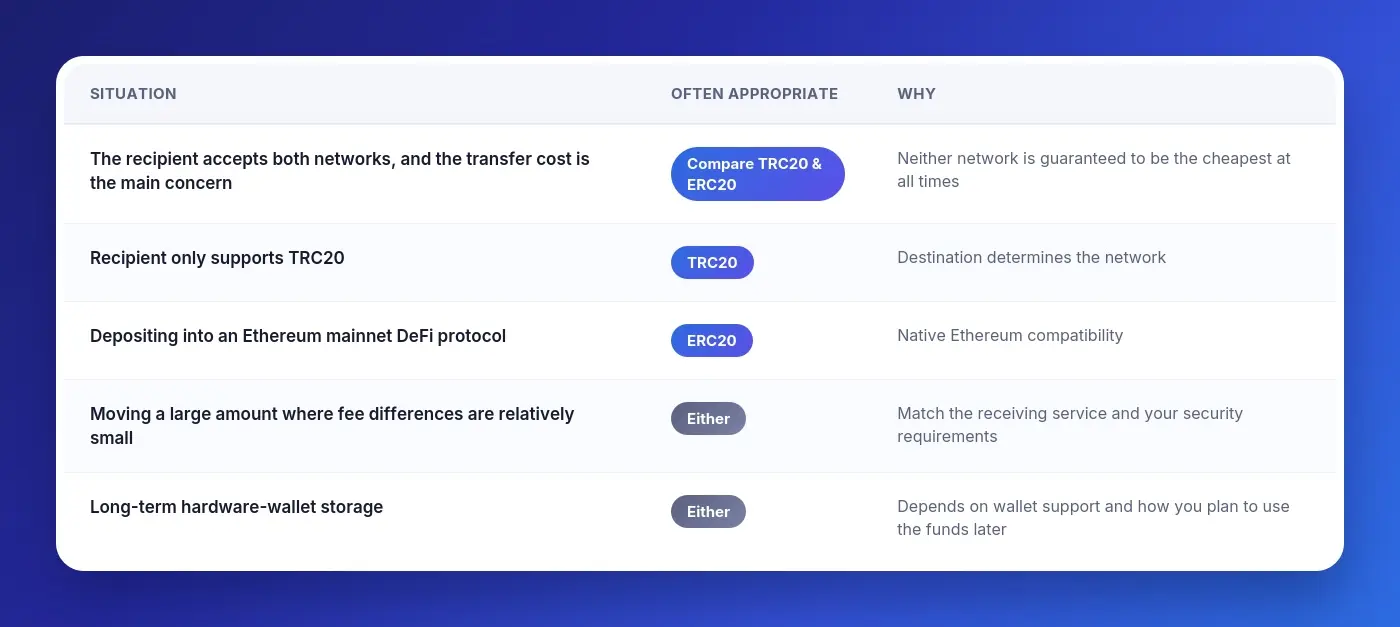
The network is a property of the route, not a different dollar value of the token. Pick the network that the destination supports, then compare cost and operational requirements.
How SimpleSwap handles TRC20 and ERC20 USDT
On SimpleSwap, USDT issued on different networks is presented as network-specific assets. This allows a user, when the relevant pair is available, to send USDT on one supported network and receive USDT on another without manually operating a blockchain bridge.
For example, a user can select USDT ERC20 as the asset to send and USDT TRC20 as the asset to receive, then provide a compatible TRON address.
SimpleSwap is a self-custodial multi-source swap aggregator that aggregates liquidity from more than 20 CEX and DEX providers. After the deposit is confirmed, the platform routes the exchange through its provider network and sends the output asset to the receiving wallet.
You do not need TRX simply to receive USDT TRC20. However, if you later want to send that USDT directly from your wallet, you will need sufficient TRON resources (TRX) to cover the transaction fee.
SimpleSwap uses an all-in-one crypto-to-crypto rate. Its fee is dynamic and depends on the asset pair, liquidity, market conditions, network costs, and routing. For some assets, the cost may start from 0.2%; 0.2% should not be treated as a guaranteed minimum fee for every USDT exchange.
A fixed-rate exchange locks the quoted rate for 20 minutes. To retain the received rate, the deposit must be sent and the required blockchain confirmation received within the applicable window.
Most crypto-to-crypto swaps can be initiated without creating an account. However, SimpleSwap applies risk-based transaction monitoring and may require KYC or additional information when compliance triggers are identified.
SimpleSwap's H1 2026 Swap Report also shows how important cross-chain traffic is to its audience. 91.8% of swaps crossed a network boundary. Separately, USDT on TRON was the largest single net gainer of the half, gaining 6.0 percentage points when comparing its share of received volume to its share of sent volume.
Those are two separate findings: the report does not say that USDT on TRON was the platform's largest asset by absolute volume.
FAQ: TRC20 vs ERC20
Can I send TRC20 USDT directly to an ERC20 address?
No. TRC20 and ERC20 operate on separate blockchains and use different user-facing address formats. To move USDT from TRON to Ethereum, use a service or cross-chain mechanism that explicitly supports both networks.
Which is cheaper, TRC20 or ERC20?
There is no universal answer. TRC20 can be inexpensive when the sender has sufficient Energy or access to delegated resources, but an unstaked TRON account may need to burn TRX to execute the USDT smart contract call. Ethereum gas can, meanwhile, become very low during quiet periods. Compare the live transaction cost before sending.
Which is faster, TRC20 or ERC20?
TRON produces blocks more frequently and normally reaches its solidified state in about one minute. Ethereum uses 12-second slots, so transactions can be included quickly, but full protocol finality normally takes around 13–15 minutes. A wallet or exchange may consider either transaction usable before full protocol finality according to its own policy.
Is TRC20 less secure than ERC20?
The networks use different consensus architectures. TRON uses Delegated Proof of Stake with 27 active Super Representatives producing blocks. Ethereum uses Proof of Stake with a much larger validator set. That is a meaningful structural difference, but decentralization and security cannot be reduced to a single number.
For USDT specifically, there is also issuer risk on both networks: Tether retains the ability to blacklist addresses and freeze tokens under applicable policies. Network security, issuer controls, wallet security, and destination risk should therefore be considered separately.
Do I need TRX to send USDT TRC20?
You need enough Bandwidth and Energy to execute the transfer. These resources can come from your own staked TRX or be delegated to your account. If available resources are insufficient, TRX is burned to cover the shortfall. So you do not necessarily need a spendable TRX balance if sufficient resources are already available, but an ordinary wallet without enough Energy will generally need TRX.
How do I convert USDT from ERC-20 to TRC-20?
Use a swap or cross-chain service that explicitly supports both versions. SimpleSwap supports network-specific USDT assets and can route supported wallet-to-wallet conversions without requiring the user to manually operate a bridge. Most swaps can be initiated without creating an account, although risk-based KYC checks may apply.
Why did my exchange deposit not arrive?
A network mismatch is one possible cause, but it is not necessarily the most common. Check the transaction hash, selected network, deposit address, required confirmations, and any additional identifiers the exchange requires. If the funds were sent over an unsupported network, contact the receiving platform's support. Recovery depends on its technical capabilities and policies.
What is Address Check? Address Check is a Customer Account tool that screens a wallet address for association with sanctioned entities and other risk categories. Enter the address and its network to receive a risk level and the connections identified. Screening is performed by third-party services and may not identify all potential issues. The number of checks available per month depends on your Loyalty Program level.
This article is for educational purposes only and is not financial or investment advice. Network fees, wallet support, resource parameters, and confirmation policies can change. Always verify the asset, network, destination address, and live transaction cost before sending funds. SimpleSwap's only official domain is simpleswap.io.
Sources:
Tether — Supported Protocols and Integration Guidelines
Ethereum — ERC-20 Token Standard (EIP-20)
Ethereum — Ethereum Accounts and Address Format
Ethereum — Gas and Network Fees
Ethereum — Proof-of-Stake Consensus
Ethereum — Finality and Single-Slot Finality
TRON — TRC-20 and Token Standards
TRON — TRC-20 Protocol Interface
TRON — Accounts and Address Format
TRON — Bandwidth and Energy Resource Model
TRON — USDT Transfer Energy Requirements
TRON — Dynamic Energy Model and Energy Costs
TRON — Consensus, Super Representatives and Finality
TRON — MainNet History and Milestones
Tether — USDT Introduced to the TRON Blockchain
SimpleSwap — Clipboard Hijackers: The Malware That Swaps Your Address





![MobileCoin (MOB): The Cryptocurrency Born to Be Private, Fast, and Mobile-First 📱🔒 [PT/SPA/ENG/GER/KOR]](https://www.publish0x.com/img/1189946.webp?action=resize&ar=1&enc=webp&h=287&inv=0&ori=1&st=1&up=1&w=510&signature=45ceda5ecef7b17ecd5d5ddc283110c0df4c71b7c2e288bee2ed314d84ded4cb)


