
Investment strategies often rely on long-studied mathematical schemes and regularities. New interpretations of basic principles help modern entrepreneurs build capital as successfully as they did 100-200 years ago. The scenery may change, but the ideas remain the same – yet another proof of the cyclical nature of all events in our world.
One of such fundamental ideas is the Lindy Effect. Let's discuss why it's commonly referred to as the "most universal" concept and what role it plays in shaping investment strategies.
From Broadway to investments
The Lindy Effect was first observed on Broadway when attempts were made to calculate how much longer a particular show would last on stage. Through brief calculations and lengthy observations, the following was revealed: if a show "survived" on the stage for, let’s say, 100 days after its premiere, it could be expected to survive for another similar period in the future. In other words, the potential lifespan of a phenomenon was determined by how long it had already existed at the time the forecast was made.
The theory's origin is credited to a finance guy named Albert Goldman. He wrote an article titled "The Lindy Law" in 1964. In it, he guessed that the length of a comedian's successful career depends on how often they perform in public. The name of the concept was lended from New York restaurant "Lindy," – popular place among American comedians in the 1960s.
The Lindy Effect is the idea that the older a product, technology, etc. is now, the longer it is likely to "survive" in the future.
How does the Lindy Effect help to get profit?
Imagine you are planning to enter the market with a new product. What exactly it will be is not clear yet, but it needs to be in demand and profitable for at least 10 years. Is it possible, based on such a request, to roughly determine what it will be? Yes, if you use Lindy Effect in market analysis.
For example, let’s pretend that you decided to enter the “coffee to go” market. After some research, you found out that pumpkin spice latte has been consistently purchased every autumn for the past 5 years. According to the Lindy Effect, there is a high degree of probability, it will continue to be bought for another 5 years. However, in 50 years, pumpkin spice latte may go out of fashion, unlike Americano, which has remained relevant since the mid-60s. So it might be a good idea to include Americano as the main drink in your menu.
What does it have to do with investments?
Investors are people who seek to profit without taking active actions. In order for investments not to turn into charity and investors into bankruptcies, certain skills and knowledge are necessary. Studying the market and its history is one of the most important aspects.
Experts successfully apply the Lindy Effect to investment realities. It’s main principle sounds like "search for something that has stood the test of time." Roughly speaking, a company that has already stayed afloat for 20 years is capable of staying afloat for another 20 years, which means its stocks can be bought.
It makes sense to think that older companies have stronger connections everywhere and lots of experience in running businesses. Even though the Lindy Law doesn't promise bigger profits when you invest in older companies compared to newer ones, there's proof that this strategy works well in the long run.
Experts from Market Sentiment checked what might happen when you invested $100 in companies that are over 100 years old. They compared this to putting the same amount of money into assets from the S&P 500 index.
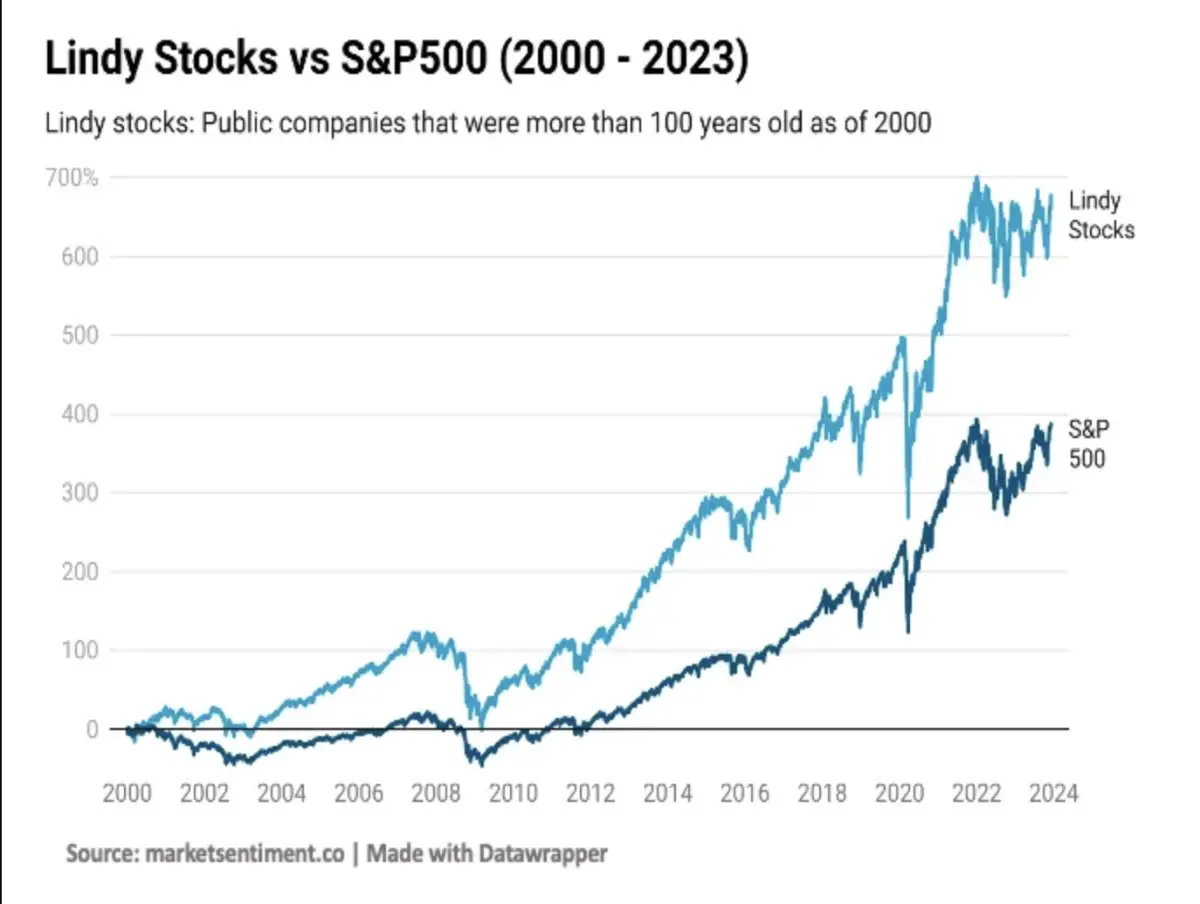
What they found was pretty interesting. From 2000 to 2023, "Lindy stocks" grew by 676%. Meanwhile, during that same time, the S&P 500 index only went up by 386%.
Connection with the Crypto World
One distinguishing feature of the Crypto World is instability. Compared to the traditional economy, cryptocurrencies have many attractive prospects, but even more risks. For example, let's compare the application of the Lindy Effect to the largest financial conglomerate JPMorgan and the largest cryptocurrency exchange Coinbase.
The former has existed for over two centuries, while the latter for about 10 years. JPMorgan has already established a name for itself, a gigantic partner base, built connections, and gained a remarkable index of economic influence in the market. Coinbase managed to "take off" due to new progressive technology, also acquired a significant partner base but hasn't gained the authority of stability. Referring to the Lindy Effect, analysts can assume that the giant JPMorgan will successfully survive another 200 years, while Coinbase may easily fade away in the flow of new projects within 10 years.
What about Bitcoin (BTC)? BTC has already been around for 15 years, so it will be in demand for at least another 15 years. Moreover, Bitcoin's prospects are quite positive, as it has introduced the world to the concept of decentralized currencies. While Bitcoin appears to be very resilient, the same can't be said for the altcoin market.
Analysts often point out the cyclical nature of cryptocurrency prices, which is believed to correlate with the roughly four-year periods between Bitcoin halvings. According to CoinGecko statistics, over 50% of all cryptocurrencies listed on their platform have ceased to exist. The service reports that since 2014, 14,039 projects have "died". Crypto launched during the bullish market of 2021 suffered the most loss.
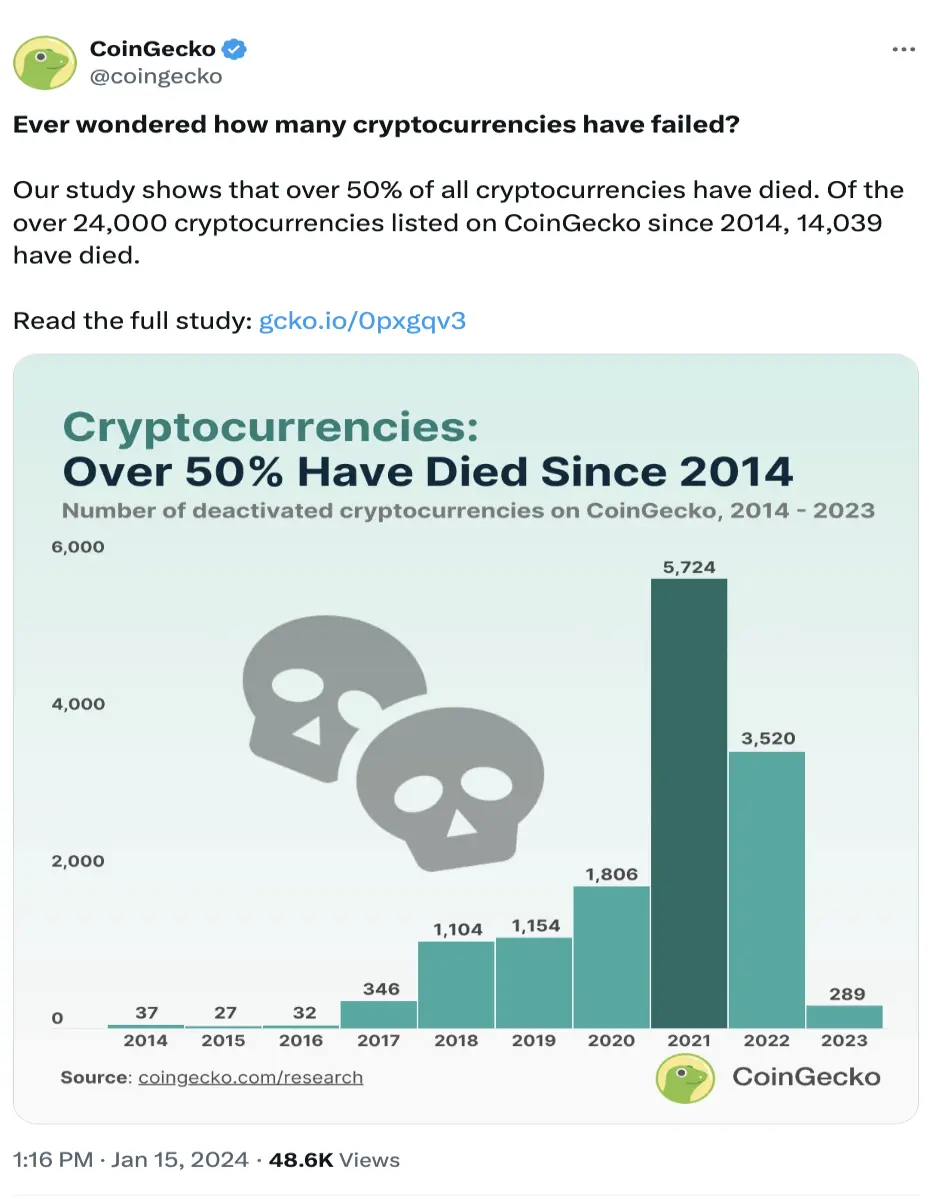
So, applying the Lindy Effect to altcoins, we might come up with a conclusion that only tokens that have "survived" at least two Bitcoin halving cycles, or around eight years, should be considered as good investment opportunities. Thus, the Lindy Effect greatly assists crypto investors in crafting strategies, highlighting the most profitable projects for investment and allowing for long-term forecasts.
Conclusion
In the realm of cryptocurrency investments, where volatility and uncertainty are prevalent, the Lindy Effect provides a framework for evaluating projects and making predictions about their long-term viability. By recognizing the staying power of established entities like Bitcoin and the potential fragility of newer ventures, investors can navigate the ever-changing landscape of digital assets with greater confidence.
If you want to learn more interesting facts about crypto then check out our blog! You might like our articles “The Use of Blockchain Technology in Satellite Communication” and “The Impact of NFTs on Copyright Law”.






