
Getting your first stablecoin means making a few decisions that ordinary payment apps usually make for you: who controls the keys, which blockchain the token runs on, and how to recover access. This guide covers the whole path — choosing a USDT wallet, picking a network, buying your first stablecoins, and setting up basic security habits.
Updated: September 10, 2026
Reviewed by: Rick Cramer, Head of Analytics at SimpleSwap
Short answer
To hold USDT, you need a wallet that supports the blockchain network on which your USDT is issued.
You can use a custodial service, where a company controls the private keys associated with your balance, or a self-custody wallet, where you control transaction authorization and are responsible for the wallet's recovery method.
Many self-custody wallets use a 12- or 24-word recovery phrase, but not all do. Some use hardware backups, passkeys, or other recovery architectures.
Two common ways to acquire USDT are buying it with fiat through an on-ramp or exchanging crypto you already own. Fiat providers commonly require identity or payment verification, depending on the provider and jurisdiction. Crypto-to-crypto services may allow swaps without an account, although compliance checks can still apply.
Whichever route you take, confirm the blockchain network, verify the full destination address from a trusted source, and consider a small test transaction before transferring a large amount.
What is USDT, and why use a stablecoin
USDT, issued by Tether, is a stablecoin designed to track the value of the US dollar.
As of September 2026, it remains the largest stablecoin by market capitalization and one of the most heavily traded digital assets.
A stablecoin can make it easier to learn how wallets and blockchain transfers work without exposing you to the same degree of price volatility associated with assets such as Bitcoin or Ether.
That does not mean USDT's market price can never move. Stablecoins can trade above or below their target price during market stress, and holding one introduces issuer, reserve, liquidity, and regulatory risks.
USDT is issued on multiple blockchains, including TRON, Ethereum, Solana, and TON. Each version represents USDT on a different blockchain. The value target is the same; the addresses, transaction fees, wallet requirements, and network mechanics are not.
Step 1: Choose a USDT wallet
The first decision is who controls transaction authorization.
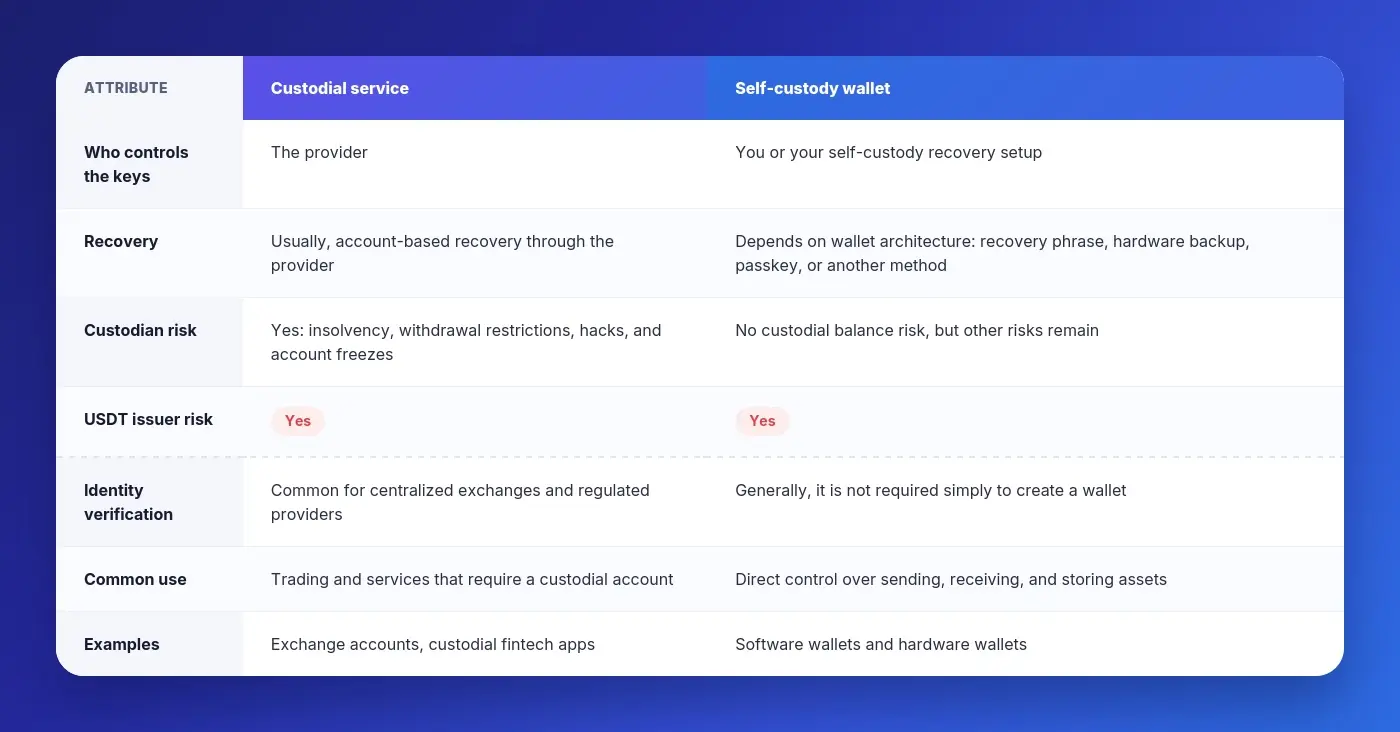
Examples of self-custody products include Exodus, Tangem and Tonkeeper, as well as hardware wallets such as Ledger, Trezor, Tangem and Ellipal. Network support differs between products and changes over time, so check the wallet's official documentation before choosing one.
Examples are illustrative, not endorsements. Download wallet software only from the developer's verified website or official app store listing.
Custodial wallets
With a custodial service, the provider controls the private keys and maintains your account balance.
That can simplify onboarding and account recovery, but it introduces counterparty risk. A provider can restrict withdrawals, freeze an account, suffer a security breach or become insolvent.
The collapses of Celsius, Voyager and FTX in 2022 illustrated different forms of centralized-platform risk. Customers did not necessarily lose every asset permanently, but many lost immediate access to funds and became dependent on bankruptcy or recovery proceedings.
Self-custody wallets
With self-custody, you control the credentials required to authorize blockchain transactions.
This removes the need to trust an exchange or fintech company to safeguard a custodial balance. It does not, however, remove every third-party risk.
USDT is a centrally issued token. Tether retains the ability to blacklist addresses and freeze USDT in certain circumstances, including in connection with law-enforcement action. That ability exists even when the tokens are held at an external self-custody address.
Self-custody therefore means control of your wallet keys, not immunity from the controls built into the USDT token itself.
For funds you use frequently, a software wallet may be convenient. For larger or longer-term holdings, some users choose hardware wallets to isolate signing keys from an internet-connected computer or phone.
Step 2: pick the network
Before receiving USDT, identify which network both your wallet and the sender support.
Some common options are:
-
TRON (TRC20): widely used for USDT transfers. Transactions consume Bandwidth and Energy. These resources can come from staking or delegation; if insufficient resources are available, TRX may be burned to cover the cost.
-
Ethereum (ERC20): widely integrated across Ethereum applications and DeFi. Standard transactions require gas denominated in ETH, and the cost varies with network demand.
-
Solana, TON and other supported networks: can offer different transaction costs and settlement characteristics, but wallet, exchange and service support varies.
Do not assume that TRC20 is always the cheapest option. TRON's USDT transaction cost depends on resource consumption, account state, available Energy and Bandwidth, and the TRX price. Ethereum gas can also become inexpensive during periods of low network demand.
The safest beginner default is therefore not a particular blockchain. It is the network that:
-
your wallet supports;
-
the sender or service supports;
-
the receiving destination explicitly accepts.
Then compare the current transaction cost.
Sending the right token over an unsupported network can result in a failed deposit or require a complicated recovery process.
Step 3: set up the wallet and protect the recovery method
Follow the wallet's official setup process.
Many traditional self-custody wallets generate a recovery phrase, often 12 or 24 words. Other wallets use different systems. Tangem, for example, can be configured without a seed phrase and instead use additional hardware devices as backups.
If your wallet gives you a recovery phrase, treat it as a master recovery credential.
-
Record it offline using the method recommended by the wallet manufacturer.
-
Do not photograph it, email it to yourself or put an unencrypted copy in cloud storage.
-
Never give it to a support agent or anyone contacting you online.
-
Never enter it into an ordinary website or dapp.
-
Only enter it when you deliberately initiate a legitimate wallet-recovery process using verified wallet software or hardware.
-
Protect the wallet or hardware device itself with its supported PIN, access code or biometric controls.
Do not enable advanced features such as an additional recovery passphrase merely because they sound more secure. A BIP39 passphrase, for example, changes the wallet derived from the recovery phrase; forgetting it can make that wallet permanently inaccessible. Use advanced recovery features only when you understand how they work.
SimpleSwap does not need your seed phrase or private keys to perform a standard exchange. Anyone claiming to represent SimpleSwap who asks for either should not be trusted.
Once your wallet is configured, locate the receive function and select the exact network you want to receive USDT on.
Step 4: How to buy USDT
There are several ways to acquire USDT. Two common routes for beginners are fiat on-ramps and crypto-to-crypto exchanges.
Route A: buy USDT with fiat
Fiat on-ramps let users buy cryptocurrency using supported currencies and payment methods such as cards or bank transfers.
The available providers, currencies, payment methods, and verification requirements depend on the user's country and the selected provider. Identity or payment verification is common and may be required before a transaction is processed.
Do not assume that every fiat purchase costs a fixed percentage. The final cost may include provider fees, spreads, payment method costs, exchange rates, and blockchain fees.
Compare the final amount of USDT that will reach your wallet, not just the advertised fee.
Route B: swap crypto you already own
If you already hold Bitcoin, Ether, or another supported cryptocurrency, you can exchange it for USDT on a supported network.
This does not automatically make the transaction cheaper than a fiat purchase or another exchange route. The final cost depends on the asset pair, available liquidity, market conditions, blockchain fees, and the service used.
Some wallet-to-wallet services allow low-risk crypto swaps without requiring users to create an account. Compliance and KYC requirements can still apply.
Buying USDT through SimpleSwap
SimpleSwap is a self-custodial multi-source swap aggregator. Crypto-to-crypto swaps route a deposit from the user's wallet through SimpleSwap's provider network and send the exchanged asset to the receiving address rather than maintaining a permanent trading balance for the user.
SimpleSwap also provides access to fiat-to-crypto purchases through third-party payment providers.
To acquire USDT:
-
Go to simpleswap.io and choose what you want to pay with — a supported fiat currency or cryptocurrency.
-
Select USDT and the exact blockchain network you want to receive on.
-
Review the estimated receiving amount.
-
For supported crypto-to-crypto exchanges, choose a fixed or floating rate. A fixed rate is locked for 20 minutes;the deposit must be sent and receive the required blockchain confirmation within that window.
-
Enter your USDT receiving address and check the network again.
-
For fiat purchases, continue through the selected third-party payment provider and complete any required payment or verification steps.
-
For crypto swaps, send the required deposit to the address generated for the exchange.
-
Track the transaction using the Exchange ID.
For crypto-to-crypto exchanges, SimpleSwap uses an all-in-one rate rather than adding a separate percentage trading fee on top. Pricing is dynamic and depends on the trading pair, market conditions, available liquidity providers, network fees, and routing costs. For some assets, the cost may start from 0.2%; this should not be interpreted as a universal 0.2% minimum fee for every USDT transaction.
The network fee for sending the exchanged asset to the receiving address is reflected in the amount shown by SimpleSwap. The network fee your own wallet charges to send the initial deposit is separate.
Crypto-to-crypto swaps can generally be started without creating an account, but SimpleSwap operates a risk-based AML/KYC system. Its policy states that mandatory KYC may be required for any transaction where appropriate under its monitoring process.
For fiat purchases, verification requirements are determined by the third-party payment provider and the circumstances of the transaction.
The only official SimpleSwap website is simpleswap.io.
Step 5: Do a test transaction and establish safe habits
Before transferring a significant amount to a new destination, consider making a small test transfer first.
Confirm that:
-
The address belongs to the intended recipient;
-
The selected blockchain is supported;
-
The test transaction is credited correctly;
-
You understand the actual transaction fee.
A successful test does not remove the need to verify the next transaction again.
From then on, follow a few basic habits:
-
Verify the full destination address against a trusted source. Do not rely only on the first and last few characters. Address-poisoning attackers deliberately generate lookalike addresses with matching prefixes and suffixes.
-
Do not copy addresses from transaction history. Use a verified address book, the recipient's current deposit page or another trusted source.
-
If you use a hardware wallet, verify transaction details on its trusted display before signing.
-
Confirm the network separately. A valid-looking address does not prove that you selected the correct blockchain.
-
Bookmark services you regularly use after verifying their domains. Search ads and search results can contain lookalike or phishing pages.
-
Read wallet requests before signing or approving them. A token approval can authorize a smart contract to transfer tokens up to the allowance you grant. Remove allowances you no longer need.
-
Treat unsolicited support messages as suspicious. Initiate support through the verified website or app rather than trusting someone who contacts you first.
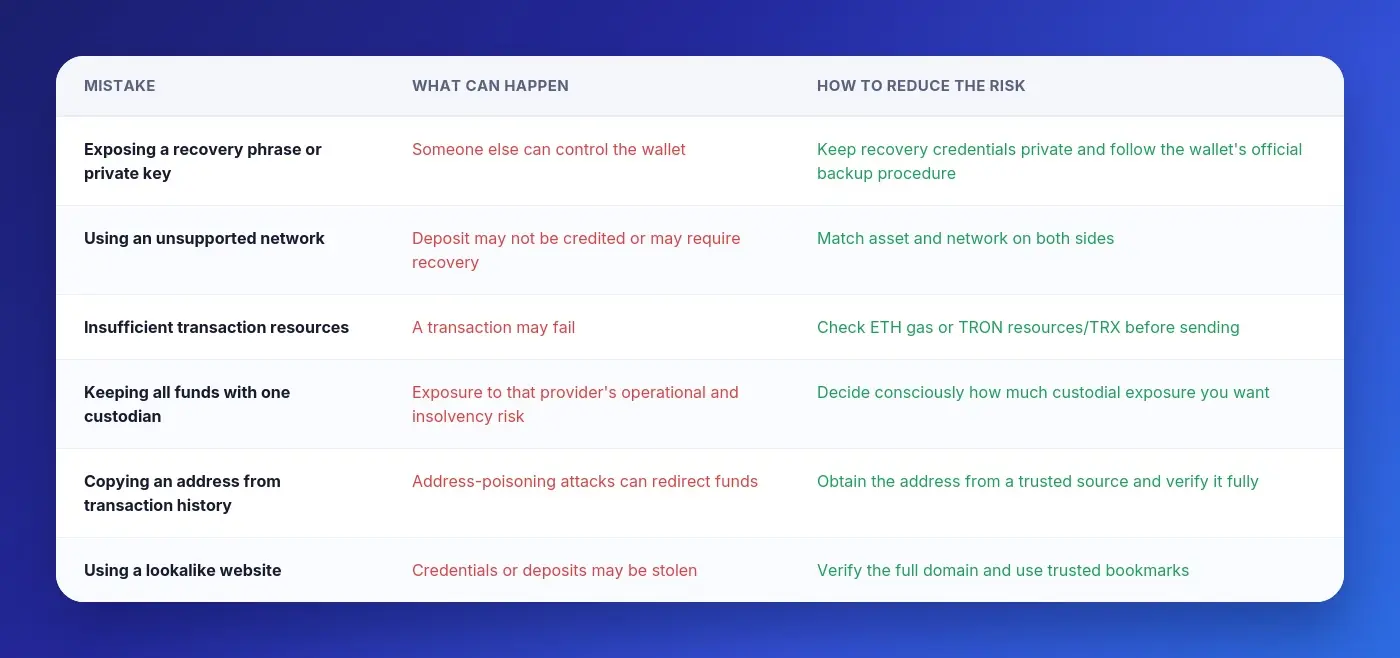
Common beginner mistakes with USDT wallets
FAQ: USDT wallets and buying stablecoins
Do I need KYC to buy USDT?
It depends on how you acquire it and which provider you use. Fiat payment providers commonly require identity or payment verification. A low-risk crypto-to-crypto swap on SimpleSwap can typically be initiated without creating an account, but SimpleSwap's risk-based policy may require KYC for certain transactions.
What is the best USDT wallet for a beginner?
There is no single best wallet for everyone. Check whether the wallet supports the USDT networks you intend to use, how its recovery system works, whether it is actively maintained, and whether you can verify the developer and official download source.
Software wallets such as Exodus and Trust Wallet and hardware wallets such as Ledger, Trezor, or Tangem are examples of different approaches, not endorsements.
Can I keep USDT on an exchange?
Yes, if the exchange supports it. This can be convenient for active trading, but a custodial exchange introduces counterparty risk because the exchange controls the keys and the withdrawal process. Self-custody removes that particular risk but transfers responsibility for wallet security and recovery to you.
Self-custody also does not remove USDT issuer risk: Tether can blacklist USDT addresses in certain circumstances.
What happens if I lose my seed phrase?
It depends on your wallet's recovery architecture.
For a conventional seed-based wallet, if you still have access to it, you can generally create a new wallet with a new recovery phrase and transfer the assets to it.
If you lose both access to the wallet and its sole recovery credential, the private keys cannot typically be recovered by the wallet company.
Some self-custody wallets use hardware backups, passkeys or other recovery systems instead of — or alongside — a seed phrase, so follow the recovery instructions for your specific wallet.
Which network should I receive USDT on?
Use a network supported by both the receiving wallet and the sender or service. Then compare current fees and the infrastructure you need.
TRC20 is widely used for USDT transfers but is not guaranteed to be the cheapest option. ERC20 is widely supported throughout the Ethereum ecosystem. Other networks such as Solana and TON may also be available depending on the destination.
How much does it cost to buy a stablecoin?
There is no universal percentage.
Fiat purchases depend on the payment provider, payment method, region and quoted exchange rate.
For crypto-to-crypto transactions, SimpleSwap uses a dynamic all-in rate. For some assets, the cost may start from 0.2%, but this is not a guaranteed fee for every swap. Your wallet may also charge a separate blockchain fee for sending the initial deposit.
Is USDT safe to hold?
USDT is designed to maintain a value close to one US dollar and is the largest stablecoin by market capitalization as of September 2026. Tether publishes quarterly reserve reports, and in August 2026, KPMG U.S. issued an unqualified audit opinion on Tether International's 2025 financial statements.
What is Address Check? Address Check is a Customer Account tool that screens a wallet address for association with sanctioned entities and other risk categories. Enter the address and its network to receive a risk level and the connections identified. Screening is performed by third-party services and may not identify all potential issues. The number of checks available per month depends on your Loyalty Program level.
That does not make USDT risk-free. Relevant risks include the issuer and reserve structure, temporary deviations from the $1 target price, regulatory action, address freezes, blockchain or smart-contract issues, wallet compromise, phishing, and user error.
For users comparing issuer and reserve risk, see the USDT vs USDC guide.
This article is for educational purposes only and is not financial or investment advice. Stablecoin availability, network fees, wallet functionality, payment-provider requirements, and compliance procedures can change. Always verify the current network, destination address, provider terms and transaction cost before sending funds. Wallets and tools named here are examples, not endorsements. SimpleSwap's only official domain is simpleswap.io.
Sources
-
Tether — Supported Protocols: USDT issuance and supported blockchain networks, including Ethereum, TRON, Solana and TON.
https://tether.to/en/supported-protocols/ -
Tether — Token Terms of Sale and Service: private-key risk, irreversibility of transfers, prohibited use, freezing and blacklisting provisions.
https://tether.to/en/legal/ -
Tether — Transparency: reserve information and Tether's reserve reporting.
https://tether.to/en/transparency/ -
Tether — 2025 Financial Statements Audit Announcement (August 13, 2026): announcement that KPMG U.S. issued an unqualified audit opinion on Tether International's 2025 financial statements.
https://tether.io/news/tether-completes-the-largest-inaugural-financial-audit-in-history/ -
CoinGecko — Tether Historical Data: USDT market capitalization, trading volume and historical price data.
https://www.coingecko.com/en/coins/tether/historical_data -
TRON Developer Documentation — Bandwidth and Energy: how TRON transactions consume resources and when TRX is burned to cover insufficient Bandwidth or Energy.
https://developers.tron.network/docs/bandwidth-and-energy -
Ethereum.org — Gas and Fees: how Ethereum transaction fees work and why gas is paid in ETH.
https://ethereum.org/developers/docs/gas/ -
Solana Documentation — Fee Structure: Solana base and priority transaction fees.
https://solana.com/docs/core/fees/fee-structure -
TON Documentation — Jetton Payments: USDT implementation on TON and the official USDT jetton contract information.
https://docs.ton.org/applications/payments/jettons -
Ledger Academy — What Is a Secret Recovery Phrase?: recovery-phrase security, storage and recovery fundamentals.
https://www.ledger.com/academy/basic-basics/2-how-to-own-crypto/whats-a-secret-recovery-phrase -
Tangem — How to Back Up a Crypto Wallet: seed-phrase and seedless/card-based wallet backup architectures.
https://tangem.com/en/blog/post/how-to-back-up-crypto-wallet/ -
Trust Wallet — Control and Revoke Token Approvals: how token approvals work and why unused permissions should be reviewed and revoked.
https://trustwallet.com/blog/announcements/control-and-revoke-token-approvals-in-trust-wallet -
SimpleSwap — FAQ: crypto-to-crypto pricing, all-in-one rates, fiat providers and exchange mechanics.
https://simpleswap.io/faq -
SimpleSwap — AML/KYC Policy: risk-based transaction monitoring and circumstances in which KYC may be required.
https://simpleswap.io/aml-kyc -
SimpleSwap — Address Poisoning: The Copy-Paste Trap: why checking only the beginning and end of a wallet address is insufficient and why transaction history should not be treated as a trusted address source.
https://simpleswap.io/blog/address-poisoning-the-copy-paste-trap -
SimpleSwap — Spot a Fake SimpleSwap in 10 Seconds: official-domain verification and phishing/lookalike-site guidance.
https://simpleswap.io/blog/spot-a-fake-simpleswap-in-10-seconds





